10.1 Monopolistic Competition

💸Principles of Economics Unit 10 Review
10.1 Monopolistic Competition
💸 Principles of Economics
Monopolistic competition blends elements of perfect competition and monopoly. Firms sell similar but differentiated products, giving each one some control over pricing. This market structure is everywhere: restaurants, clothing brands, coffee shops, consumer goods. Understanding it helps explain why so many real-world markets don't fit neatly into the "perfect competition" or "monopoly" boxes.
In the short run, firms can earn economic profits or losses. Over time, free entry drives profits to zero. The tradeoff: consumers get product variety, but prices end up higher and firms produce below full capacity compared to perfect competition.
Characteristics and Dynamics of Monopolistic Competition

Top images from around the web for Features of differentiated products
8.4 Monopolistic Competition – Principles of Microeconomics View original
Is this image relevant?
8.4 Monopolistic Competition – Principles of Microeconomics View original
Is this image relevant?
Monopolistic Competition · Economics View original
Is this image relevant?
8.4 Monopolistic Competition – Principles of Microeconomics View original
Is this image relevant?
8.4 Monopolistic Competition – Principles of Microeconomics View original
Is this image relevant?
Features of differentiated products
Monopolistic competition has three defining features that set it apart from other market structures.
- Many firms sell differentiated products that are similar but not perfect substitutes (think Pepsi vs. Coca-Cola, or two burger restaurants on the same street).
- Differentiation can come from quality, style, location, or brand name. Each of these creates a unique appeal to different consumer preferences.
- Because products aren't identical, firms can build brand loyalty and charge somewhat higher prices than they could in a perfectly competitive market.
- Firms face a downward-sloping demand curve. Product differentiation gives each firm some pricing power. If a firm raises its price a little, it won't lose all its customers the way a perfectly competitive firm would.
- That said, demand is still relatively elastic because close substitutes exist. Raise your price too much, and customers switch to a competitor.
- Low barriers to entry and exit allow firms to enter and leave the market without much difficulty (e.g., opening a new restaurant or closing one that isn't profitable).
- There are no significant economies of scale or government-imposed barriers blocking new competitors.
Price and output determination
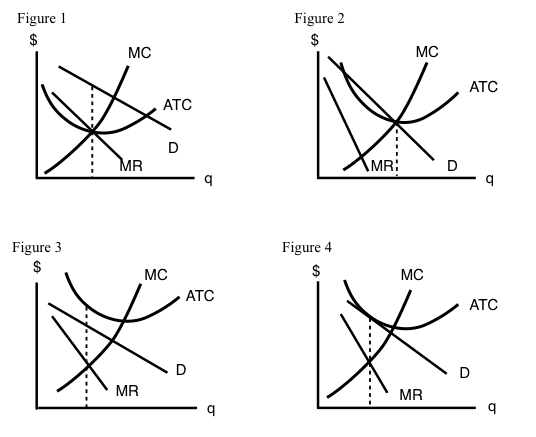
Like any profit-maximizing firm, a monopolistic competitor produces where marginal revenue equals marginal cost: . But because the demand curve slopes downward, marginal revenue is less than price. The firm must lower its price to sell each additional unit, so at every quantity.
Short-run outcomes depend on where price falls relative to average total cost at the profit-maximizing quantity:
- If , the firm earns economic profits (perhaps from a successful new product or strong brand).
- If , the firm incurs economic losses and may need to cut costs, improve its product, or eventually exit the market.
One important result: firms in monopolistic competition operate with excess capacity. The profit-maximizing quantity sits to the left of the output level that minimizes ATC. In other words, each firm could produce more at a lower per-unit cost but chooses not to because doing so would require lowering price below the profit-maximizing level.

Market power and competition
- Firms have some market power from differentiation, but far less than a monopolist. They're price-setters, not price-takers, but their pricing power is limited by close substitutes.
- Product variety benefits consumers by offering more choices that match individual preferences.
- Non-price competition is common. Firms compete through improved quality, better customer service, store atmosphere, or packaging rather than just cutting prices.
- Short-run equilibrium occurs where each firm maximizes profit (), but the firm is not necessarily producing at the minimum of its ATC curve.
Long-Term Equilibrium and Efficiency in Monopolistic Competition

Effects of free entry and exit
Free entry is what drives the long-run result. Here's the process:
- If existing firms earn economic profits, new firms enter the market with competing (differentiated) products.
- Entry shifts each existing firm's demand curve to the left as customers spread across more options.
- Entry continues until economic profits fall to zero: .
- At that point, no new firms have an incentive to enter, and no existing firms are forced to exit.
In long-run equilibrium, three things are true:
- Firms earn zero economic profit (total revenue equals total cost, including opportunity costs).
- Each firm's demand curve is tangent to its ATC curve. This tangency is what guarantees while the demand curve still slopes downward.
- Firms produce at a quantity where ATC is not minimized, meaning excess capacity persists even in the long run.
Compared to perfect competition, monopolistic competition is inefficient in two ways:
- Allocative inefficiency: Price exceeds marginal cost (), so society values additional units more than they cost to produce. This creates deadweight loss.
- Productive inefficiency: Firms don't produce at the minimum of ATC. They have excess capacity, operating below the minimum efficient scale.
The standard tradeoff argument is that consumers pay for this inefficiency through slightly higher prices, but they gain product variety in return.
Role of advertising in competition
Advertising plays a central role in monopolistic competition because differentiation only works if consumers know about it. A firm's ad campaign shifts its demand curve to the right by increasing consumer awareness and willingness to pay (Apple's "Think Different" campaign is a classic example).
Advertising has both positive and negative effects:
- Positive: It informs consumers about available products, features, and innovations (e.g., a new smartphone's capabilities). It also pushes firms to innovate and improve their products to stay competitive.
- Negative: It can create artificial differentiation, making products seem more different than they really are. Heavy advertising spending by established firms can act as a barrier to entry, since new firms must spend heavily just to get noticed. And those advertising costs get passed along as higher prices, representing resources spent on persuasion rather than production.
Whether advertising's benefits outweigh its costs depends on the specific market. In some cases it genuinely helps consumers make better choices; in others it mostly inflates prices without adding real value.
See Fiveable more often in Google
Mark Fiveable as a preferred source and Google is more likely to show you our guides in Top Stories, with a "preferred" badge in AI Mode and AI Overviews.