24.2 Building a Model of Aggregate Demand and Aggregate Supply

💸Principles of Economics Unit 24 Review
24.2 Building a Model of Aggregate Demand and Aggregate Supply
💸 Principles of Economics
Aggregate Demand and Aggregate Supply Model
The Aggregate Demand and Aggregate Supply (AD-AS) model is the central framework for understanding macroeconomic fluctuations. It shows how the overall price level and real GDP are determined together, and it helps explain economic booms, recessions, and long-term growth.
This model combines short-run and long-run perspectives, illustrating how the economy adjusts to shocks over time. Understanding it is essential for analyzing recessionary gaps, inflationary pressures, and the forces that drive the economy toward equilibrium.

Top images from around the web for Aggregate Supply Curve
Reading: The Long Run and the Short Run | Macroeconomics View original
Is this image relevant?
The Aggregate Market – Introduction to Macroeconomics View original
Is this image relevant?
File:Aggregate Demand-Aggregate Supply.jpg - Wikimedia Commons View original
Is this image relevant?
Reading: The Long Run and the Short Run | Macroeconomics View original
Is this image relevant?
The Aggregate Market – Introduction to Macroeconomics View original
Is this image relevant?
Aggregate Supply Curve
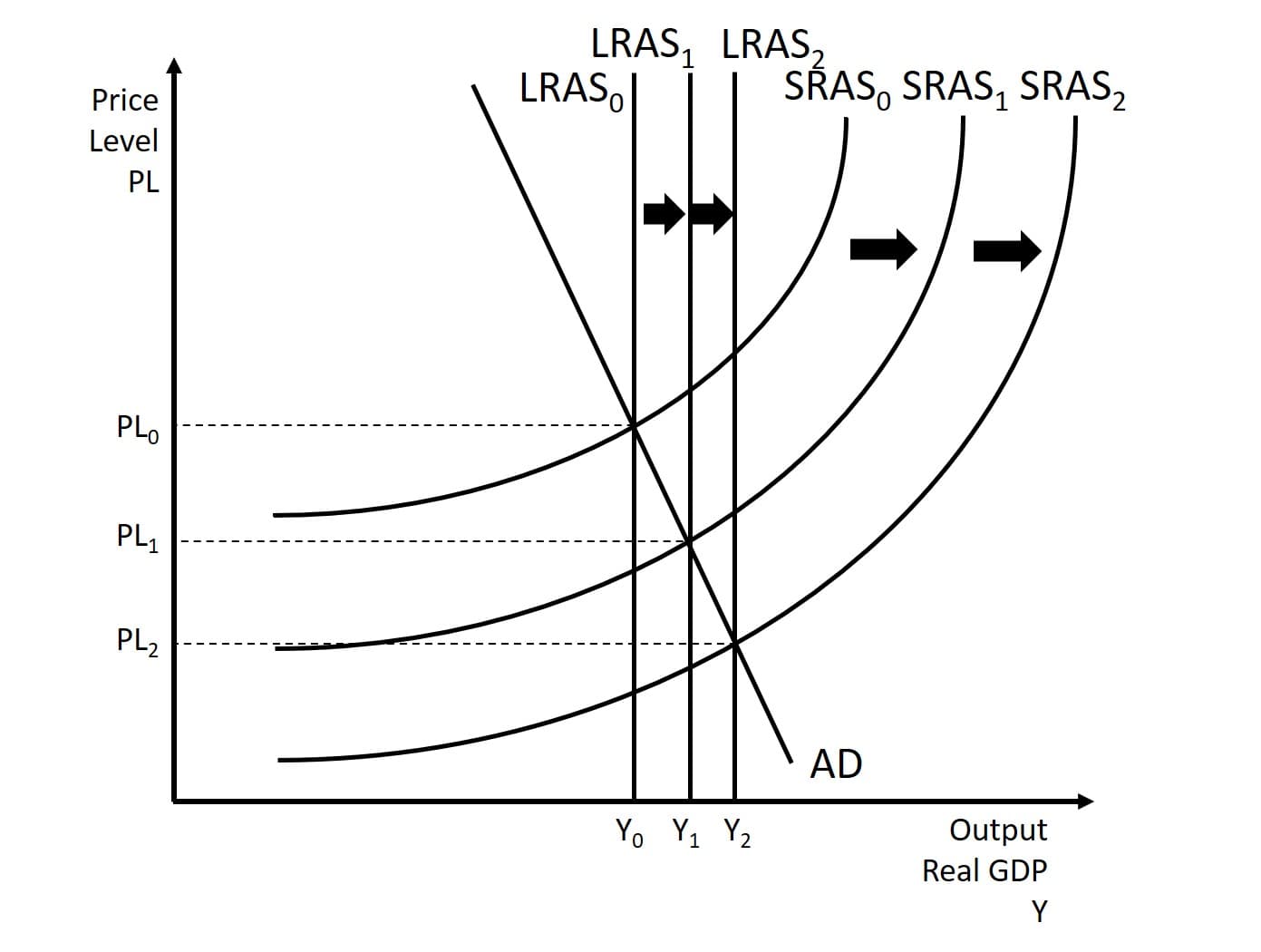
The aggregate supply (AS) curve shows the relationship between the overall price level and the total quantity of real GDP that firms are willing to produce. There are two versions of this curve, and the distinction between them is one of the most important ideas in the model.
Short-Run Aggregate Supply (SRAS): This curve slopes upward. When the price level rises but input costs (like wages) haven't adjusted yet, firms find it profitable to produce more. They hire additional workers, run factories longer, and increase output. The key assumption here is that input prices are "sticky" in the short run.
Long-Run Aggregate Supply (LRAS): This curve is vertical, sitting at the economy's potential GDP (also called full-employment output). Potential GDP is the maximum sustainable output when all resources are fully employed. In the long run, input prices fully adjust to match changes in the price level, so a higher price level doesn't lead to more real output. The position of LRAS is determined by factors like technology, the size of the labor force, and the capital stock.
Two important gaps can emerge when the economy's actual output differs from potential GDP:
- A recessionary gap occurs when real GDP falls below potential GDP. The economy is operating under capacity, with unemployed resources.
- An inflationary gap occurs when real GDP exceeds potential GDP. The economy is running above its sustainable level, which puts upward pressure on prices.

Aggregate Demand Curve
The aggregate demand (AD) curve shows an inverse relationship between the price level and the total quantity of real GDP demanded. It slopes downward: as the price level falls, the quantity of goods and services demanded across the economy rises.
The AD curve can shift when any of its components change. These components correspond to the spending categories in GDP:
- Consumption spending (C): Affected by consumer confidence, household wealth, and interest rates. For example, if a stock market boom increases household wealth, consumers spend more, shifting AD to the right.
- Investment spending (I): Influenced by business confidence, interest rates, and expectations about future profits. Lower interest rates make borrowing cheaper, encouraging firms to invest in new equipment and facilities.
- Government spending (G): Determined by fiscal policy decisions. An increase in government purchases directly increases aggregate demand.
- Net exports (NX): Impacted by exchange rates and the economic conditions of trading partners. If the dollar weakens, U.S. exports become cheaper for foreign buyers, increasing net exports and shifting AD right.

Equilibrium
Macroeconomic equilibrium is reached at the intersection of the AD and AS curves. This is where the quantity of real GDP demanded equals the quantity supplied, and it determines both the equilibrium price level and equilibrium real GDP.
- Short-run equilibrium occurs at the intersection of AD and SRAS. This equilibrium may not align with potential GDP. If it falls short, you have a recessionary gap. If it overshoots, you have an inflationary gap.
- Long-run equilibrium occurs when AD, SRAS, and LRAS all intersect at the same point. At this point, the economy is at potential GDP with full employment and stable prices. There is no pressure for wages or prices to adjust further.
Short-Run vs. Long-Run Aggregate Supply
This distinction is worth revisiting because it drives much of how the model works:
| Feature | SRAS | LRAS |
|---|---|---|
| Slope | Upward sloping | Vertical |
| Input prices | Fixed (sticky wages) | Fully flexible |
| Output response to price changes | Firms increase/decrease production | No change in real GDP |
| Position determined by | Current input costs, price level | Technology, capital stock, labor force |
In the short run, because wages and other input costs are slow to adjust, changes in the price level do affect how much firms produce. A rising price level with unchanged wages means higher profit margins, so firms expand output.
In the long run, wages and input prices catch up to reflect the new price level. Once that adjustment is complete, firms have no extra incentive to produce more or less than potential GDP. That's why the LRAS curve is vertical: changes in the price level don't affect long-run real output. Only changes in the economy's productive capacity (better technology, more workers, more capital) can shift LRAS.
See Fiveable more often in Google
Mark Fiveable as a preferred source and Google is more likely to show you our guides in Top Stories, with a "preferred" badge in AI Mode and AI Overviews.