7.1 Explicit and Implicit Costs, and Accounting and Economic Profit

💸Principles of Economics Unit 7 Review
7.1 Explicit and Implicit Costs, and Accounting and Economic Profit
💸 Principles of Economics
Costs and Profitability

Top images from around the web for Explicit vs implicit costs
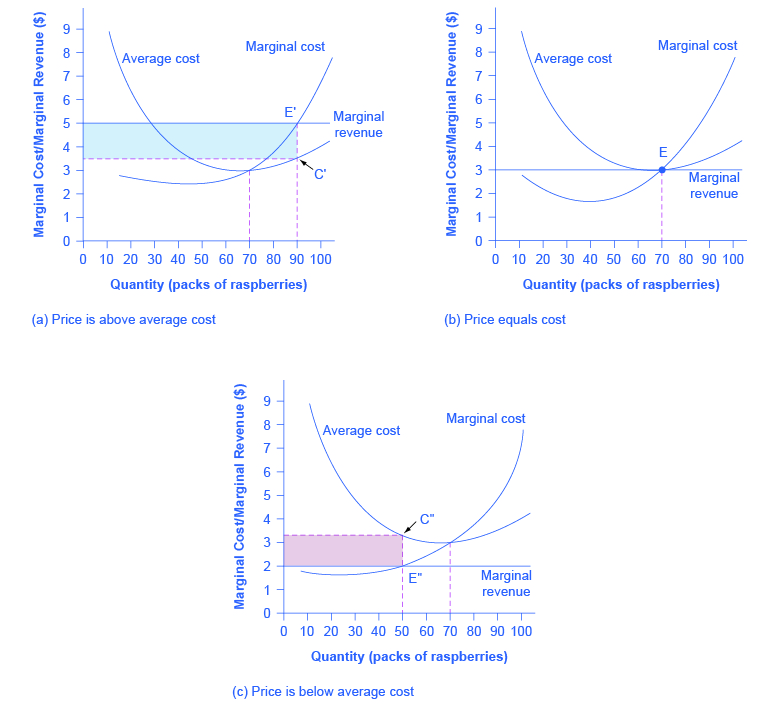
Reading: Profits and Losses with the Average Cost Curve | Microeconomics View original
Is this image relevant?
Economic Profit | Boundless Economics View original
Is this image relevant?
Reading: Profits and Losses with the Average Cost Curve | Microeconomics View original
Is this image relevant?
Economic Profit | Boundless Economics View original
Is this image relevant?
Explicit vs. Implicit Costs
Every business decision involves costs, but not all costs show up on a bill or bank statement. Economics distinguishes between explicit costs and implicit costs, and both matter when evaluating whether a firm is truly profitable.
Explicit costs are direct, out-of-pocket payments a firm makes for the resources it uses:
- Wages paid to employees
- Rent for office space, storefronts, or equipment
- Payments to suppliers for raw materials and components
These are straightforward because there's an actual monetary transaction you can point to.
Implicit costs are the opportunity costs of using resources the firm already owns. There's no invoice, but the cost is real because those resources could have been used elsewhere.
- If an owner invests $50,000 of personal savings into the business, the foregone interest or investment returns on that $50,000 is an implicit cost.
- If the firm operates out of a building it owns, the rental income it could have earned by leasing that building to someone else is an implicit cost.
- If the owner works full-time in the business instead of taking a $70,000 salary elsewhere, that $70,000 in foregone wages is an implicit cost.
The key idea: implicit costs don't involve a payment to anyone, but they represent real value given up.
Accounting vs. Economic Profit
These two types of profit differ in which costs they subtract from revenue.
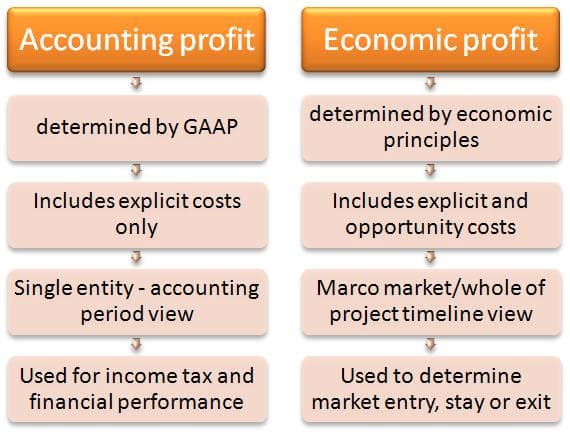
Accounting profit only subtracts explicit costs:
This is the profit number you'd see on a firm's income statement. It's useful for taxes and financial reporting, but it doesn't tell the whole story.
Economic profit subtracts both explicit and implicit costs:
Economic profit tells you whether the firm is doing better than the owner's next best alternative. Because it accounts for more costs, economic profit is always less than or equal to accounting profit.
- Positive economic profit means the firm is earning more than it would in its next best use of resources. The owner is better off running this business.
- Zero economic profit means the firm is earning exactly what its resources could earn elsewhere. The owner has no reason to leave, but no extra reward for staying either. Economists call this a normal profit.
- Negative economic profit means the firm's resources would generate more value in some other use. Even if accounting profit is positive, the owner would be better off doing something else.
Example: A bakery earns $200,000 in revenue and pays $120,000 in explicit costs (ingredients, wages, rent). Accounting profit is $80,000. But the owner turned down a $60,000 job to run the bakery and invested $100,000 of savings that would have earned $5,000 in interest. Implicit costs total $65,000. Economic profit is . The bakery is still worth running, but the margin is much thinner than accounting profit suggests.
Impact of Costs on Profitability
Revenue is the total amount a firm earns from selling goods or services:
Profitability depends on the gap between revenue and costs. Firms can improve profitability in two ways:
- Increase revenue through pricing strategies, marketing, or selling greater quantities
- Reduce costs through more efficient production methods (like automation) or smarter resource use (like bulk purchasing)
When making strategic decisions, firms should look at economic profit, not just accounting profit. A business that shows a healthy accounting profit but negative economic profit is actually underperforming relative to what the owner could earn elsewhere.
One more concept worth knowing: sunk costs are costs that have already been incurred and cannot be recovered. A rational firm should ignore sunk costs when making future decisions, since that money is gone regardless of what the firm does next.
Cost Analysis
This section previews cost concepts covered in greater depth later in the unit.
- Fixed costs stay the same regardless of how much the firm produces (e.g., rent, insurance premiums).
- Variable costs change with the level of output (e.g., raw materials, hourly labor).
- Marginal cost is the additional cost of producing one more unit of output. This concept is central to production decisions.
- The break-even point is where total revenue exactly equals total costs, meaning the firm earns zero profit.
- Economies of scale occur when a firm's long-run average cost per unit decreases as it increases production. Larger output spreads fixed costs over more units and can improve efficiency.
See Fiveable more often in Google
Mark Fiveable as a preferred source and Google is more likely to show you our guides in Top Stories, with a "preferred" badge in AI Mode and AI Overviews.