20.2 Labor Productivity and Economic Growth

💸Principles of Economics Unit 20 Review
20.2 Labor Productivity and Economic Growth
💸 Principles of Economics
Labor Productivity and Economic Growth

Top images from around the web for Labor Productivity and Economic Growth
Labor Productivity and Economic Growth | Macroeconomics View original
Is this image relevant?
Labor Productivity and Economic Growth | OpenStax Macroeconomics 2e View original
Is this image relevant?
Which investments in human capital will boost productivity growth? - Economics Observatory View original
Is this image relevant?
Labor Productivity and Economic Growth | Macroeconomics View original
Is this image relevant?
Labor Productivity and Economic Growth | OpenStax Macroeconomics 2e View original
Is this image relevant?
Labor Productivity and Economic Growth
Labor productivity measures the quantity of goods and services produced per unit of labor input. You'll usually see it expressed as output per worker or output per hour worked. This is the single most important driver of long-run economic growth and rising living standards.
The logic is straightforward: if each worker produces more output, the economy's total output (GDP) grows even without adding more workers. That extra output is what funds higher wages, greater profits, and better access to goods and services.
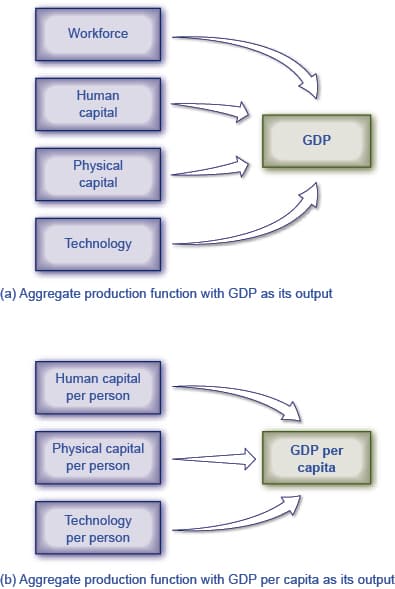
Three main factors determine how productive workers are:
- Human capital: the education, skills, training, and experience workers bring to their jobs. A workforce with more schooling and on-the-job training produces more per hour.
- Physical capital: the tools, machines, factories, computers, and infrastructure workers use. A construction crew with excavators moves far more earth than one with shovels.
- Technology: new methods, processes, and innovations that let the same inputs generate more output. Think automation on an assembly line or software that speeds up data analysis.
When productivity grows, businesses can pay higher wages without raising the prices of their goods, because each worker is generating more value. That's why economists treat productivity growth as a win for both firms and workers.

Aggregate Production Function
The aggregate production function describes the relationship between an economy's inputs and its total output (real GDP). It tells you how labor, physical capital, human capital, and technology combine to produce everything an economy makes.
A common version is the Cobb-Douglas production function:
- = total output (real GDP)
- = total factor productivity (TFP), capturing technology and overall efficiency
- = labor input (number of workers or total hours worked)
- = capital input (machines, equipment, infrastructure)
- = output elasticity of labor (a value between 0 and 1 that shows labor's share of output)
The variable is worth paying attention to. It represents everything that makes production more efficient beyond just adding more workers or machines. When rises through better technology or smarter processes, the economy gets more output from the same quantities of labor and capital.
Diminishing marginal returns is a key concept here. If you keep adding more of one input while holding the others constant, each additional unit of that input produces less and less extra output. For example, doubling the number of workers in a factory without adding any new machines won't double the factory's output, because workers start competing for the same equipment. This is why balanced investment in both labor and capital matters for sustained growth.

Productivity Growth Rate
The productivity growth rate is the percentage change in output per unit of labor input over a given period. You calculate it the same way you'd calculate any percentage change:
Several forces push this growth rate higher:
- Investment in human capital: funding education, job training programs, and apprenticeships so workers become more skilled over time
- Investment in physical capital: purchasing new machinery, upgrading infrastructure, and expanding production facilities
- Technological innovation: spending on research and development, adopting new production methods, and creating new products
- Efficiency improvements: streamlining production through techniques like lean manufacturing or better supply chain management
Even small differences in productivity growth rates compound dramatically over time. An economy growing productivity at 2% per year will roughly double output per worker in 35 years, while one growing at 1% takes about 70 years to do the same. That gap translates directly into differences in wages, living standards, and overall prosperity.
Conversely, low or negative productivity growth signals trouble. When output per worker stagnates, wage growth stalls, business profits shrink, and living standards can decline. This is why policymakers focus so heavily on policies that support education, infrastructure, and innovation.
See Fiveable more often in Google
Mark Fiveable as a preferred source and Google is more likely to show you our guides in Top Stories, with a "preferred" badge in AI Mode and AI Overviews.