14.2 Wages and Employment in an Imperfectly Competitive Labor Market

💸Principles of Economics Unit 14 Review
14.2 Wages and Employment in an Imperfectly Competitive Labor Market
💸 Principles of Economics
Monopsony Power and Its Effects on Labor Markets
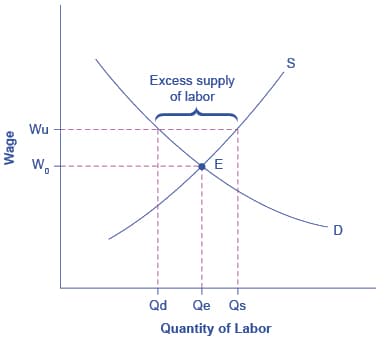
In a perfectly competitive labor market, many employers compete for workers, which pushes wages toward a fair equilibrium. But real labor markets often don't work that way. When a single employer dominates hiring in a region, that employer gains monopsony power, and the outcomes for workers look very different.

Top images from around the web for Monopsony Power
Demand and Supply at Work in Labor Markets | OS Microeconomics 2e View original
Is this image relevant?
Labor Market Power by Employees | Public Economics View original
Is this image relevant?
Labor Market Power by Employers | Microeconomics View original
Is this image relevant?
Demand and Supply at Work in Labor Markets | OS Microeconomics 2e View original
Is this image relevant?
Labor Market Power by Employees | Public Economics View original
Is this image relevant?
Monopsony Power
A monopsony exists when there's only one buyer of labor in a market. Think of a coal mining company that's the only major employer in a rural town, or a large retailer like Walmart in a small community where few other jobs exist. That single employer has enormous bargaining power because workers don't have realistic alternatives.
A monopsonistic employer faces an upward-sloping labor supply curve. This means that to attract additional workers, the firm must raise the wage it offers. But here's the catch: it typically has to raise wages for all its employees, not just the new hire. That makes each additional worker more expensive than the last, so the marginal cost of labor (MCL) rises faster than the wage itself.
The profit-maximizing monopsonist hires where (marginal revenue product). Compared to a competitive market, this leads to two key outcomes:
- Fewer workers hired. The firm restricts employment to keep labor costs down.
- Lower wages paid. The wage is set on the labor supply curve at the reduced quantity of workers, which falls below the competitive wage.
In a competitive market, the wage equals the MRP of the last worker hired. Under monopsony, the wage is lower than MRP, and the employer pockets the difference as extra profit.

Imperfect Competition and Government Policies in Labor Markets

Imperfect Competition
Monopsony is the extreme case, but labor markets can be imperfectly competitive in less dramatic ways too. Oligopsony (a few dominant employers) and general labor market concentration also give employers the ability to suppress wages below competitive levels.
The core problem is the same across all these structures:
- Employers with market power set wages below the marginal revenue product of labor, meaning workers are paid less than the value they produce.
- Employment levels fall because these employers hire fewer workers than a competitive market would support.
- The result is a deadweight loss: labor resources go underused, economic output shrinks, and workers who would have been hired at competitive wages are left without jobs.
Government Policies
Several policy tools can push imperfectly competitive labor markets closer to competitive outcomes.
Minimum wage laws set a wage floor. In a monopsony, a carefully set minimum wage can actually increase both wages and employment simultaneously, because it removes the employer's incentive to restrict hiring. However, if the minimum wage is set above the competitive equilibrium, it can lead to job losses as employers cut back on hiring.
Antitrust policies promote competition on the employer side by:
- Blocking mergers that would increase labor market concentration
- Investigating and prosecuting anticompetitive practices, such as no-poach agreements where employers secretly agree not to recruit each other's workers
Collective bargaining rights allow workers to form unions and negotiate as a group. Unions counteract employer bargaining power by acting as a single "seller" of labor, pushing wages closer to the competitive level. This is sometimes described as bilateral monopoly: one buyer (the monopsonist) facing one seller (the union).
Education and training policies take a longer-term approach. Job training programs and subsidized higher education help workers develop skills that are valuable to multiple employers, reducing any single employer's market power. When workers have portable, in-demand skills, they have more outside options, which strengthens their bargaining position.
See Fiveable more often in Google
Mark Fiveable as a preferred source and Google is more likely to show you our guides in Top Stories, with a "preferred" badge in AI Mode and AI Overviews.