15.1 Drawing the Poverty Line

💸Principles of Economics Unit 15 Review
15.1 Drawing the Poverty Line
💸 Principles of Economics
Measuring Poverty

Top images from around the web for Poverty Line Calculation and Implications
List of U.S. states and territories by poverty rate - Wikipedia View original
Is this image relevant?
Poverty in the United States, 2014: Key charts from the U.S. Census Bureau - Journalist's Resource View original
Is this image relevant?
Poverty in the United States, 2014: Key charts from the U.S. Census Bureau - The Journalist's ... View original
Is this image relevant?
List of U.S. states and territories by poverty rate - Wikipedia View original
Is this image relevant?
Poverty in the United States, 2014: Key charts from the U.S. Census Bureau - Journalist's Resource View original
Is this image relevant?
Poverty Line Calculation and Implications
The poverty line is the minimum income level a family needs to secure basic necessities like food, housing, and clothing. The U.S. Census Bureau sets this threshold, and it varies based on family size and composition (larger families have a higher threshold).
The way it's calculated has an interesting history. In 1963, economist Mollie Orshansky estimated the cost of a minimum adequate food diet, then multiplied it by three, since families at the time spent roughly one-third of their income on food. That multiplier accounted for other expenses like housing, clothing, and transportation. Each year, the threshold is adjusted for inflation using the Consumer Price Index (CPI) so it maintains its purchasing power over time.
The poverty line matters because it determines eligibility for major government assistance programs:
- Medicaid (health coverage)
- SNAP (food assistance, formerly food stamps)
- TANF (Temporary Assistance for Needy Families, cash aid)
- Housing assistance programs
Beyond individual eligibility, the poverty rate serves as a benchmark for the nation's economic well-being. A rising poverty rate signals growing economic hardship, which in turn influences policy decisions around funding for assistance programs, minimum wage laws, and other poverty alleviation efforts.

Poverty Rate Trends Across Demographics
The overall U.S. poverty rate was 11.4% in 2020, representing about 37.2 million people living below the poverty line. But that single number hides significant variation across groups.
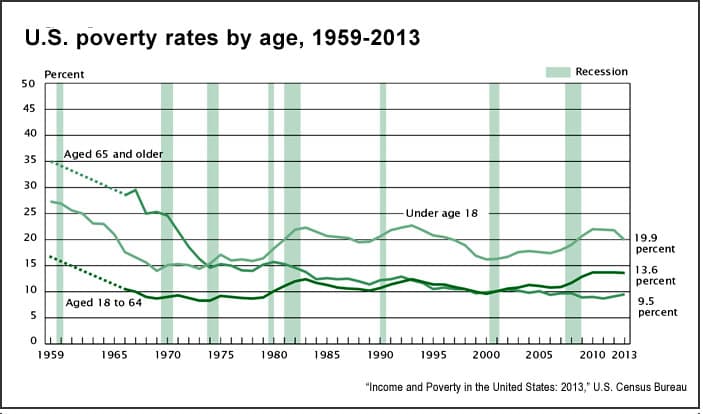
By age group, children bear the heaviest burden:
- Children under 18: 16.1% (11.6 million)
- Adults aged 18–64: 10.4% (21.2 million)
- Adults 65 and older: 9.0% (4.9 million)
Children face the highest rate partly because they depend entirely on their household's income, and single-parent families with children tend to have lower earnings.
By race and ethnicity, disparities are stark:
- African Americans: 19.5% (8.1 million)
- Hispanics: 17.0% (9.8 million)
- Asians: 8.1% (1.9 million)
- Non-Hispanic Whites: 7.3% (14.2 million)
These gaps reflect longstanding differences in access to education, employment opportunities, wealth accumulation, and the effects of historical discrimination.
By educational attainment (adults 25 and older), the pattern is clear: more education correlates with lower poverty rates.
- Less than high school diploma: 24.7% (5.4 million)
- High school diploma or equivalent: 12.7% (9.3 million)
- Some college or associate's degree: 8.4% (6.9 million)
- Bachelor's degree or higher: 4.0% (4.1 million)
Notice that earning a bachelor's degree cuts the poverty rate to roughly one-sixth of the rate for those without a high school diploma. Education is one of the strongest predictors of whether someone will experience poverty.

Strengths and Limitations of the Income-Based Poverty Measure
Strengths:
- Provides a clear, quantifiable threshold, making it easy to determine who counts as poor
- Allows comparisons across demographic groups (age, race, education level) and geographic areas (states, counties, cities)
- Helps policymakers target assistance programs by setting income-based eligibility criteria
Limitations:
The income-based measure misses a lot. Here are the main criticisms:
- Excludes non-cash benefits. Programs like SNAP, Medicaid, and housing assistance aren't counted as income, even though they significantly improve living standards for low-income families. Someone receiving thousands of dollars in benefits could still be counted as "in poverty."
- Ignores regional cost-of-living differences. The same poverty threshold applies whether you live in rural Mississippi or downtown San Francisco, where housing costs are dramatically higher.
- Based on outdated spending assumptions. The original 1963 formula assumed families spent one-third of income on food. Today, food is a much smaller share of the budget, while housing and healthcare costs have grown substantially. This means the multiplier of three likely underestimates what families actually need.
- Doesn't account for taxes or tax credits. The Earned Income Tax Credit (EITC) and Child Tax Credit (CTC) can meaningfully boost disposable income for working families, but the official measure ignores them.
- Misses the multi-dimensional nature of poverty. Income alone doesn't capture differences in health, housing quality, education access, or neighborhood safety, all of which affect well-being.
To address some of these gaps, the Census Bureau also publishes a Supplemental Poverty Measure (SPM) that accounts for non-cash benefits, taxes, and regional cost differences. You should know that the official measure remains the one used for program eligibility, but the SPM gives a more complete picture.
See Fiveable more often in Google
Mark Fiveable as a preferred source and Google is more likely to show you our guides in Top Stories, with a "preferred" badge in AI Mode and AI Overviews.