20.3 Components of Economic Growth

💸Principles of Economics Unit 20 Review
20.3 Components of Economic Growth
💸 Principles of Economics
Economic growth measures the increase in an economy's output over time. Understanding what drives that growth is central to economics, because it explains why some countries prosper while others stagnate. This section breaks growth into its core components: physical capital, human capital, and technological progress.
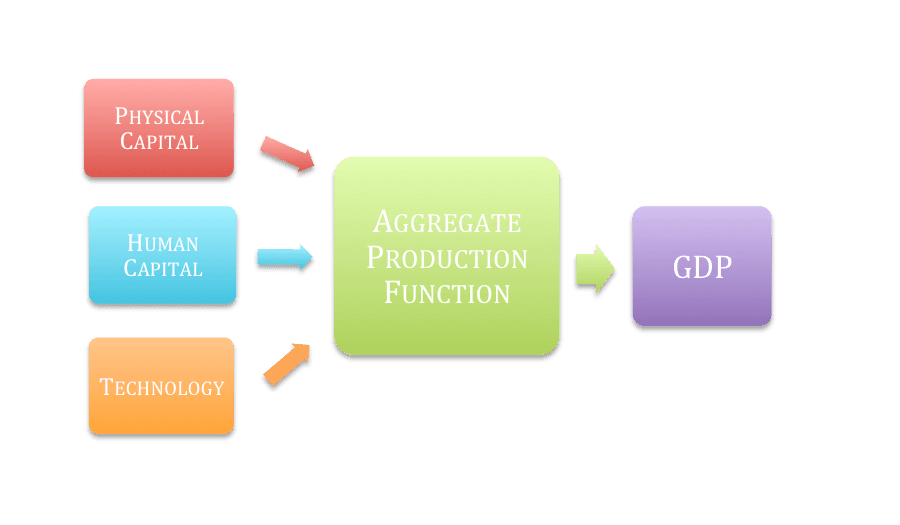
These three factors work together to boost productivity, which is output per worker. As a country invests in better equipment and education, workers produce more. Higher output raises incomes, which funds further investment. That positive feedback loop is the basic story of long-run economic growth.
Determinants of Economic Growth

Top images from around the web for Key Factors
Which investments in human capital will boost productivity growth? - Economics Observatory View original
Is this image relevant?
Labor Productivity and Economic Growth | Public Economics View original
Is this image relevant?
Reading: Components of Economic Growth | Macroeconomics View original
Is this image relevant?
Which investments in human capital will boost productivity growth? - Economics Observatory View original
Is this image relevant?
Labor Productivity and Economic Growth | Public Economics View original
Is this image relevant?
Key Factors
Physical capital refers to the buildings, machinery, equipment, and infrastructure used in production. A construction worker with a backhoe moves far more earth per hour than one with a shovel. Factories, computers, highways, and ports all count as physical capital. More and better physical capital means each worker can produce more output.
Human capital is the knowledge, skills, and experience the labor force carries. It improves through education, job training, and hands-on learning. A worker with an engineering degree or specialized vocational training can operate complex equipment, solve problems faster, and adapt to new production methods. Human capital is what lets people actually use physical capital and technology effectively.
Technological progress is the development of new products, processes, and methods that raise efficiency. Think of the assembly line, the internet, or advances in renewable energy. Technology lets an economy produce more output with the same inputs, or the same output with fewer inputs. It's often considered the most important driver of long-run growth because, unlike capital, it doesn't run into diminishing returns as easily.

Capital Deepening
Capital deepening occurs when the amount of capital per worker increases. This can mean physical capital (more machines and tools per worker) or human capital (a more educated and skilled workforce).
Why does it matter for productivity?
- More and better equipment lets each worker produce more per hour. A factory that adds industrial robots or upgrades to advanced software gets more output without necessarily hiring more people.
- A more skilled workforce uses existing technology more effectively. Engineers and programmers, for example, can extract far more value from the same equipment than untrained workers could.
This creates a positive feedback loop: higher productivity raises output and incomes, which gives businesses and governments more resources to invest in capital, which raises productivity further. That cycle is a core reason why already-wealthy countries tend to keep growing.

Growth Accounting and Policy
Growth Accounting
Growth accounting is a technique economists use to figure out how much each factor contributes to economic growth. It decomposes GDP growth into three pieces:
- Growth in labor (more workers or more hours worked)
- Growth in capital (more machines, buildings, infrastructure)
- Total factor productivity (TFP), which captures everything else
The portion of growth that can't be explained by increases in labor or capital is called the Solow residual. It's named after economist Robert Solow and is typically interpreted as the contribution of technological progress, though it also picks up things like better management practices and efficiency gains.
Growth accounting has real limitations, though:
- It assumes constant returns to scale and perfect competition, which don't always hold in the real world.
- It can't easily capture spillover effects between industries (e.g., the internet boosting productivity across nearly every sector).
- Quality improvements in inputs are hard to measure. A computer today is vastly more powerful than one from 2005, but growth accounting may not fully reflect that.
Growth-Promoting Policies
Governments can pursue several strategies to encourage long-run growth:
- Investing in education and skills development builds human capital. This includes funding universities and vocational schools, as well as supporting programs like coding bootcamps and apprenticeships that help workers adapt to new technologies.
- Encouraging research and development (R&D) pushes the frontier of technology. Policies include tax credits for private-sector R&D and direct government funding for basic research through agencies like the NIH and NSF.
- Protecting intellectual property rights through patents, copyrights, and trademarks gives inventors a financial incentive to innovate, since they can profit from their ideas for a set period.
- Maintaining macroeconomic stability reduces uncertainty for businesses making long-term investment decisions. This means keeping inflation low and predictable (many central banks target around 2%) and maintaining sustainable government debt levels.
- Promoting international trade and foreign direct investment gives domestic firms access to larger markets and exposes them to new technologies. Free trade agreements increase competition and encourage countries to specialize based on comparative advantage, which raises overall efficiency.
See Fiveable more often in Google
Mark Fiveable as a preferred source and Google is more likely to show you our guides in Top Stories, with a "preferred" badge in AI Mode and AI Overviews.