22.3 How the U.S. and Other Countries Experience Inflation

💸Principles of Economics Unit 22 Review
22.3 How the U.S. and Other Countries Experience Inflation
Measuring and Analyzing Inflation
The Consumer Price Index (CPI) is the main tool used to track inflation in the U.S. It measures how prices change over time for a typical "basket" of goods and services, giving us a concrete number to describe what's happening to purchasing power. Understanding how CPI works, how inflation plays out globally, and how it connects to broader economic conditions are all central to this topic.

Top images from around the web for Consumer Price Index
The Story Of Inflation Between 1996 And 2016 Is Of Rising Prices In Things That You Need: Prices ... View original
Is this image relevant?
Consumer price index - Wikipedia View original
Is this image relevant?
Consumer Price Index View original
Is this image relevant?
The Story Of Inflation Between 1996 And 2016 Is Of Rising Prices In Things That You Need: Prices ... View original
Is this image relevant?
Consumer price index - Wikipedia View original
Is this image relevant?
Consumer Price Index
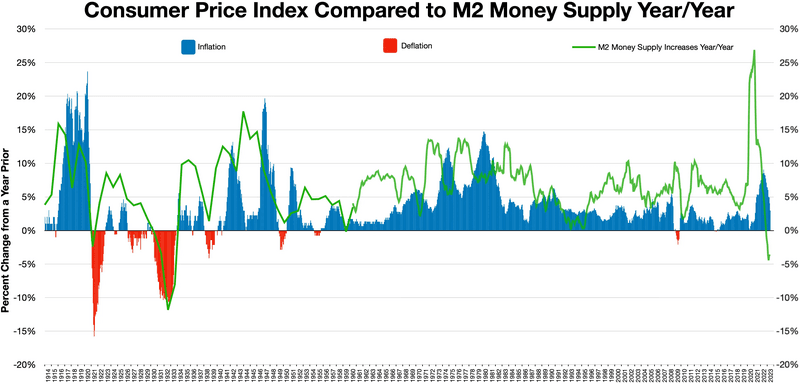
The CPI tracks the average change in prices paid by urban consumers for a market basket of goods and services. This basket includes categories like food, clothing, shelter, fuel, transportation, and medical care.
Here's how it works:
- The Bureau of Labor Statistics (BLS) defines a market basket based on what typical urban consumers actually buy.
- Prices for those items are collected periodically from thousands of locations.
- Each item is given a weight based on how much of a consumer's budget it represents (shelter gets a much larger weight than, say, apparel).
- The weighted average of price changes is used to calculate the CPI.
To find the inflation rate, you compare the CPI from one period to a base year:
For example, if the CPI was 251 last year and 258 this year, the inflation rate would be .
The CPI is also used for indexation, which means adjusting dollar amounts to keep up with inflation. Social Security benefits, federal income tax brackets, and some private-sector wages are all indexed to the CPI so that rising prices don't silently erode people's purchasing power.

International Inflation Patterns
Inflation rates vary widely across countries and time periods. Developed countries tend to have lower, more stable inflation rates, while developing countries are more prone to sharp spikes.
Hyperinflation is the extreme case, defined as a monthly inflation rate exceeding 50%. At that pace, prices can double in a matter of weeks. A few notable examples:
- Germany (1920s): After World War I, the German government printed massive amounts of money to pay war reparations. Prices spiraled so fast that people famously used wheelbarrows of cash to buy bread.
- Zimbabwe (2000s): Disruptive land reform policies and heavy money printing collapsed the economy. Inflation peaked at an estimated 79.6 billion percent in November 2008.
- Venezuela (2010s): A combination of political instability, plummeting oil revenues, and excessive money printing pushed inflation to roughly 10 million percent by 2019.
Notice the common thread: in every case, governments printed enormous amounts of money, which flooded the economy with currency and destroyed its value.
The consequences of hyperinflation are severe:
- Purchasing power erodes so fast that savings become worthless
- People lose confidence in the currency and turn to foreign currencies or barter
- Businesses can't plan or set prices, which stalls investment
- Economic instability fuels social unrest and political crisis

Inflation and Economic Conditions
Inflation doesn't happen in a vacuum. It's closely tied to the overall state of the economy.
During economic growth, demand for goods and services rises. That increased demand puts upward pressure on prices, and inflation tends to climb. During recessions, the opposite happens: demand falls, businesses cut prices or hold them steady, and inflation drops. If prices actually fall on average, that's called deflation.
The Phillips curve captures a key short-run relationship: when unemployment is low, inflation tends to be higher, and vice versa. The logic is that when more people are employed, there's more spending in the economy, which pushes prices up. However, this tradeoff breaks down in the long run. Over time, the economy tends to settle at its natural rate of unemployment regardless of the inflation rate.
Central banks use this understanding to guide policy. The Federal Reserve manages inflation through monetary policy:
- When inflation is too high, the Fed raises interest rates. Higher rates make borrowing more expensive, which slows spending and investment, reducing upward pressure on prices.
- When inflation is too low or the economy is in recession, the Fed lowers interest rates. Cheaper borrowing encourages spending and investment, stimulating economic growth.
The Fed's goal is price stability, typically targeting an inflation rate of about 2% per year, which is considered healthy enough to support growth without eroding purchasing power too quickly.
See Fiveable more often in Google
Mark Fiveable as a preferred source and Google is more likely to show you our guides in Top Stories, with a "preferred" badge in AI Mode and AI Overviews.