12.3 Market-Oriented Environmental Tools

💸Principles of Economics Unit 12 Review
12.3 Market-Oriented Environmental Tools
💸 Principles of Economics
Market-Oriented Environmental Tools
Environmental economics uses market-oriented tools to tackle pollution. Instead of telling every firm exactly what to do, tools like pollution charges and tradable permits give firms flexibility in how they reduce emissions. The core idea: create financial incentives so that pollution reduction happens where it's cheapest, making environmental protection more cost-effective overall.
These approaches work best when emissions are easy to measure and monitor. They can fall short for localized pollutants or situations involving irreversible damage. Policymakers have to weigh the specific environmental problem, potential impacts on consumers, and fairness concerns when choosing between market tools and traditional command-and-control regulations.

Top images from around the web for Pollution Charges
5.3 Directly Targeting Pollution – Principles of Microeconomics View original
Is this image relevant?
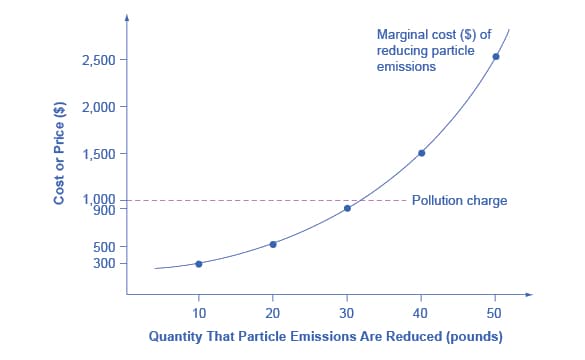
Market-Oriented Environmental Tools · Economics View original
Is this image relevant?
U.S. Environmental Laws | Microeconomics View original
Is this image relevant?
5.3 Directly Targeting Pollution – Principles of Microeconomics View original
Is this image relevant?
Market-Oriented Environmental Tools · Economics View original
Is this image relevant?
Pollution Charges
A pollution charge is a fee imposed on firms based on the amount of pollution they emit. For example, a firm might pay a set dollar amount for each ton of carbon dioxide it releases. This creates a direct financial reason to pollute less.
Here's how firms respond to a pollution charge:
- If the marginal cost of abatement (the cost of reducing one more unit of pollution) is less than the charge, the firm will reduce emissions. It's cheaper to clean up than to pay.
- If the marginal cost of abatement is greater than the charge, the firm pays the charge instead. At that point, paying is the cheaper option.
- Firms keep reducing emissions until the marginal cost of abatement equals the pollution charge per unit.
This decision process ensures cost-effective emissions reduction. Each firm reduces pollution up to the point where further reductions would cost more than just paying the fee. Across the whole economy, the firms that can cut pollution most cheaply end up doing the most cutting.

Tradable Pollution Permits
Tradable permits (also called cap-and-trade) take a different approach. The government sets a total cap on pollution and issues a fixed number of permits equal to that cap. Each permit allows a firm to emit a specific amount, such as one ton of emissions.
The key feature is that firms can buy and sell these permits on an open market. This trading is what drives efficiency:
- The government determines the total allowable emissions and distributes permits to firms.
- Firms with low abatement costs find it cheap to reduce emissions below their permit level. They sell their excess permits for profit.
- Firms with high abatement costs buy extra permits because purchasing them is cheaper than making costly reductions.
- Trading continues until the market reaches a permit price where no firm can gain from further trades.
The result is the same as with pollution charges: the least expensive emissions reductions happen first, minimizing the overall cost of hitting the pollution target.
Property rights are essential for this system to function. Each permit represents a legally enforceable right to emit a certain amount of pollution. When these rights are clearly defined and secure, firms have confidence to invest in cleaner technology, knowing they can profit by selling permits they no longer need.

Appropriateness of Market-Based Tools
Market-based tools aren't a universal solution. Their effectiveness depends on the nature of the environmental problem.
Where they work well:
- Emissions that are easily measured and monitored, like carbon dioxide or sulfur dioxide
- Situations where firms have varying abatement costs, so trading or charge-based flexibility produces real savings
- Problems where continuous improvement matters, since firms always have an incentive to adopt cleaner technologies and reduce costs further
Where they fall short:
- Pollutants that are hard to quantify or have localized impacts, such as toxic chemical runoff or noise pollution. If you can't measure it reliably, you can't charge for it or cap it.
- Environmental issues involving threshold effects or irreversible damage. If crossing a certain pollution level causes a species to go extinct or an ecosystem to collapse, the flexibility of market tools is too risky. Strict command-and-control regulations are more appropriate here.
Distributional concerns also matter. Firms often pass the cost of permits or pollution charges on to consumers through higher prices. And permit trading can create pollution hotspots, where firms in low-income areas buy extra permits rather than cleaning up, concentrating harm in communities that are already vulnerable.
In practice, the best policy often combines market-based tools with traditional regulations. The choice depends on careful analysis of the specific problem and the trade-offs between effectiveness, cost, and equity.
See Fiveable more often in Google
Mark Fiveable as a preferred source and Google is more likely to show you our guides in Top Stories, with a "preferred" badge in AI Mode and AI Overviews.