30.3 Federal Deficits and the National Debt

💸Principles of Economics Unit 30 Review
30.3 Federal Deficits and the National Debt
💸 Principles of Economics
Federal Deficits and the National Debt
Federal deficits and the national debt reflect the government's fiscal health over time. A deficit occurs in any single year when spending exceeds revenue, while the national debt is the total accumulation of past deficits minus any surpluses. Both fluctuate with economic cycles, policy decisions, and unexpected crises.

Top images from around the web for Economic Expansions and Contractions
Federal Deficits and the National Debt | OpenStax Macroeconomics 2e View original
Is this image relevant?
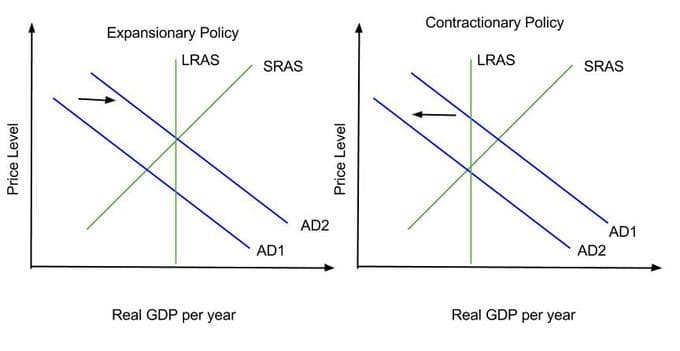
Introduction to Fiscal Policy | Boundless Economics View original
Is this image relevant?
Government Spending | Macroeconomics with Prof. Dolar View original
Is this image relevant?
Federal Deficits and the National Debt | OpenStax Macroeconomics 2e View original
Is this image relevant?
Introduction to Fiscal Policy | Boundless Economics View original
Is this image relevant?
Economic Expansions and Contractions
The business cycle has a direct, almost automatic effect on the federal budget. You don't need Congress to pass new laws for the budget to shift during booms and busts.
During economic expansions, tax revenues rise and government spending on safety-net programs falls:
- More people are employed, so personal income tax collections increase.
- Corporate profits grow, generating higher corporate income tax revenue.
- Consumer spending rises, which boosts sales tax revenue (at the state level) and overall economic activity that feeds federal revenue.
- Fewer people qualify for means-tested programs like Medicaid and food assistance (SNAP), so spending on those programs drops.
- Unemployment insurance payments decline as fewer workers file claims.
The result: the budget deficit shrinks, and in strong expansions it can even flip into a budget surplus (tax revenues > government spending).
During economic contractions, the opposite happens:
- Layoffs and hiring freezes reduce the number of workers paying income taxes.
- Corporate profits fall, and some businesses close entirely, cutting corporate tax revenue.
- Consumers pull back spending as disposable income drops, reducing consumption-based revenues.
- More people qualify for unemployment benefits, Medicaid, and food assistance, pushing government spending up.
The result: the budget deficit widens, sometimes dramatically. These revenue and spending shifts happen without any new legislation, which is why economists call them automatic stabilizers. They cushion the economy during downturns and cool it during booms.

National Debt and Budget Deficits/Surpluses
Think of the national debt as a running total. Each year's budget outcome either adds to it or chips away at it.
- A budget deficit means the government spent more than it collected that year. To cover the gap, it borrows (typically by issuing Treasury bonds), and that borrowing gets added to the national debt.
- A budget surplus means the government collected more than it spent. The extra funds can be used to pay down existing debt, reducing the national total.
One often-overlooked consequence of a large national debt is the interest payments on it. The federal government must pay interest to bondholders, and those payments are mandatory spending. As the debt grows, interest costs consume a larger share of the budget. This can create a feedback loop: higher interest payments increase total outlays, which can widen the deficit, which adds more debt, which generates even more interest costs.

Factors Influencing Federal Spending and Tax Revenue
Several forces shape the budget beyond just the business cycle:
Demographic shifts play a long-term role. An aging population increases spending on entitlement programs like Social Security and Medicare, since more retirees draw benefits while relatively fewer workers pay in. Population growth also raises demand for public services such as education and transportation infrastructure.
Economic conditions act through the automatic stabilizers described above. Recessions push spending up and revenue down; expansions do the reverse.
Policy changes are the deliberate lever. Congress can alter tax rates, deductions, and credits, directly affecting how much revenue the government collects. It can also shift spending priorities, reallocating funds among defense, education, healthcare, and other areas. A major tax cut without corresponding spending cuts will widen the deficit, and vice versa.
Emergencies and crises can cause sudden, large spending increases. Wars require military funding, natural disasters trigger relief efforts, and pandemics can prompt massive stimulus measures. These events are hard to predict and can push deficits far beyond normal levels in a short time.
Debt service costs tie back to the interest payment problem. When interest rates rise, the cost of servicing existing debt increases. And as the total debt grows, even stable interest rates mean larger dollar amounts going to interest, potentially crowding out other government spending (meaning less room in the budget for programs like infrastructure or education).
See Fiveable more often in Google
Mark Fiveable as a preferred source and Google is more likely to show you our guides in Top Stories, with a "preferred" badge in AI Mode and AI Overviews.