24.5 How the AD/AS Model Incorporates Growth, Unemployment, and Inflation

💸Principles of Economics Unit 24 Review
24.5 How the AD/AS Model Incorporates Growth, Unemployment, and Inflation
💸 Principles of Economics
Economic Growth, Unemployment, and Inflation in the AD/AS Model
The AD/AS model does more than show equilibrium at a single point in time. It also explains the three big macroeconomic outcomes you need to track: economic growth, unemployment, and inflation. Each one connects to a specific shift in AD, SRAS, or LRAS.

Top images from around the web for Economic Growth and Recessions
Reading: Growth and Recession in the AS–AD Diagram | Macroeconomics View original
Is this image relevant?
AD–AS model - Wikipedia View original
Is this image relevant?
Stages of the Economy | Introduction to Business View original
Is this image relevant?
Reading: Growth and Recession in the AS–AD Diagram | Macroeconomics View original
Is this image relevant?
AD–AS model - Wikipedia View original
Is this image relevant?
Economic Growth and Recessions
Economic growth means the economy's potential GDP is rising over time. On the AD/AS diagram, this shows up as a rightward shift of the long-run aggregate supply (LRAS) curve. When LRAS shifts right, the economy can produce more output at every price level. Over time, this leads to higher real GDP and puts downward pressure on prices (all else equal).
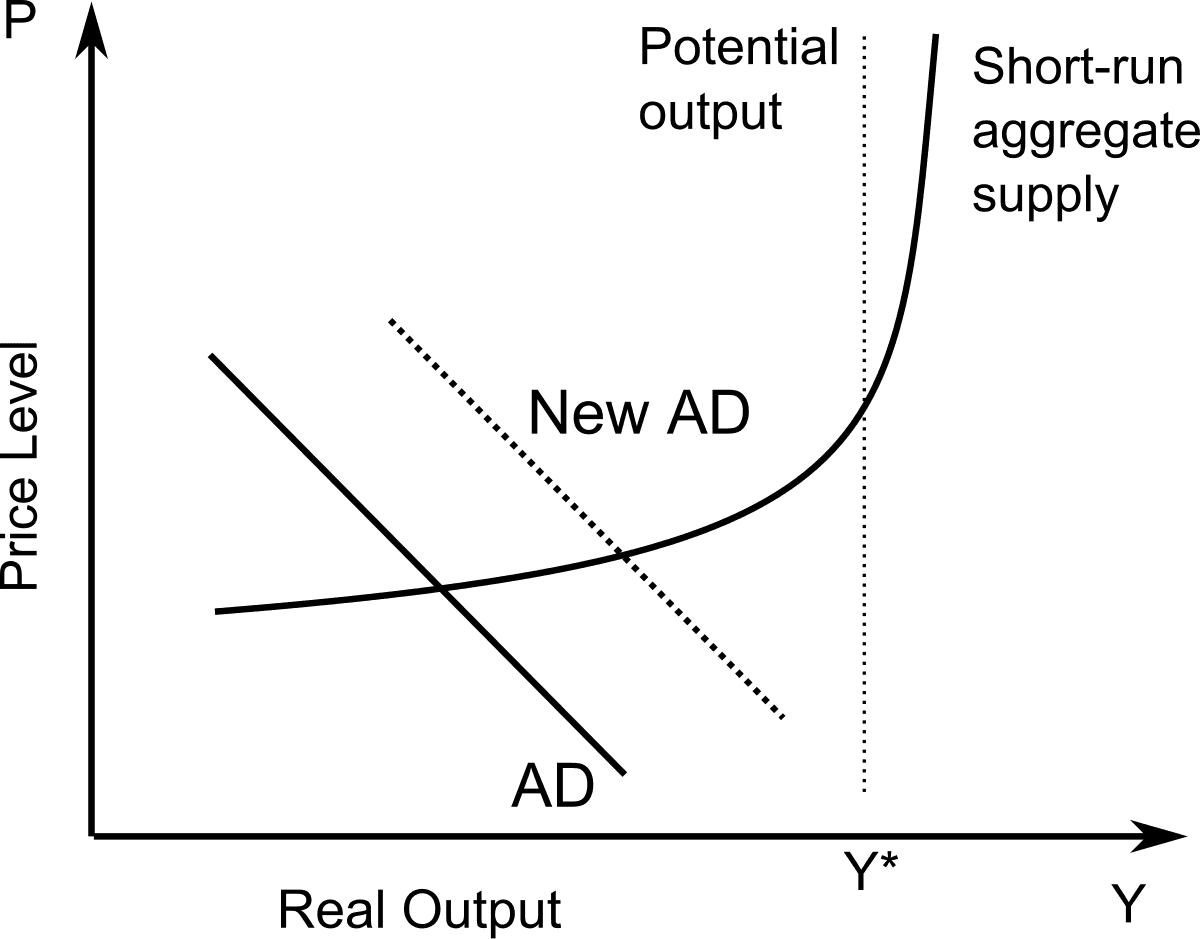
Recessions work differently. A recession is defined as a decline in real GDP for two consecutive quarters. In the model, a recession typically starts with a leftward shift of the aggregate demand (AD) curve. That shift moves the short-run equilibrium to the left of the LRAS curve, creating a recessionary gap (also called a negative output gap). In this gap, real GDP falls below potential GDP, and unemployment rises.
A recessionary gap means the economy is producing less than it sustainably could. An inflationary gap means it's producing more than potential, which drives prices up.

Unemployment and Potential GDP
Potential GDP is the maximum level of output the economy can sustain when all resources are fully employed. On the graph, it corresponds to where the LRAS curve sits.
- Cyclical unemployment appears when the economy operates below potential GDP. This happens during a recessionary gap, where the short-run equilibrium lies to the left of LRAS. The cause is typically a decrease in aggregate demand (leftward AD shift).
- As aggregate demand recovers (rightward AD shift), the short-run equilibrium moves back toward LRAS. Real GDP rises, and cyclical unemployment falls.
- At potential GDP, cyclical unemployment is zero. The economy still has frictional and structural unemployment, but those are built into the LRAS position itself.
The key takeaway: the distance between short-run equilibrium and LRAS tells you the direction of cyclical unemployment. Left of LRAS means cyclical unemployment is positive. Right of LRAS means the labor market is overheated.

Shifts in Aggregate Demand and Supply
Inflation in the AD/AS model comes from two distinct sources, and you need to be able to tell them apart.
Demand-pull inflation occurs when aggregate demand increases faster than aggregate supply. A rightward shift in the AD curve pushes the equilibrium price level up. Common causes include increased consumer spending, higher government spending, or a surge in exports. On the graph, you'll see both higher prices and higher real GDP in the short run.
Cost-push inflation occurs when production costs rise, shifting the short-run aggregate supply (SRAS) curve to the left. This raises the price level while reducing real GDP, a painful combination sometimes called stagflation. Common causes include rising oil prices, higher wages, or increased business taxes.
Demand-pull inflation: AD shifts right → prices up, output up. Cost-push inflation: SRAS shifts left → prices up, output down.
Long-run aggregate supply (LRAS) does not respond to changes in the price level. It only shifts when the economy's productive capacity changes, through factors like technological progress, improvements in education, or capital accumulation. A rightward shift in LRAS increases potential GDP, which can help ease inflationary pressures by expanding what the economy can produce without overheating.
See Fiveable more often in Google
Mark Fiveable as a preferred source and Google is more likely to show you our guides in Top Stories, with a "preferred" badge in AI Mode and AI Overviews.