12.6 The Tradeoff between Economic Output and Environmental Protection

💸Principles of Economics Unit 12 Review
12.6 The Tradeoff between Economic Output and Environmental Protection
💸 Principles of Economics
The Tradeoff between Economic Output and Environmental Protection

Top images from around the web for Production Possibility Frontier (PPF) Model
The Tradeoff between Economic Output and Environmental Protection · Economics View original
Is this image relevant?
The Tradeoff between Economic Output and Environmental Protection · Economics View original
Is this image relevant?
Production–possibility frontier - Wikipedia, the free encyclopedia View original
Is this image relevant?
The Tradeoff between Economic Output and Environmental Protection · Economics View original
Is this image relevant?
The Tradeoff between Economic Output and Environmental Protection · Economics View original
Is this image relevant?
Production Possibility Frontier (PPF) Model
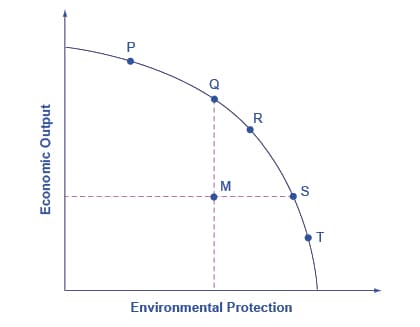
The PPF is a graph that shows the maximum combinations of two goods an economy can produce given its current resources and technology. In this context, the two "goods" are economic output and environmental protection.
Every point along the PPF curve represents an efficient allocation, meaning all resources are fully utilized. Points inside the curve are inefficient (you could get more of one good without giving up the other), and points outside the curve are unattainable with current resources.
The core insight here is opportunity cost. Because resources are limited, putting more toward economic output means pulling resources away from environmental protection, and vice versa. You can't maximize both at the same time.
- Linear PPF: The tradeoff is constant. Each additional unit of output costs the same amount of environmental protection.
- Concave (bowed-out) PPF: The tradeoff gets steeper as you produce more of one good. This reflects the law of increasing opportunity costs, which is the more realistic shape. Resources aren't perfectly adaptable, so shifting the last units toward output costs increasingly more environmental protection.

Economic Growth and Environmental Quality
The Environmental Kuznets Curve (EKC) is a hypothesis that describes an inverted-U relationship between a country's income level and its environmental degradation.
Here's how it works in stages:
- At low income levels, economic growth causes environmental quality to worsen. Early industrialization tends to be resource-intensive and pollution-heavy.
- After a country reaches a certain income threshold, environmental quality starts to improve even as the economy keeps growing.
- This improvement happens because wealthier societies tend to demand cleaner environments, develop better technology, and adopt stricter environmental regulations.
On a graph, you'd plot per-capita income on the x-axis and an environmental degradation indicator (like sulfur dioxide emissions) on the y-axis. The curve rises at first, hits a turning point, then declines.
Limitations of the EKC:
- The pattern doesn't hold for all pollutants. It fits some (like sulfur dioxide) better than others (like carbon dioxide or waste generation).
- It ignores the potential irreversibility of environmental damage. Some ecosystems, once destroyed, don't recover just because a country gets richer.
- Wealthier countries sometimes "export" their pollution by outsourcing dirty industries to developing nations, which can make their own EKC look better without reducing global degradation.

Policy Approaches
Governments use several strategies to manage the tradeoff between growth and environmental quality. These fall into a few broad categories.
Market-based instruments work by internalizing external costs, making polluters pay for the damage they cause:
- Pigouvian taxes place a tax on activities that generate negative externalities. A carbon tax, for example, raises the cost of emitting greenhouse gases, giving firms a financial incentive to reduce emissions.
- Cap-and-trade systems set a total limit (cap) on emissions and issue tradable permits. Firms that can reduce pollution cheaply do so and sell their extra permits to firms where reduction is more expensive. This achieves the emissions target at the lowest overall cost.
Command-and-control regulations directly mandate behavior rather than using price signals:
- Examples include emission standards (maximum allowable pollution levels) and technology mandates (requiring specific equipment like catalytic converters).
- These are effective at guaranteeing specific outcomes, but they tend to be less flexible and more costly than market-based approaches because they don't let firms find the cheapest way to comply.
Subsidies and incentives encourage adoption of cleaner alternatives:
- Governments may subsidize renewable energy, energy-efficient appliances, or sustainable agriculture.
- These help overcome market barriers, like the high upfront cost of solar panels, and steer behavior toward environmentally friendly choices.
International agreements address environmental problems that cross borders, especially climate change:
- The Paris Agreement (2015) coordinates countries' commitments to reduce emissions and pursue sustainable development.
- Major challenges include getting all countries to participate, ensuring compliance with pledged targets, and distributing costs fairly between wealthy nations (which industrialized first) and developing nations (which need room to grow).
See Fiveable more often in Google
Mark Fiveable as a preferred source and Google is more likely to show you our guides in Top Stories, with a "preferred" badge in AI Mode and AI Overviews.