34.1 Protectionism: An Indirect Subsidy from Consumers to Producers

💸Principles of Economics Unit 34 Review
34.1 Protectionism: An Indirect Subsidy from Consumers to Producers
💸 Principles of Economics
34.1
Protectionism: An Indirect Subsidy from Consumers to Producers
34.2
International Trade and Its Effects on Jobs, Wages, and Working Conditions
34.3
Arguments in Support of Restricting Imports
34.4
How Governments Enact Trade Policy: Globally, Regionally, and Nationally
34.5
The Tradeoffs of Trade Policy
Protectionism and Its Impact on Markets
Protectionism refers to government policies that restrict international trade in order to shield domestic industries from foreign competition. The core idea behind this unit's title, "An Indirect Subsidy from Consumers to Producers," is straightforward: when trade barriers raise the price of goods, consumers pay more so that domestic producers can survive against cheaper foreign alternatives. The money doesn't flow through the government budget like a direct subsidy would, but the effect is similar.
Understanding protectionism matters because it sits at the center of ongoing debates about trade policy, jobs, and economic growth. The key question is always: who benefits, who pays, and what happens to the economy overall?

Top images from around the web for Protectionism and Key Forms
Tariffs vs. Quotas | Marginal Revolution University View original
Is this image relevant?
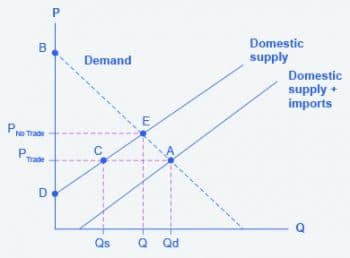
Chapter 14.5 – Protectionism: An Indirect Subsidy from Consumers to Producers – Agribusiness ... View original
Is this image relevant?
Barriers to Trade | Boundless Economics View original
Is this image relevant?
Tariffs vs. Quotas | Marginal Revolution University View original
Is this image relevant?
Chapter 14.5 – Protectionism: An Indirect Subsidy from Consumers to Producers – Agribusiness ... View original
Is this image relevant?
Key Forms of Protectionism
Tariffs are taxes placed on imported goods and services. They raise the price of imports, making them less competitive compared to domestic goods. Tariffs come in two forms:
- Ad valorem tariffs: a percentage of the imported good's value (e.g., a 15% tariff on imported steel)
- Specific tariffs: a fixed dollar amount per unit (e.g., $2 per ton of imported sugar)
Import quotas are quantitative limits on how much of a good can be imported. For example, a country might allow only 500,000 tons of foreign rice per year. By capping supply, quotas drive up the domestic price of that good and protect local producers.
Nontariff barriers restrict trade without using taxes or hard quantity limits. These include things like strict product standards, complex licensing requirements, and slow administrative procedures. They make it harder or more expensive for foreign firms to sell in the domestic market, giving local producers an edge.

How Protectionist Policies Affect Markets
Tariffs and quotas both shift the import supply curve to the left. With fewer imports available, the domestic price rises. Here's the chain of effects:
- The price of the protected good increases in the domestic market.
- Domestic producers, now facing less foreign competition, can sell more at the higher price. Producer surplus increases.
- Consumers pay higher prices and buy less overall. Consumer surplus decreases.
- The economy experiences deadweight loss, a reduction in total surplus that represents pure inefficiency. No one captures this lost value.
Nontariff barriers produce similar outcomes. Even though they don't show up as a tax or a quota number, they raise costs for foreign producers and reduce the quantity of imports, pushing domestic prices up.

The "Indirect Subsidy" Explained
This is the central insight of the topic. A direct subsidy would involve the government writing a check to domestic producers, funded by taxpayers. With protectionism, the transfer is indirect: consumers pay artificially higher prices, and that extra money flows to domestic producers as higher revenue. The government doesn't collect and redistribute the funds (except in the case of tariff revenue), but the economic effect on producers is much like receiving a subsidy.
The difference is that this "subsidy" is hidden in the price tag rather than visible in a government budget.
Costs and Benefits
Benefits (mainly for producers):
- Protection from foreign competition, allowing domestic firms to maintain or increase market share and profits
- Preservation of jobs in protected industries, at least in the short run
Costs (mainly for consumers and the broader economy):
- Higher prices on protected goods, which reduces consumer surplus and overall purchasing power
- Fewer choices and potentially lower quality, since foreign competitors are kept out
- Deadweight loss for the economy as a whole: resources get pulled toward protected industries rather than toward industries where the country has a comparative advantage (the ability to produce a good at a lower opportunity cost than trading partners)
Retaliation and trade wars are a serious risk. When one country raises trade barriers, its trading partners often respond with their own tariffs or quotas. This escalation raises prices on both sides, reduces total trade volume, and harms exporters in both countries.
In the long run, protectionism tends to reduce competition and weaken the incentive for domestic firms to innovate and improve efficiency. This can slow economic growth over time.
Key Concepts and Formulas
- Tariff revenue:
This is the revenue the government collects from the tariff. It represents a transfer from consumers (who pay higher prices) to the government.
- Deadweight loss: The reduction in total economic surplus (the combined loss of consumer and producer surplus that nobody recaptures) caused by the market distortion of protectionist policies. On a supply-and-demand diagram, it shows up as the triangular areas between the world price, the domestic price, and the supply/demand curves.
- Comparative advantage: A country's ability to produce a good or service at a lower opportunity cost than its trading partners. Trade based on comparative advantage increases total output and benefits all countries involved. Protectionism works against this principle by directing resources toward industries that may not be the country's most efficient use of labor and capital.
See Fiveable more often in Google
Mark Fiveable as a preferred source and Google is more likely to show you our guides in Top Stories, with a "preferred" badge in AI Mode and AI Overviews.