21.1 How Economists Define and Compute Unemployment Rate

💸Principles of Economics Unit 21 Review
21.1 How Economists Define and Compute Unemployment Rate
Unemployment and the Labor Market
Unemployment is one of the most closely watched indicators in economics. Understanding how it's measured helps you evaluate the health of an economy and recognize what the official numbers capture and what they miss.

Top images from around the web for Labor Force Participation and Unemployment Rates
Information Transfer Economics: Unemployment and labor force participation (models vs data) View original
Is this image relevant?
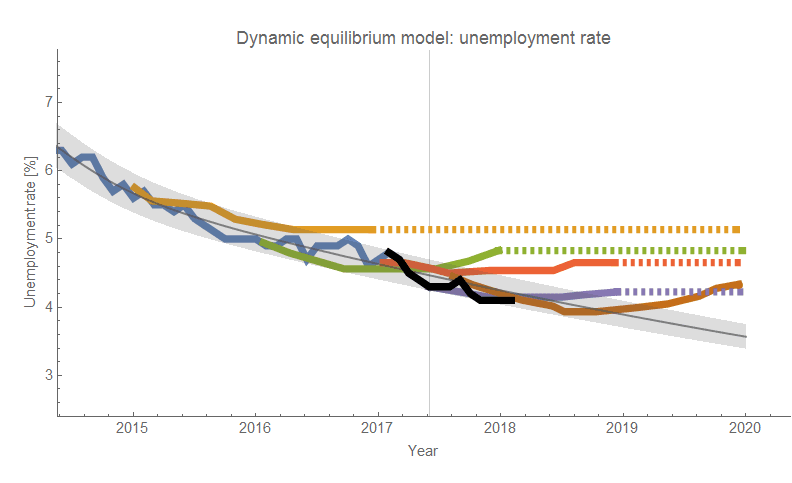
Information Transfer Economics: Unemployment and labor force participation (models vs data) View original
Is this image relevant?
Calculating the Unemployment Rate | Public Economics View original
Is this image relevant?
Information Transfer Economics: Unemployment and labor force participation (models vs data) View original
Is this image relevant?
Information Transfer Economics: Unemployment and labor force participation (models vs data) View original
Is this image relevant?
Labor Force Participation and Unemployment Rates
Before you can understand unemployment, you need to know what the labor force actually is. The labor force includes everyone in the adult (16+) civilian population who is either working or actively looking for work. People who are neither working nor looking are simply not counted.
Two rates built from this concept show up constantly in economics:
Labor force participation rate measures what share of the adult population is active in the labor market:
For example, if the adult population is 260 million and the labor force is 164 million, the participation rate is about 63%.
Unemployment rate measures what share of the labor force can't find work:
If 8 million people in that 164-million labor force are unemployed, the unemployment rate is about 4.9%. Notice the denominator is the labor force, not the total adult population. That distinction matters a lot for interpreting the number.
Several factors influence both rates:
- Demographics: Younger workers (16–24) and older workers (65+) tend to have lower participation rates. Higher education levels are associated with higher participation and lower unemployment.
- Economic conditions: Recessions push unemployment up and can pull participation down as some workers stop searching. Expansions do the reverse.
- Social and cultural factors: Shifts in retirement age affect older workers' participation. Women's participation has risen significantly over decades as gender roles have evolved.
- Government policies: Unemployment insurance, minimum wage laws, and job training programs can all influence how many people participate and how quickly the unemployed find work.

Types of Labor Force Status
The Bureau of Labor Statistics (BLS) sorts every adult into one of three categories:
Employed includes anyone who worked at least one hour for pay or profit during the survey's reference week. This covers both full-time and part-time workers. Someone who worked just a few hours at a part-time job counts the same as someone working 50-hour weeks.
Unemployed includes people who meet all three conditions: they don't currently have a job, they've actively searched for work in the past four weeks, and they're available to start working. People temporarily laid off and waiting to be recalled also count as unemployed.
Out of the labor force covers everyone else: retirees, full-time students, stay-at-home parents, people unable to work due to disability, and discouraged workers. Discouraged workers are people who want a job but have stopped searching because they believe no work is available for them. Because they aren't actively looking, they don't count as unemployed. This is one of the biggest reasons the official unemployment rate can understate the true level of joblessness.
A common exam question: If a discouraged worker starts looking for a job again, the unemployment rate increases (because the labor force and the number of unemployed both go up). That feels counterintuitive, but it follows directly from the definitions.

Unemployment Data Collection and Interpretation
The government uses two main surveys to track employment, and they measure different things:
Current Population Survey (CPS): A monthly survey of about 60,000 households conducted by the BLS. Interviewers ask about each household member's work activity during a specific reference week. This is the source of the official unemployment rate and the labor force participation rate. Because it surveys people, it captures the self-employed and agricultural workers.
Establishment Survey (Current Employment Statistics): A monthly survey of about 131,000 businesses and government agencies. It tracks nonfarm payroll employment, average hours worked, and average earnings. Because it surveys employers, it gives detailed data on job growth by industry but misses the self-employed and agricultural workers.
When these two surveys tell different stories, economists dig into why. Each has strengths the other lacks.
Seasonally adjusted vs. non-seasonally adjusted data: Raw employment data swings with predictable patterns (retail hiring in December, construction slowdowns in winter). Seasonally adjusted data strips out those regular patterns so you can see the underlying trend. Most headline numbers you see reported are seasonally adjusted.
Limitations of the official unemployment rate (U-3): The standard rate excludes discouraged workers and doesn't distinguish between someone working 5 hours a week who wants full-time work and someone happily employed full-time. This means it can understate the true level of labor market weakness.
To address this, the BLS publishes alternative measures ranging from U-1 to U-6:
- U-1: People unemployed 15 weeks or longer (captures long-term unemployment only)
- U-2: People who lost jobs or completed temporary work
- U-3: The official unemployment rate
- U-4: U-3 plus discouraged workers
- U-5: U-4 plus all marginally attached workers (people who want work and searched recently, but not in the last four weeks)
- U-6: U-5 plus people employed part-time for economic reasons (they want full-time work but can't find it)
U-6 is often called the "broadest" measure of unemployment. It's typically several percentage points higher than U-3. For instance, when U-3 sits around 4%, U-6 might be closer to 7–8%. Comparing U-3 and U-6 gives you a much fuller picture of how the labor market is actually performing.
See Fiveable more often in Google
Mark Fiveable as a preferred source and Google is more likely to show you our guides in Top Stories, with a "preferred" badge in AI Mode and AI Overviews.