8.1 Perfect Competition and Why It Matters

💸Principles of Economics Unit 8 Review
8.1 Perfect Competition and Why It Matters
💸 Principles of Economics
Characteristics and Dynamics of Perfect Competition
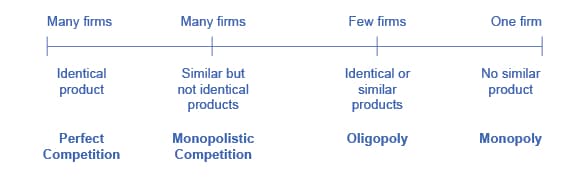
Perfect competition is a market structure where many firms sell identical products, with no barriers to entry or exit. Buyers and sellers have perfect information, and no single participant can influence prices. This creates a level playing field where firms must be efficient to survive.
Because firms are price-takers, they maximize profit by producing where marginal revenue equals marginal cost. In the long run, equilibrium occurs when all firms earn zero economic profit (also called normal profit). This structure promotes market efficiency and pushes firms toward cost-effective production.

Top images from around the web for Characteristics of perfect competition
Perfect Competition – Introduction to Microeconomics View original
Is this image relevant?
Why It Matters: Perfect Competition | Microeconomics View original
Is this image relevant?
Perfect Competition – Introduction to Microeconomics View original
Is this image relevant?
Perfect Competition – Introduction to Microeconomics View original
Is this image relevant?
Why It Matters: Perfect Competition | Microeconomics View original
Is this image relevant?
Characteristics of Perfect Competition
Five conditions define a perfectly competitive market. If any of these breaks down, you're dealing with a different market structure.
- Large number of buyers and sellers. No single buyer or seller is big enough to move the market price. Each firm's output is a tiny fraction of total supply.
- Homogeneous products. All firms sell identical goods with zero product differentiation. Think commodities like wheat or crude oil. A buyer has no reason to prefer one seller over another.
- Free entry and exit. Firms can enter or leave the industry in the long run without facing barriers like patents, licenses, or massive startup costs. This is what drives long-run profits to zero.
- Perfect information. All participants have complete knowledge of prices, product quality, and production techniques. No firm can charge above market price because buyers would instantly switch.
- Price-taking behavior. Because of all the conditions above, each firm accepts the market price as given. A single firm that tried to raise its price would lose all its customers.

Firm Responses in Perfect Competition
Short-run profit maximization follows one core rule: produce the quantity where marginal revenue (MR) equals marginal cost (MC).
That equation holds because in perfect competition, the firm's demand curve is perfectly horizontal at the market price. Every additional unit sells for the same price, so marginal revenue is the price.
But what if the market price is too low to cover costs? Firms face three scenarios in the short run:
- Price ≥ ATC: The firm earns economic profit (or breaks even if price equals ATC). It keeps producing.
- AVC ≤ Price < ATC: The firm loses money but still covers its variable costs. It's better to keep operating in the short run than to shut down, because shutting down means losing all fixed costs anyway. The firm minimizes its losses by staying open.
- Price < AVC: The firm shuts down production immediately. At this point, it loses less money by closing than by continuing to operate.
Long-run equilibrium is where the entry and exit mechanism kicks in:
- When existing firms earn economic profits, new firms enter the market. This increases supply, which pushes the market price down.
- When firms incur losses, some exit the market. This decreases supply, which pushes the market price up.
- The process continues until price equals the minimum of average total cost (ATC). At that point, every firm earns zero economic profit, and there's no incentive for entry or exit.
Market equilibrium is established where market supply and demand intersect, determining both the price every firm takes and the total quantity traded.

Economic Profit in Perfect Competition
Economic profit is the difference between total revenue and total economic costs. Total economic costs include both explicit and implicit costs:
- Explicit costs are actual out-of-pocket payments for inputs like wages, rent, and materials.
- Implicit costs represent the opportunity cost of using resources you already own. For example, if you invest $100,000 of your own money into a business, the interest you could have earned elsewhere is an implicit cost.
Normal profit occurs when economic profit equals zero. This doesn't mean the firm is making no money. It means total revenue exactly covers all costs, including the owner's opportunity costs. Normal profit is the minimum return needed to keep the firm's resources in their current use.
Economic profit is the signal that drives the long-run adjustment process:
- Positive economic profit attracts new firms into the market.
- Negative economic profit (losses) causes firms to exit.
- Over time, entry and exit push economic profit to zero for all firms.
- The result: firms produce at the lowest possible average total cost, and resources flow to where they're valued most.
Market Efficiency and Competition
Perfect competition achieves two types of efficiency:
- Allocative efficiency: Price equals marginal cost (), so the quantity produced matches what consumers value. Resources aren't wasted on goods people don't want at that cost.
- Productive efficiency: In the long run, firms produce at the minimum of their ATC curve. Any firm with higher costs gets driven out by competition.
Because products are identical, firms can't compete on branding or features. The only way to gain an edge is through cost efficiency, whether that means adopting better technology, improving production processes, or achieving economies of scale. This constant pressure to cut costs is what makes perfect competition a benchmark for how markets can allocate resources efficiently.
See Fiveable more often in Google
Mark Fiveable as a preferred source and Google is more likely to show you our guides in Top Stories, with a "preferred" badge in AI Mode and AI Overviews.