24.6 Keynes’ Law and Say’s Law in the AD/AS Model

💸Principles of Economics Unit 24 Review
24.6 Keynes’ Law and Say’s Law in the AD/AS Model
💸 Principles of Economics
Keynes' Law and Say's Law in the AD/AS Model
Keynes' Law and Say's Law offer two competing views of what drives the economy. Say's Law holds that "supply creates its own demand," meaning production itself generates enough income to purchase everything produced. Keynes' Law argues the reverse: "demand creates its own supply," meaning the level of spending in the economy determines how much gets produced. The AD/AS model connects these two perspectives by showing that each law applies best in a different zone of the economy.
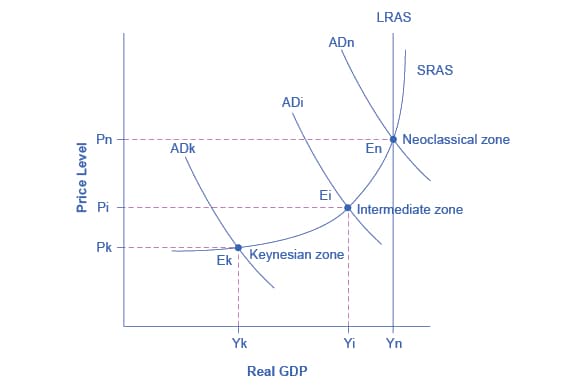
The AD/AS model divides the economy into three zones: Keynesian, Intermediate, and Neoclassical. Each zone captures a different relationship between aggregate demand, output, and prices, and each has different implications for policy.

Top images from around the web for Neoclassical, Intermediate, and Keynesian Zones
AD-AS Model Explained | EconProph View original
Is this image relevant?
Keynes’ Law and Say’s Law in the AD/AS Model · Economics View original
Is this image relevant?
Aggregate Demand in Keynesian Analysis | OpenStax Macroeconomics 2e View original
Is this image relevant?
AD-AS Model Explained | EconProph View original
Is this image relevant?
Keynes’ Law and Say’s Law in the AD/AS Model · Economics View original
Is this image relevant?
Neoclassical, Intermediate, and Keynesian Zones
Keynesian Zone (flat portion of SRAS)
This is where Keynes' Law dominates. The economy is operating far below potential GDP, with high unemployment and plenty of idle factories and equipment. Because so many resources are sitting unused, firms can ramp up production without bidding up wages or input prices.
- The SRAS curve is nearly horizontal in this zone
- Changes in aggregate demand affect real GDP and employment with little to no change in the price level
- Think of it this way: if you have a restaurant with 50 empty tables, seating 10 more customers doesn't require raising prices
Intermediate Zone (upward-sloping portion of SRAS)
This is the transition between the Keynesian and Neoclassical zones. The economy has some slack, but resources are starting to get tighter.
- The SRAS curve slopes upward here
- Changes in aggregate demand affect both real GDP and the price level
- As demand increases, firms hire more workers and expand output, but they also start facing higher input costs, which pushes prices up
Neoclassical Zone (vertical portion at potential GDP)
This is where Say's Law dominates. The economy is at or near full employment output (potential GDP), and all resources are being utilized efficiently.
- The LRAS curve is vertical at potential GDP
- Changes in aggregate demand affect only the price level, not real GDP, because the economy can't produce beyond its capacity in the long run
- More spending just bids up prices rather than creating more output

Diagnosing Economic States and Policy Implications
Recessionary Gap
A recessionary gap exists when equilibrium output falls below potential GDP. Resources are underutilized, unemployment is above the natural rate, and inflation is low or possibly negative (deflation).
- Policy response: expansionary measures to boost aggregate demand
- Fiscal policy: increase government spending or cut taxes
- Monetary policy: lower interest rates to encourage borrowing and investment
- The economy is operating in the Keynesian or Intermediate zone, so increasing AD raises output without causing much inflation
Inflationary Gap
An inflationary gap exists when equilibrium output exceeds potential GDP. The economy is overheating, unemployment is below the natural rate, and inflation is accelerating.
- Policy response: contractionary measures to reduce aggregate demand
- Fiscal policy: cut government spending or raise taxes
- Monetary policy: raise interest rates to discourage borrowing and cool spending
- The economy is operating in or near the Neoclassical zone, so the excess demand is mostly pushing up prices rather than increasing real output
Long-Run Equilibrium
Long-run equilibrium occurs when actual output equals potential GDP. The economy experiences the natural rate of unemployment (which includes frictional and structural unemployment but not cyclical) and stable inflation.
- Policy focus: maintain stability, or pursue supply-side policies to expand potential GDP over time (investing in education, infrastructure, and research and development)

Shifts in Aggregate Demand and Supply
Shifts in Aggregate Demand (AD)
A rightward shift means more total spending at every price level. A leftward shift means less.
- Rightward shift in AD can be caused by:
- Rising consumer confidence or wealth (higher consumption)
- Lower interest rates or an optimistic business outlook (higher investment)
- Increased government spending (expansionary fiscal policy)
- Stronger foreign demand or a weaker domestic currency (higher net exports)
- Result: higher output, higher employment, and a higher price level
- Leftward shift in AD can be caused by:
- Falling consumer confidence or higher taxes (lower consumption)
- Higher interest rates or a pessimistic business outlook (lower investment)
- Reduced government spending (contractionary fiscal policy)
- Weaker foreign demand or a stronger domestic currency (lower net exports)
- Result: lower output, lower employment, and a lower price level
Shifts in Short-Run Aggregate Supply (SRAS)
A rightward shift means firms can produce more at every price level. A leftward shift means they produce less.
- Rightward shift in SRAS can be caused by:
- Productivity gains from new technology or improved efficiency
- Lower input prices (e.g., falling oil prices, reduced labor costs)
- Favorable supply shocks (e.g., a strong harvest)
- Result: higher output and employment, lower price level
- Leftward shift in SRAS can be caused by:
- Rising input prices (e.g., an oil price spike, higher wages)
- Adverse supply shocks (e.g., natural disasters, trade disruptions)
- Result: lower output and employment, higher price level (this combination is called stagflation)
Shifts in Long-Run Aggregate Supply (LRAS)
LRAS shifts reflect changes in the economy's productive capacity, or potential GDP.
- Rightward shift in LRAS can be caused by:
- Growth in factors of production: more labor (population growth, immigration), more capital (investment in equipment and infrastructure), new natural resources
- Technological progress that permanently raises productivity
- Result: higher potential GDP
- Leftward shift in LRAS can be caused by:
- Shrinking factors of production (aging population, capital depreciation without replacement)
- Technological regress or institutional decline
- Result: lower potential GDP
The key takeaway connecting everything: where the economy sits on the SRAS curve determines whether Keynes' Law or Say's Law better describes reality. In a deep recession (Keynesian zone), boosting demand is what matters most. At full employment (Neoclassical zone), the economy's productive capacity is the binding constraint, and more demand just raises prices.
See Fiveable more often in Google
Mark Fiveable as a preferred source and Google is more likely to show you our guides in Top Stories, with a "preferred" badge in AI Mode and AI Overviews.