23.4 The National Saving and Investment Identity

💸Principles of Economics Unit 23 Review
23.4 The National Saving and Investment Identity
💸 Principles of Economics
The National Saving and Investment Identity
The national saving and investment identity is an accounting relationship that connects a country's trade balance to its domestic saving and investment decisions. It tells you something powerful: a trade deficit isn't just about what a country buys and sells abroad. It's also a reflection of how much the country saves versus how much it invests. Understanding this identity helps you see why trade balances, government budgets, and capital flows are all intertwined.

Top images from around the web for Trade Balance and Current Account
Exchange-Rate Policies | Macroeconomics View original
Is this image relevant?
Trade Balances and Flows of Financial Capital – Principles of Economics: Scarcity and Social ... View original
Is this image relevant?
Trade Balances in Historical and International Context | OpenStax Macroeconomics 2e View original
Is this image relevant?
Exchange-Rate Policies | Macroeconomics View original
Is this image relevant?
Trade Balances and Flows of Financial Capital – Principles of Economics: Scarcity and Social ... View original
Is this image relevant?
Trade Balance and Current Account
The trade balance is simply exports minus imports of goods and services. When exports exceed imports, you have a trade surplus. When imports exceed exports, you have a trade deficit.
The current account is a broader measure. It includes the trade balance plus net income from abroad (interest and dividends earned on foreign assets) and net current transfers (like foreign aid and remittances). For most countries, the trade balance is the largest component, so the two measures tend to move together.
Several factors determine whether a country runs a surplus or deficit:
- Exchange rates shift the relative price of goods across borders. When a country's currency appreciates, its exports become more expensive to foreign buyers and imports become cheaper for domestic consumers, pushing the trade balance toward deficit. Japan experienced this during the yen's appreciation in the 1990s. The reverse happens with depreciation: cheaper exports and pricier imports push the balance toward surplus.
- Domestic income levels affect import demand. During the U.S. economic boom of the 1990s, rising incomes pulled in more imports and widened the trade deficit. During the 2008–2009 recession, falling incomes reduced import spending.
- Foreign income levels affect export demand. As China's economy grew rapidly, U.S. exports to China increased. When Europe entered recession in 2012–2013, demand for U.S. exports fell.
- Trade policies like tariffs, quotas, and subsidies directly alter trade flows. The 2018 U.S. tariffs on imported steel aimed to reduce imports, while the European Union's Common Agricultural Policy subsidizes agricultural exports to boost them.

International Financial Capital Flows
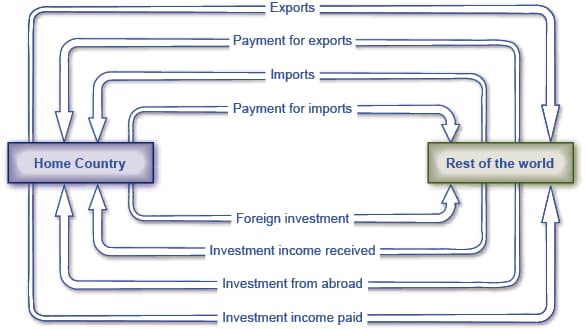
Capital flows across borders for the same basic reason goods do: people seek the best return for their money. These flows are the financial mirror of the trade balance. A country running a trade deficit is, by definition, receiving a net inflow of foreign financial capital. A country running a trade surplus is sending capital abroad.
Demand-side factors (what pulls capital into a country):
- Investment opportunities with higher expected returns attract foreign capital. High-growth emerging markets like India and Brazil have drawn significant foreign investment for this reason.
- Economic growth prospects signal future profitability. China's rapid growth in the 2000s made it a magnet for foreign investors.
- Political and economic stability reduces risk. Developed countries like the U.S. and Germany attract capital partly because investors trust their institutions.
Supply-side factors (what makes capital available to flow):
- Domestic saving rates determine how much capital a country has available to invest abroad. Japan's high saving rate in the 1980s generated large outflows of capital to other countries.
- Interest rates influence where investors park their money. High U.S. interest rates in the 1980s attracted foreign capital because returns on U.S. assets were relatively attractive.
- Financial market development makes it easier for capital to move. London and New York serve as global financial centers partly because their deep, liquid markets reduce transaction costs.
- Capital controls can restrict these flows. China's capital controls, for example, limit how freely foreign investors can move money in and out of the country.

Domestic Saving, Investment, and Trade
Here's where everything comes together. The national saving and investment identity is:
Where:
- = Exports
- = Imports
- = Private saving
- = Private investment
- = Tax revenue
- = Government spending
The left side is the trade balance. The right side has two components: the private saving-investment balance and the government budget balance . Together, equals national saving minus domestic investment.
This identity isn't a theory or a prediction. It's an accounting fact that always holds true. And it leads to two clean conclusions:
- A trade surplus occurs when national saving exceeds domestic investment. The extra saving flows abroad.
- A trade deficit occurs when domestic investment exceeds national saving. The country borrows from abroad to fill the gap.
Each component of the identity matters:
- Private saving (): Higher private saving increases national saving and pushes the trade balance toward surplus. Singapore's consistently high saving rate helps explain its persistent trade surpluses. The U.S., with a comparatively low saving rate, has run trade deficits for decades.
- Private investment (): Higher investment spending means the country needs more funds. If saving doesn't rise to match, the gap is filled by foreign capital, and the trade deficit widens. Australia's investment boom is a good example of this dynamic producing trade deficits. Conversely, Japan's low domestic investment contributed to its trade surpluses.
- Government budget (): A budget surplus adds to national saving, pushing the trade balance toward surplus. Germany's budget surpluses have coincided with large trade surpluses. A budget deficit subtracts from national saving, pushing the trade balance toward deficit. This is sometimes called the twin deficits hypothesis: budget deficits and trade deficits tend to move together, as the U.S. has often demonstrated.
The key takeaway is that you can't fully understand a country's trade balance by looking only at trade policies or exchange rates. The saving and investment identity shows that the trade balance is ultimately shaped by how much a nation saves relative to how much it invests, including the government's fiscal position.
See Fiveable more often in Google
Mark Fiveable as a preferred source and Google is more likely to show you our guides in Top Stories, with a "preferred" badge in AI Mode and AI Overviews.