30.1 Government Spending

💸Principles of Economics Unit 30 Review
30.1 Government Spending
💸 Principles of Economics
Government Budgets
The U.S. government's budget reflects the balance between spending and revenue. Over recent decades, it has swung between deficits and surpluses depending on economic conditions, tax policies, and spending decisions. Understanding these trends is central to understanding fiscal policy.
Federal, state, and local budgets all fund public services, but they operate under different rules. The federal government can run deficits by borrowing, while most state and local governments are required to balance their books annually. This difference shapes how each level of government manages its finances.

Top images from around the web for Federal Budget Deficit and Surplus Trends
Federal Deficits and the National Debt | OpenStax Macroeconomics 2e View original
Is this image relevant?
United States federal budget - Wikipedia View original
Is this image relevant?
United States federal budget - Wikipedia View original
Is this image relevant?
Federal Deficits and the National Debt | OpenStax Macroeconomics 2e View original
Is this image relevant?
United States federal budget - Wikipedia View original
Is this image relevant?
Federal Budget Deficit and Surplus Trends
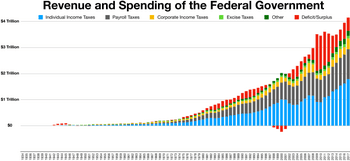
A budget deficit occurs when government spending exceeds tax revenue in a given year. A budget surplus is the opposite: revenue exceeds spending. The difference between the two is straightforward, but the forces that push the budget in each direction are worth understanding.
The U.S. has experienced both in recent decades. The late 1990s produced federal budget surpluses, but the government has run a deficit every year since 2001.
Factors that push toward deficits:
- Economic downturns reduce tax revenue (fewer people working, lower corporate profits) while simultaneously increasing spending on social programs like unemployment benefits and welfare
- Tax cuts reduce incoming revenue. The Bush tax cuts of 2001 and 2003 are a major example.
- Increased spending on large programs such as defense (Iraq and Afghanistan wars), healthcare (Medicare Part D, added in 2003), and Social Security (growing costs as the population ages)
Factors that push toward surpluses:
- Economic growth increases tax revenue as incomes and profits rise. The dot-com boom of the late 1990s drove the surpluses of that era.
- Tax increases boost revenue. The Clinton tax increases of 1993 contributed to the late-1990s surpluses.
- Reduced spending, such as post-Cold War defense cuts in the 1990s

Federal vs. State/Local Government Budgets
The federal budget is the financial plan for the entire U.S. federal government, covering spending and revenue at the national level. A key feature: the federal government can run budget deficits by borrowing money, primarily by issuing Treasury bonds.
State and local government budgets are financial plans for individual states, cities, and counties. They cover spending and revenue within their respective jurisdictions. Most state and local governments are legally required to balance their budgets annually, meaning they cannot run persistent deficits the way the federal government can.
The federal government also provides funding to state and local governments through grants and programs. This funding is typically earmarked for specific purposes, such as education (Title I grants for schools in low-income areas) and infrastructure (federal highway funding).

Major Components of Federal Government Spending
Federal spending falls into three main categories: mandatory spending, discretionary spending, and interest on the national debt.
Mandatory spending consists of programs required by law. Congress doesn't vote on these amounts each year; spending is determined by eligibility rules and benefit formulas.
- Social Security provides retirement, disability, and survivor benefits (about trillion in 2021)
- Medicare provides health insurance for people 65 and older and some people with disabilities ( billion in 2021)
- Medicaid provides health insurance for low-income individuals and families ( billion in 2021)
- Other mandatory programs include income security programs (SNAP, TANF), veterans' benefits, and agricultural subsidies
Mandatory spending is the largest share of the federal budget, and it grows automatically as more people become eligible for programs like Social Security and Medicare.
Discretionary spending is determined annually through the congressional budget process.
- Defense spending funds military operations, equipment, and personnel ( billion in 2021)
- Non-defense discretionary spending funds a wide range of programs and agencies:
- Education (Pell Grants, Title I)
- Transportation (highway funding, airport improvement grants)
- Science and research (NIH, NSF)
- Foreign aid (USAID, State Department programs)
- Environmental protection (EPA)
Interest on the national debt covers the cost of borrowing to fund past deficits ( billion in 2021). This category is notable because the government has no choice but to pay it, and it grows as the total debt increases or as interest rates rise.
The key distinction to remember: mandatory spending is set by existing law and runs on autopilot, while discretionary spending requires annual approval from Congress. Interest payments are obligatory and depend on how much the government has borrowed.
See Fiveable more often in Google
Mark Fiveable as a preferred source and Google is more likely to show you our guides in Top Stories, with a "preferred" badge in AI Mode and AI Overviews.