20.4 Economic Convergence

💸Principles of Economics Unit 20 Review
20.4 Economic Convergence
💸 Principles of Economics
Economic Growth and Convergence
Economic convergence is the idea that poorer countries can grow faster than richer ones, gradually closing the income gap over time. Understanding convergence helps explain why some nations have rapidly industrialized while others remain stuck in poverty, and it connects directly to debates about trade policy, foreign aid, and institutional reform.

Top images from around the web for High-Income vs Low-Income Nations
File:1 AD to 2003 AD Historical Trends in global distribution of GDP China India Western Europe ... View original
Is this image relevant?
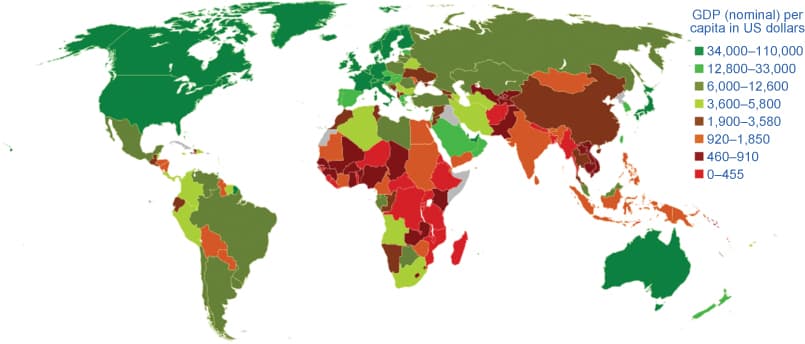
The Diversity of Countries and Economies across the World | OpenStax Macroeconomics 2e View original
Is this image relevant?
Economic Growth - Our World In Data View original
Is this image relevant?
File:1 AD to 2003 AD Historical Trends in global distribution of GDP China India Western Europe ... View original
Is this image relevant?
The Diversity of Countries and Economies across the World | OpenStax Macroeconomics 2e View original
Is this image relevant?
High-Income vs. Low-Income Nations
High-income and low-income countries tend to grow in fundamentally different ways.
High-income nations typically see annual growth rates around 2–3%. They're already near the technological frontier, meaning most of the "easy" gains from adopting existing technology have already been made. Further growth depends on innovation: developing new technologies, improving processes, and pushing productivity into uncharted territory.
Low-income nations have the potential for much higher annual growth rates, often in the 5–10% range. This is sometimes called catch-up growth. Instead of inventing new technologies, these countries can adopt what already exists elsewhere. A factory in a developing country doesn't need to reinvent modern manufacturing; it can import the machinery and techniques that high-income countries spent decades developing. Growth in these economies is also driven by accumulating physical capital (machinery, roads, power plants) and improving worker productivity.
The key insight behind convergence: it's easier to copy and adopt than to invent from scratch. That's why low-income countries can grow faster, though whether they actually do depends on many other factors.

Factors That Promote Convergence
- Technology transfer and diffusion: Low-income countries can import or license technologies rather than developing them independently. Foreign direct investment often brings new production methods along with it.
- Trade and globalization: Access to global markets increases competition, allows countries to specialize based on comparative advantage, and exposes domestic firms to better practices.
- Human capital investment: Spending on education and skill development raises labor productivity. A more educated workforce can adopt and use new technologies more effectively.
- Institutional quality: Strong property rights, rule of law, and transparent governance create a stable environment where businesses are willing to invest and grow.

Factors That Hinder Convergence
Not all low-income countries actually catch up. Several barriers can stall or reverse progress:
- Corruption and weak governance lead to inefficient resource allocation. When government contracts go to political allies rather than the best firms, productivity suffers.
- Lack of infrastructure in transportation, energy, communication, and water supply raises the cost of doing business and limits what firms can produce.
- Political instability and conflict deter both domestic and foreign investment. It's hard to build a factory in a war zone.
- Geographic disadvantages: Landlocked countries face higher trade costs. Countries dependent on a narrow range of commodity exports can fall into the natural resource curse, where resource wealth distorts the economy and discourages diversification.
Convergence Speed
How fast convergence happens depends on the growth rate differential between countries. A larger gap in growth rates means faster catch-up, all else being equal.
The Solow growth model provides the theoretical foundation:
- Diminishing returns to capital: Each additional unit of capital (say, another machine) adds less output than the one before it. This is why capital-rich countries grow more slowly from additional investment.
- Steady-state equilibrium: Every economy tends toward a steady-state level of output per capita, determined by its savings rate, population growth rate, and rate of technological progress.
- Convergence prediction: Countries with similar underlying characteristics should converge to the same steady state over time.
Rule of 70 gives a quick way to estimate how long it takes for income to double:
A country growing at 7% per year doubles its income in about 10 years (). A country growing at 2% takes 35 years (). That difference compounds dramatically over decades.
Conditional vs. Absolute Convergence
This distinction matters for exams. Absolute convergence would mean all poor countries automatically catch up to rich ones simply because they're poor. The evidence doesn't support this.
What economists observe instead is conditional convergence: countries converge to the same steady state only if they share similar characteristics like institutions, policies, savings rates, and human capital levels. Two countries with similar governance and education systems but different income levels will tend to converge. But a country with weak institutions and low investment in education may never catch up, regardless of how poor it is.
This is why convergence is not guaranteed. The "potential" for faster growth exists, but realizing it requires the right conditions.
See Fiveable more often in Google
Mark Fiveable as a preferred source and Google is more likely to show you our guides in Top Stories, with a "preferred" badge in AI Mode and AI Overviews.