30.5 Automatic Stabilizers

💸Principles of Economics Unit 30 Review
30.5 Automatic Stabilizers
💸 Principles of Economics
Fiscal Policy and Automatic Stabilizers
Governments use fiscal policy to influence the overall economy through changes in spending and taxation. These tools affect aggregate demand, which in turn shapes output, employment, and price levels. Fiscal policy comes in two forms: discretionary actions that require deliberate decisions, and automatic stabilizers that respond to economic conditions on their own.

Top images from around the web for Discretionary Fiscal Policies
Putting It Together: Fiscal Policy | Macroeconomics View original
Is this image relevant?
The Keynesian School – Introduction to Macroeconomics View original
Is this image relevant?
Expansionary and Contractionary Fiscal Policy | Macroeconomics with Prof. Dolar View original
Is this image relevant?
Putting It Together: Fiscal Policy | Macroeconomics View original
Is this image relevant?
The Keynesian School – Introduction to Macroeconomics View original
Is this image relevant?
Discretionary Fiscal Policies
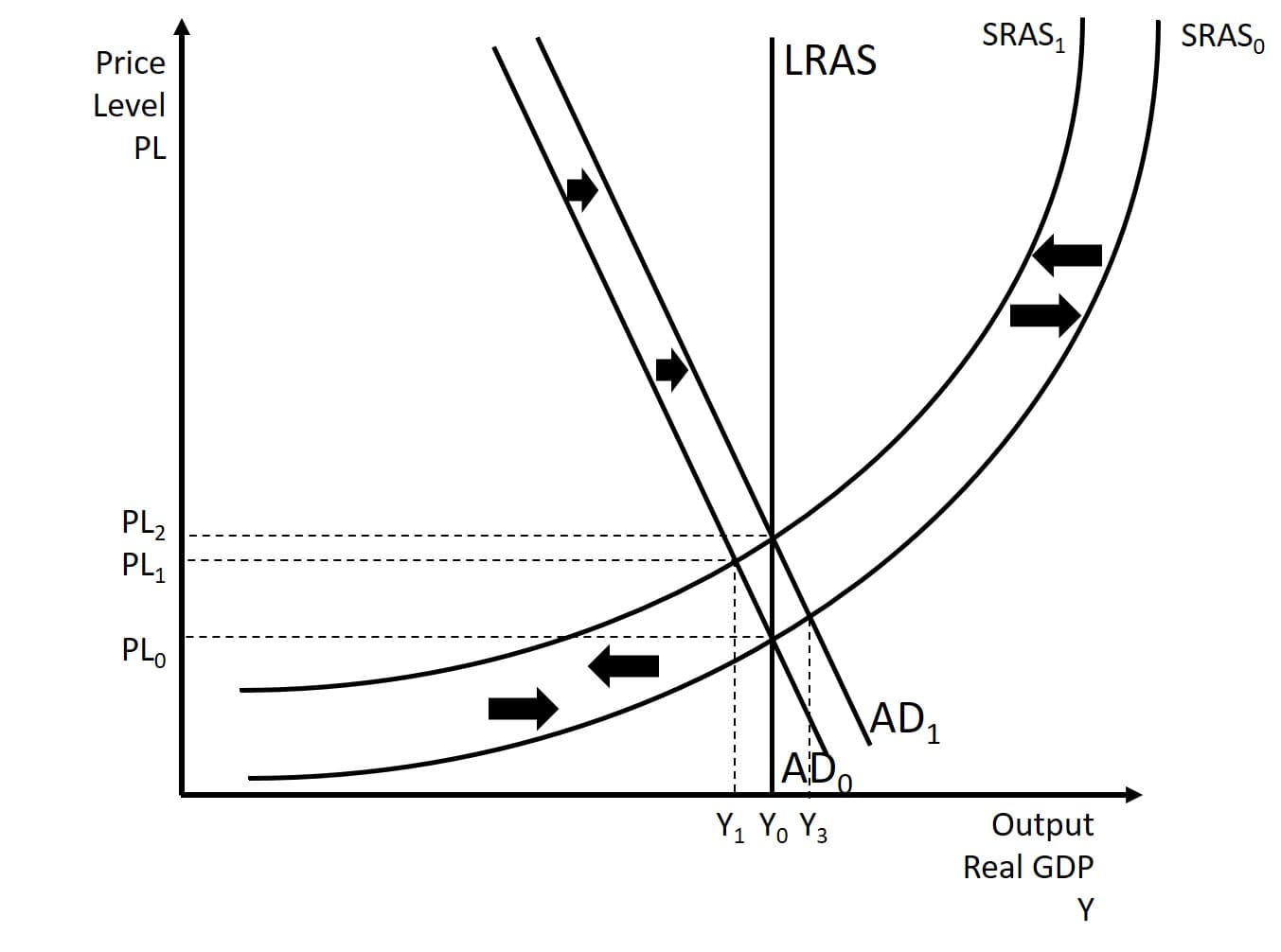
Discretionary fiscal policy refers to deliberate changes in government spending or taxes designed to shift aggregate demand. There are two directions it can go:
- Expansionary fiscal policy is used during a recession. The government increases spending (on infrastructure, public services, etc.) or cuts taxes to put more money in people's pockets. Both actions boost disposable income and consumption, shifting aggregate demand to the right.
- Contractionary fiscal policy is used when inflation is running too high. The government decreases spending or raises taxes, which pulls disposable income down and reduces aggregate demand.
A major drawback of discretionary policy is the time it takes to work. Three lags slow the process:
- Recognition lag — It takes time to identify that the economy actually needs intervention.
- Decision lag — Congress or the relevant body must debate and pass the appropriate policy.
- Impact lag — Even after a policy is enacted, it takes time for spending or tax changes to ripple through the economy.
These lags are a big reason why automatic stabilizers matter so much.

Automatic Stabilizers
Automatic stabilizers are built-in features of the tax and transfer system that cushion the economy during booms and busts without requiring any new legislation. They work because their size naturally changes as economic conditions change.
Progressive income taxes are the clearest example. During an expansion, rising incomes push households into higher tax brackets, which takes a larger share of each additional dollar earned. That slows down spending growth and helps prevent the economy from overheating. During a recession, the reverse happens: falling incomes mean lower tax bills, which leaves households with relatively more disposable income and softens the downturn.
Unemployment insurance and welfare benefits work from the spending side. When the economy contracts, more workers lose jobs and qualify for unemployment benefits. That income keeps them spending on necessities, which supports aggregate demand. When the economy recovers and people find work again, fewer people collect benefits, and government transfer spending naturally falls.
Corporate income taxes follow a similar pattern. Corporations pay more tax when profits are high (expansion) and less when profits shrink (recession), which automatically moderates swings in business spending.
The key idea: automatic stabilizers reduce disposable income during expansions and increase it during recessions, dampening the severity of the business cycle in both directions.

Standardized Employment Budget
The standardized employment budget (SEB) is the budget deficit or surplus that would exist if the economy were operating at full employment. It strips out the effects of automatic stabilizers so you can see the government's underlying fiscal stance.
Here's why that matters: during a recession, the actual budget deficit grows automatically (tax revenue falls, transfer payments rise) even if the government hasn't changed any policy. The SEB lets you separate that automatic effect from any deliberate policy choices.
Comparing the actual budget to the SEB tells you what automatic stabilizers are doing:
- If the actual deficit is larger than the SEB deficit, automatic stabilizers are widening the deficit. This signals the economy is below full employment (a recessionary gap).
- If the actual deficit is smaller than the SEB deficit, automatic stabilizers are narrowing the deficit. This signals the economy is above full employment (an inflationary gap).
The size of the automatic stabilizer effect is simply the difference between the two:
For example, if the actual budget shows a deficit of $500 billion and the SEB shows a deficit of $300 billion, the automatic stabilizers account for $200 billion of the actual deficit, indicating the economy is operating below full employment.
See Fiveable more often in Google
Mark Fiveable as a preferred source and Google is more likely to show you our guides in Top Stories, with a "preferred" badge in AI Mode and AI Overviews.