28.1 The Federal Reserve Banking System and Central Banks

💸Principles of Economics Unit 28 Review
28.1 The Federal Reserve Banking System and Central Banks
💸 Principles of Economics
The Federal Reserve System
The Federal Reserve System is the central bank of the United States. It manages the nation's money supply, regulates banks, and works to keep the financial system stable. Its decisions shape interest rates, inflation, and employment at the national level.

Top images from around the web for Structure and Organization
Introducing the Federal Reserve | Boundless Economics View original
Is this image relevant?
Talk:Structure of the Federal Reserve System - Wikipedia, the free encyclopedia View original
Is this image relevant?
Introducing the Federal Reserve | Boundless Economics View original
Is this image relevant?
Introducing the Federal Reserve | Boundless Economics View original
Is this image relevant?
Talk:Structure of the Federal Reserve System - Wikipedia, the free encyclopedia View original
Is this image relevant?
Structure and Organization
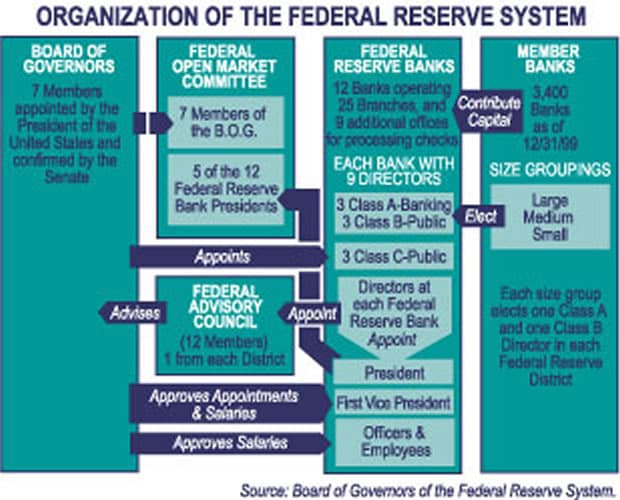
Congress created the Federal Reserve in 1913 through the Federal Reserve Act to provide a safer, more flexible financial system. The Fed is structured around three key entities:
- Board of Governors — Seven members based in Washington, D.C., appointed by the President and confirmed by the Senate. Each serves a 14-year term, which insulates them from short-term political pressure. The Board oversees the entire Federal Reserve System.
- 12 Federal Reserve Banks — Regional banks located in major cities (New York, Chicago, San Francisco, etc.) that serve their geographic districts. They act as the operating arms of the Fed, providing services like check clearing and cash distribution to commercial banks in their region.
- Federal Open Market Committee (FOMC) — The Fed's primary policymaking body for monetary policy. It includes all seven Board members, the president of the New York Fed (who always has a vote because New York is the financial center), and four other Reserve Bank presidents who rotate in on a yearly basis.
One detail worth remembering: the Fed operates within the government but has decision-making autonomy from the President and Congress. This independence is designed to keep monetary policy focused on long-term economic health rather than short-term political goals.

Monetary Policy
The Fed's dual mandate is to pursue maximum employment and price stability, with a target inflation rate of around 2%. To hit these goals, the Fed uses several tools:
-
Open Market Operations (OMOs) — The most frequently used tool. The FOMC directs the buying or selling of U.S. Treasury securities on the open market.
- Buying securities → injects money into the banking system → increases money supply → pushes interest rates down
- Selling securities → pulls money out of the banking system → decreases money supply → pushes interest rates up
-
Federal Funds Rate — The interest rate banks charge each other for overnight loans. The FOMC sets a target for this rate, and open market operations are the main mechanism used to reach that target. Changes in the federal funds rate ripple outward, affecting rates on mortgages, car loans, credit cards, and business borrowing.
-
Reserve Requirements — The minimum percentage of deposits that banks must hold in reserve (rather than lend out). Raising the requirement shrinks the money available for lending; lowering it expands it. (Note: in 2020, the Fed reduced reserve requirements to 0%, so this tool is less prominent today.)
-
Discount Rate — The interest rate the Fed charges commercial banks for short-term loans directly from the Fed. Banks typically borrow from each other first (at the federal funds rate), so the discount rate acts more as a ceiling and a backup.
-
Forward Guidance — The Fed communicates its future policy intentions through press conferences, speeches, and official statements. Markets react not just to what the Fed does but to what it signals it will do, so clear communication is itself a policy tool.

Roles of the Federal Reserve
Financial Stability and Banking Services
Beyond setting monetary policy, the Fed plays several other critical roles:
- Lender of Last Resort — During financial crises, banks can face sudden shortages of cash even if they're fundamentally solvent. The Fed can step in and provide emergency liquidity, preventing bank failures from cascading through the system. This function was heavily used during the 2008 financial crisis.
- Supervision and Regulation — The Fed oversees banks to ensure they operate safely and soundly. This includes conducting stress tests, which simulate worst-case economic scenarios to check whether banks hold enough capital to survive a downturn. The Fed also enforces consumer protection laws.
- Payment Systems — The Fed operates and oversees systems that move money between banks. Fedwire handles large-value, time-sensitive transactions (think interbank transfers worth millions), while the Automated Clearing House (ACH) processes high volumes of smaller transactions like direct deposits and bill payments.
- Economic Research and Data — Each Reserve Bank conducts research and publishes data on regional and national economic conditions. This information supports the FOMC's policy decisions and helps the public understand economic trends.
- International Cooperation — The Fed coordinates with other central banks and international organizations like the Bank for International Settlements (BIS) and the G7 to promote global financial stability and respond to cross-border crises.
See Fiveable more often in Google
Mark Fiveable as a preferred source and Google is more likely to show you our guides in Top Stories, with a "preferred" badge in AI Mode and AI Overviews.