32.4 Causes of Inflation in Various Countries and Regions

💸Principles of Economics Unit 32 Review
32.4 Causes of Inflation in Various Countries and Regions
💸 Principles of Economics
Causes and Effects of Inflation
Inflation is a sustained increase in the general price level of goods and services over time. Understanding what drives inflation matters because different causes call for different policy responses. The three main types are demand-pull, cost-push, and monetary inflation.

Top images from around the web for Demand-pull, Cost-push, Monetary
Monetary Policy and Interest Rates | Macroeconomics with Prof. Dolar View original
Is this image relevant?
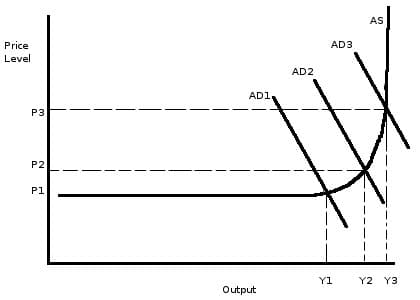
Cost of Living | Boundless Economics View original
Is this image relevant?
AD–AS model - Wikipedia View original
Is this image relevant?
Monetary Policy and Interest Rates | Macroeconomics with Prof. Dolar View original
Is this image relevant?
Cost of Living | Boundless Economics View original
Is this image relevant?
Demand-Pull, Cost-Push, and Monetary Inflation
Demand-pull inflation occurs when aggregate demand exceeds aggregate supply, pushing prices upward. Several factors can trigger it:
- Increased consumer spending from higher disposable income
- Expansionary fiscal policy (more government spending)
- Rising business investment driven by optimism about the future
The result is higher prices across the economy. In the short run, demand-pull inflation can actually coincide with economic growth, since businesses are producing more to meet that extra demand. The problem comes when demand outpaces the economy's capacity to produce.
Cost-push inflation starts on the supply side. When production costs rise, businesses pass those costs on to consumers through higher prices.
- Rising input prices (oil, raw materials) are a classic trigger. Think of how oil price spikes in the 1970s drove inflation across the globe.
- Higher labor costs from minimum wage increases or union negotiations
- New taxes, tariffs, or regulations that increase the cost of doing business
Unlike demand-pull inflation, cost-push inflation tends to slow the economy down. Businesses produce less because it's more expensive to operate, so you can end up with rising prices and falling output at the same time.
Monetary inflation happens when the money supply grows faster than real economic output. Too much money chasing too few goods drives prices up.
- Central banks can cause this by printing money (quantitative easing) or keeping interest rates too low for too long, which encourages excessive borrowing and spending.
- The increased money supply reduces the value of each unit of currency, which can also lead to currency devaluation relative to other countries.
A dramatic example: Zimbabwe in the late 2000s printed money to cover government deficits, and inflation peaked at an estimated 79.6 billion percent per month in November 2008.
Effects of inflation cut across the entire economy:
- Reduced purchasing power: The same amount of money buys fewer goods and services over time.
- Higher borrowing costs: Lenders charge higher interest rates to compensate for the fact that they'll be repaid in less valuable currency.
- Wealth redistribution: Inflation benefits debtors (who repay loans with depreciated money) at the expense of creditors (who receive less valuable repayments).
- Greater uncertainty: When future prices are hard to predict, businesses and individuals shift toward shorter-term thinking and reduce long-term investment.

Converging Economies and Inflation Experiences
Converging economies are developing countries that are catching up to developed nations in per capita income and living standards. China and India are prominent examples. These economies typically undergo major structural changes like industrialization (shifting from agriculture to manufacturing) and urbanization (large-scale rural-to-urban migration).
These structural shifts tend to produce higher inflation rates than you'd see in mature economies, for a few reasons:
- The Balassa-Samuelson effect: Productivity grows rapidly in the tradable sector (manufacturing, exports). That drives up wages in manufacturing, but those higher wages spill over into the non-tradable sector (services like haircuts, restaurants) where productivity hasn't risen as fast. The result is higher overall prices.
- Rising middle-class demand: As incomes grow, a new middle class demands higher wages and better living standards, adding to inflationary pressure.
- Rapid credit expansion: Fast-growing economies often see rapid lending growth, which can fuel demand beyond what the economy can supply.
Higher inflation in converging economies isn't automatically a bad sign. It can reflect genuine economic development and improving living standards. But it does create real policy challenges. Central banks have to balance supporting growth against the risk of the economy overheating. If inflation isn't well-managed, it can lead to asset price bubbles in housing or stock markets and broader economic instability.

Managing High Inflation
Countries facing persistent high inflation have several tools available, each with significant trade-offs.
Indexing, Dollarization, and Other Strategies
Indexing means adjusting prices, wages, or financial instruments automatically based on a price index like the Consumer Price Index (CPI). The goal is to protect purchasing power from being eroded by inflation.
Common examples of indexing:
- Cost-of-living adjustments (COLAs): Social Security payments in the U.S. are adjusted annually based on CPI changes.
- Inflation-indexed bonds: Treasury Inflation-Protected Securities (TIPS) adjust their principal value with inflation, so investors don't lose real value.
- Rent escalation clauses: Lease agreements that automatically raise rent in line with a price index.
Indexing helps individuals and businesses cope with inflation, but it has a downside: it can make inflation harder to stop. If every price and wage automatically adjusts upward, inflation becomes self-reinforcing.
Dollarization is when a country adopts a foreign currency (usually the U.S. dollar) as its official currency. Panama, Ecuador, and El Salvador have all fully dollarized.
The main benefit is stability. By tying the economy to a more stable currency, a country can anchor inflation expectations and reduce price volatility. However, the costs are significant:
- The country gives up independent monetary policy. It can no longer set its own interest rates or adjust the money supply to respond to domestic conditions.
- It loses seigniorage revenue, which is the profit a government earns from issuing its own currency.
- If the U.S. economy and the dollarized economy face different conditions, the imported monetary policy may be a poor fit.
Other strategies for managing high inflation:
- Tight monetary policy: The central bank raises interest rates to slow money supply growth. Higher rates make borrowing more expensive, which cools demand. This is the most common tool.
- Fiscal discipline: The government reduces budget deficits by cutting spending or raising taxes. Less government spending means less demand-side pressure on prices.
- Structural reforms: Addressing supply-side problems like poor infrastructure, excessive regulation, or low productivity through investment in education and technology. These reforms target cost-push inflation at its source.
Challenges in managing high inflation are real and often severe:
- Political and social resistance is common. Tight monetary and fiscal policies can slow growth and raise unemployment in the short term, making them deeply unpopular.
- There's a genuine risk of recession. Raising interest rates and cutting government spending both reduce demand, which can tip an economy into a downturn.
- Wage-price spirals are hard to break. When workers expect prices to keep rising, they demand higher wages. Businesses then raise prices to cover those wages, which confirms workers' expectations. This self-reinforcing cycle means that once high inflation becomes entrenched in people's expectations, bringing it down requires sustained and often painful policy action.
See Fiveable more often in Google
Mark Fiveable as a preferred source and Google is more likely to show you our guides in Top Stories, with a "preferred" badge in AI Mode and AI Overviews.