6.1 Consumption Choices

💸Principles of Economics Unit 6 Review
6.1 Consumption Choices
💸 Principles of Economics
Consumer Choice Theory
Consumer choice theory explains how people decide what to buy when they have limited income. It provides the foundation for understanding demand: why consumers buy certain quantities at certain prices, and why demand curves slope downward.

Top images from around the web for Total utility and consumer satisfaction
Consumer Choice and Utility | Microeconomics View original
Is this image relevant?
Consumer Choice and Utility | Microeconomics View original
Is this image relevant?
On the diminishing marginal utility of true beliefs View original
Is this image relevant?
Consumer Choice and Utility | Microeconomics View original
Is this image relevant?
Consumer Choice and Utility | Microeconomics View original
Is this image relevant?
Total Utility and Consumer Satisfaction
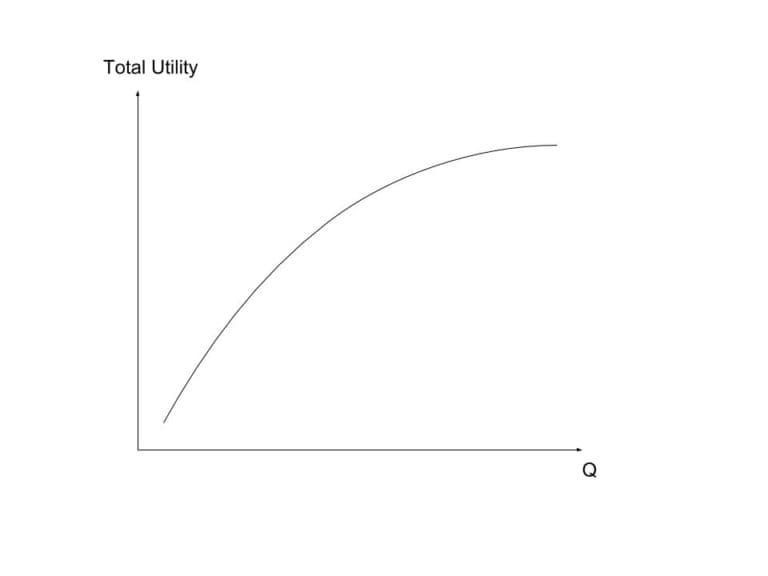
Total utility is the overall satisfaction a consumer gets from consuming a given quantity of a good or service. If you eat three slices of pizza and each one gives you some amount of satisfaction, your total utility is the sum of all that satisfaction combined.
You can express this with a formula:
where is the marginal utility of the -th unit consumed.
As you consume more of something, total utility generally increases. But it increases at a slower and slower rate. Your first scoop of ice cream adds a lot of satisfaction. Your fifth scoop still adds some, but not nearly as much. This pattern sets up one of the most important ideas in consumer theory: diminishing marginal utility.

Marginal Utility in Decision-Making
Marginal utility is the additional satisfaction gained from consuming one more unit of a good or service. It's calculated as:
where is the change in total utility and is the change in quantity consumed.
Marginal utility matters because consumers don't just ask "do I like this?" They ask "is this worth the price?" A candy bar and an apple might both cost $1, but if the candy bar gives you more additional satisfaction right now, that's the one you'll pick.
This logic extends across your entire budget. A rational consumer keeps spending on a good until the marginal utility per dollar spent on it equals the marginal utility per dollar spent on every other good. This is called the equimarginal principle (also known as the law of equimarginal utility), and it looks like this:
If a movie ticket costs $10 and gives you 20 utils of marginal utility, that's 2 utils per dollar. If snacks cost $5 and give you 10 utils, that's also 2 utils per dollar. You're in balance. But if the snacks gave you 15 utils per dollar spent, you'd be better off shifting some spending toward snacks until the ratios equalize.
This entire process is subject to the consumer's budget constraint, which limits total spending to available income.

Diminishing Marginal Utility's Influence
The law of diminishing marginal utility states that as you consume more of a good, each additional unit tends to give you less satisfaction than the one before it. The 10th slice of pizza is far less satisfying than the 1st.
This principle shapes consumer behavior in three important ways:
- It encourages diversification. Because the marginal utility of any single good drops as you consume more of it, you get more total satisfaction by spreading your spending across different goods. A balanced meal beats a plate of nothing but bread.
- It creates a natural stopping point. You'll stop consuming a good once its marginal utility falls below the price you're paying. If a fourth slice of pizza only gives you 50 cents worth of satisfaction but costs $2, you stop at three.
- It explains downward-sloping demand curves. Since each additional unit is worth less to you, you'll only buy more units if the price drops. When apples go on sale, the lower price makes it worthwhile to buy additional apples whose marginal utility is lower.
Diminishing marginal utility is ultimately why consumers make trade-offs. You don't spend your entire paycheck on one thing because the 20th unit of anything just isn't worth as much as the 1st unit of something else.
Consumer Decision-Making Framework
Rational choice theory assumes consumers make decisions to maximize their total utility given their preferences and their budget.
- Preferences can be represented by indifference curves, which show all the combinations of two goods that give a consumer the same level of satisfaction. Any point on a single indifference curve is equally appealing to the consumer.
- Every choice involves an opportunity cost: picking one option means giving up the next best alternative.
- The optimal consumption choice occurs where the consumer's budget constraint is tangent to the highest attainable indifference curve. At that point, the consumer is getting the most satisfaction possible from their income.
This tangency condition is just the graphical version of the equimarginal principle. At the optimal point, the rate at which the consumer is willing to trade one good for another (the slope of the indifference curve) equals the rate at which the market allows them to trade (the slope of the budget constraint, determined by relative prices).
See Fiveable more often in Google
Mark Fiveable as a preferred source and Google is more likely to show you our guides in Top Stories, with a "preferred" badge in AI Mode and AI Overviews.