7.3 Costs in the Short Run

💸Principles of Economics Unit 7 Review
7.3 Costs in the Short Run
💸 Principles of Economics
Costs and Production in the Short Run
In the short run, firms can only adjust some of their inputs. At least one factor of production is fixed (usually capital like machinery, equipment, or factory size), so the only way to change output is by adjusting variable inputs like labor and raw materials. This constraint creates predictable cost patterns that drive production decisions.

Top images from around the web for Production and costs in short run
Production Decisions in Perfect Competition | Boundless Economics View original
Is this image relevant?
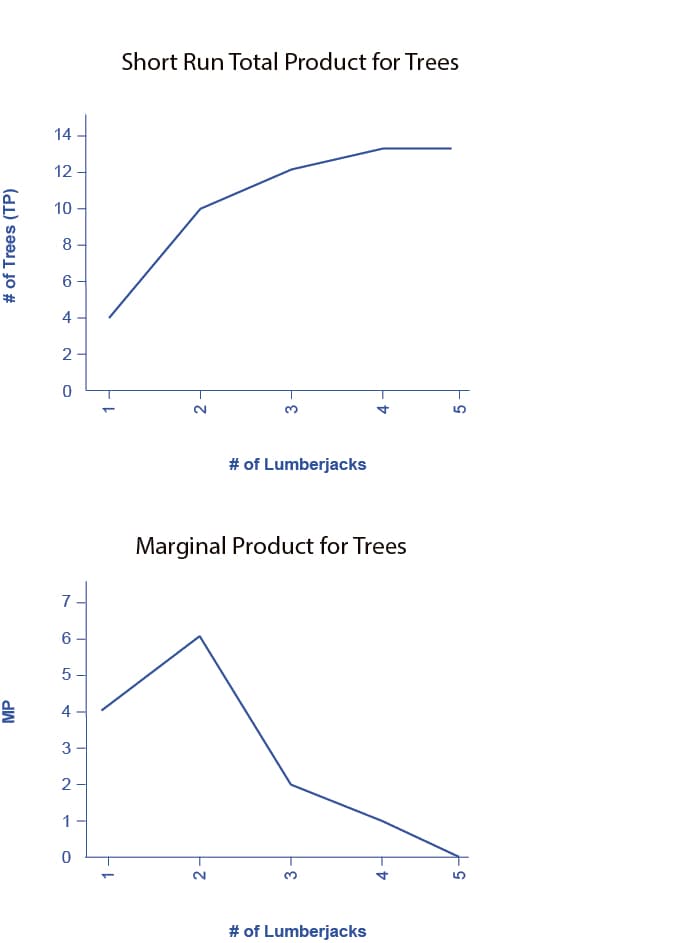
Production in the Short Run | OS Microeconomics 2e View original
Is this image relevant?
Production Cost | Boundless Economics View original
Is this image relevant?
Production Decisions in Perfect Competition | Boundless Economics View original
Is this image relevant?
Production in the Short Run | OS Microeconomics 2e View original
Is this image relevant?
Production and Costs in the Short Run
As production increases, costs increase too, because producing more output requires more variable inputs (more workers, more materials). But costs don't just rise steadily. The law of diminishing marginal returns shapes how they rise.
Here's how diminishing returns work: as you add more of a variable input (say, workers) to a fixed input (a factory of a given size), the additional output from each new worker eventually starts to decline. The tenth worker in a small factory adds less output than the fifth worker did, because the space and equipment are getting crowded.
This matters for costs because if each additional worker produces less output, the cost of producing each additional unit of output rises. That's why marginal costs tend to increase as output grows in the short run.
Factor Prices for Production Inputs
Every input has a price, called its factor price:
- Labor: the wage rate (), such as an hourly wage or salary
- Capital: the rental rate of capital (), such as equipment leasing costs or interest on loans
- Land: the rental rate of land (), such as the cost of leasing office space or farmland
- Entrepreneurship: the return to entrepreneurship (), meaning the business owner's income or profit

Types of Short-Run Costs
Total Cost (TC) is the sum of all production costs:
It breaks into two categories:
- Fixed Costs (FC/TFC): Costs that stay the same no matter how much you produce. Think rent, insurance, or salaries of top management. These exist even if output is zero. Some fixed costs are sunk costs, meaning they can't be recovered once paid.
- Variable Costs (VC/TVC): Costs that change with the level of output. Raw materials, production worker wages, and utilities all rise as you produce more.
From these totals, you can calculate several per-unit cost measures:
-
Marginal Cost (MC): The additional cost of producing one more unit of output. Because fixed costs don't change, MC really reflects the change in variable costs.
-
Average Total Cost (ATC): Total cost spread across all units produced.
-
Average Fixed Cost (AFC): Fixed cost spread across all units. AFC always declines as output increases, since you're dividing a constant number by a larger and larger quantity.
-
Average Variable Cost (AVC): Variable cost per unit of output.
Note that , which follows directly from the total cost equation.
Economic Costs and Profit
Economists count costs differently than accountants do. Explicit costs are the direct monetary payments a firm makes (wages, rent, materials). Implicit costs are the opportunity costs of using resources the firm already owns. For example, if an owner could earn $$60,000 working elsewhere, that foregone salary is an implicit cost of running the business.
Economic profit subtracts both explicit and implicit costs from total revenue. Accounting profit only subtracts explicit costs. This means economic profit is always less than or equal to accounting profit.

Average Profit Calculation and Interpretation
Profit () equals total revenue minus total cost:
Average Profit divides this across all units produced:
How to interpret it:
- : The firm earns a profit per unit on average.
- : The firm takes a loss per unit on average.
- : The firm breaks even.
Cost Patterns for Profitability Assessment
Firms use cost relationships to guide three key decisions:
Should the firm produce more or less? Compare marginal revenue (MR) to marginal cost (MC).
- If , producing one more unit adds more to revenue than to cost, so increase production.
- If , the next unit costs more than it brings in, so decrease production.
Is the firm profitable? Compare price (P) to average total cost (ATC).
- : The firm is earning a profit.
- : The firm is operating at a loss.
- : The firm is breaking even.
Should the firm shut down? Compare price to average variable cost (AVC). This is the shutdown point.
- If , the firm can't even cover its variable costs. It should shut down in the short run to minimize losses (it still pays fixed costs, but avoids piling on variable losses).
- If , the firm should keep producing even if it's losing money, because revenue covers variable costs and contributes something toward fixed costs. Shutting down would actually make losses worse.
See Fiveable more often in Google
Mark Fiveable as a preferred source and Google is more likely to show you our guides in Top Stories, with a "preferred" badge in AI Mode and AI Overviews.