6.3 Behavioral Economics: An Alternative Framework for Consumer Choice

💸Principles of Economics Unit 6 Review
6.3 Behavioral Economics: An Alternative Framework for Consumer Choice
💸 Principles of Economics
Behavioral Economics and Consumer Choice

Top images from around the web for Concept of intertemporal choice
Frontiers | Reassessing intertemporal choice: human decision-making is more optimal in a ... View original
Is this image relevant?
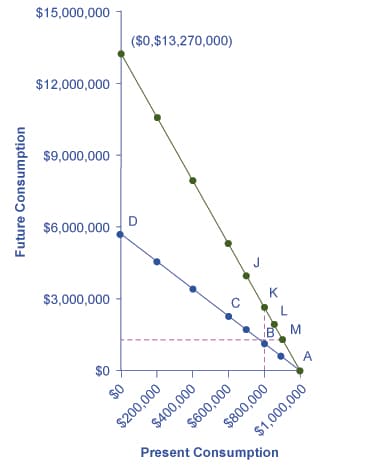
Intertemporal Choices in Financial Capital Markets · Economics View original
Is this image relevant?
Social Preferences, Financial Literacy and Intertemporal Choice View original
Is this image relevant?
Frontiers | Reassessing intertemporal choice: human decision-making is more optimal in a ... View original
Is this image relevant?
Intertemporal Choices in Financial Capital Markets · Economics View original
Is this image relevant?
Concept of Intertemporal Choice
Intertemporal choice refers to decisions where the costs and benefits are spread across different points in time. Any time you weigh spending now against saving for later, you're making an intertemporal choice. Think of saving for retirement, investing in education, or deciding whether to buy a car now or wait.
Two closely related concepts explain why these decisions are so hard:
- Present bias is the tendency to prioritize immediate rewards over long-term benefits. This is why people consistently undersave for retirement or put off healthy habits. The reward right now just feels more compelling than a larger reward down the road.
- Hyperbolic discounting describes how present bias works mathematically. People apply steep discount rates to rewards in the near future but much flatter rates to rewards further out. For example, you might prefer $100 today over $110 next week, but you'd happily choose $110 in 51 weeks over $100 in 50 weeks. The time gap is the same, but the first scenario feels different because it involves right now. This creates time-inconsistent preferences, where your future self wants something different from what your present self chooses.
Several factors shape how people handle intertemporal choices:
- Interest rates: Higher rates make saving more attractive because your money grows faster, encouraging delayed consumption.
- Uncertainty about the future: When the future feels unpredictable, people tend to grab rewards now rather than wait.
- Self-control: People with stronger self-control are better at sticking with long-term goals, even when short-term temptations arise.
Behavioral Economics vs. Traditional Assumptions
Traditional economic models assume that consumers are rational agents. That means they have stable preferences, maximize utility, have access to complete information, and exercise perfect self-control. Under these assumptions, people always make the best possible decision given their constraints.
Behavioral economics pushes back on every one of those assumptions. Drawing on psychology research, it argues that real people have bounded rationality: limited cognitive capacity, imperfect information, and emotions that shape their choices. People don't optimize; they do the best they can with mental shortcuts and incomplete thinking.
Here are some of the most well-documented biases that challenge the rationality assumption:
- Status quo bias: People tend to stick with their current situation even when switching would make them better off. Inertia is powerful.
- Loss aversion: Losses hurt roughly twice as much as equivalent gains feel good. This insight comes from Kahneman and Tversky's prospect theory. For example, losing $50 feels significantly worse than finding $50 feels good.
- Framing effects: The way a choice is presented changes what people pick. Describing meat as "90% lean" versus "10% fat" leads to different purchasing decisions, even though the information is identical.
- Anchoring: People rely too heavily on the first number or piece of information they encounter. If a store lists a jacket at $200 then marks it down to $120, that $200 anchor makes $120 feel like a deal, regardless of the jacket's actual value.
The practical takeaway is that because people don't always make optimal decisions, the context in which choices are presented matters enormously. This is the foundation of nudge theory: policies and interventions can be designed to steer people toward better outcomes without restricting their freedom to choose.

Cognitive Biases and Heuristics in Decision-Making
Heuristics are mental shortcuts people use to make complex decisions quickly. They're useful most of the time, but they can lead to predictable errors called cognitive biases, which are systematic patterns of flawed thinking.
Some key examples:
- Confirmation bias: People seek out and favor information that supports what they already believe, while ignoring contradictory evidence. This affects everything from investment decisions to product reviews.
- Availability heuristic: People judge how likely something is based on how easily an example comes to mind. After seeing news coverage of a plane crash, you might overestimate the danger of flying, even though driving is statistically far riskier.
- Overconfidence bias: People consistently overestimate their own knowledge or abilities. Surveys regularly show that most drivers rate themselves "above average," which is mathematically impossible.
Richard Thaler, who won the Nobel Prize in Economics in 2017, made major contributions to this field. One of his key concepts is mental accounting: the tendency to treat money differently depending on where it comes from or what it's earmarked for. You might refuse to spend $20 from your savings account on lunch but happily spend a $20 bill you found on the ground. Economically, $20 is $20, but mentally, people put it in different categories.
Factors in US Saving Behavior
The US has historically had low personal saving rates, and behavioral economics helps explain why:
- Present bias and hyperbolic discounting lead people to consistently choose spending now over saving for the future.
- Limited self-control makes it hard to resist immediate consumption, especially with easy access to credit.
- Low financial literacy means many people don't fully grasp how compound interest works, so they underestimate how much early saving matters. Even small contributions grow dramatically over decades.
One of the most powerful findings in behavioral economics involves default options in retirement plans. When employers automatically enroll workers in 401(k) plans (with the option to opt out), participation rates jump dramatically compared to plans where employees must actively sign up. Default contribution rates and pre-selected investment options also shape how much people save. This is a textbook example of nudge theory in action: the choice architecture changes, but no one's freedom is restricted.
Mental accounting also plays a role. People save more effectively when money is allocated to a specific goal or labeled account ("vacation fund," "emergency fund"). Windfalls like tax refunds or bonuses tend to get spent more freely than regular income, even though the dollars are identical.
Social norms and peer influence affect saving too. People are more likely to save when they believe their peers are saving. Studies have shown that simply informing employees about their coworkers' saving rates can increase contributions.
Several behavioral interventions have proven effective at boosting saving:
- Commitment devices: These let people voluntarily restrict their future choices. For example, the "Save More Tomorrow" program (designed by Thaler and Benartzi) has workers commit in advance to putting a portion of future raises toward retirement savings.
- Reminders and feedback: Regular prompts about saving goals and progress updates help keep long-term objectives top of mind.
- Financial education: Teaching people about the benefits of saving and how compound interest works can shift behavior, though education alone tends to be less effective than structural nudges like automatic enrollment.
See Fiveable more often in Google
Mark Fiveable as a preferred source and Google is more likely to show you our guides in Top Stories, with a "preferred" badge in AI Mode and AI Overviews.