23.5 The Pros and Cons of Trade Deficits and Surpluses

💸Principles of Economics Unit 23 Review
23.5 The Pros and Cons of Trade Deficits and Surpluses
💸 Principles of Economics
International Trade and Capital Flows
When a country imports more than it exports, it runs a trade deficit. When it exports more than it imports, it runs a trade surplus. Neither is automatically good or bad. What matters is how the deficit or surplus is financed and what the borrowed or invested money gets used for. This section covers why trade deficits require foreign capital, the benefits and risks of that capital, and real-world examples of countries that handled it well or poorly.

Top images from around the web for Trade Deficits and Foreign Borrowing
The Foreign Exchange Market | Macroeconomics View original
Is this image relevant?
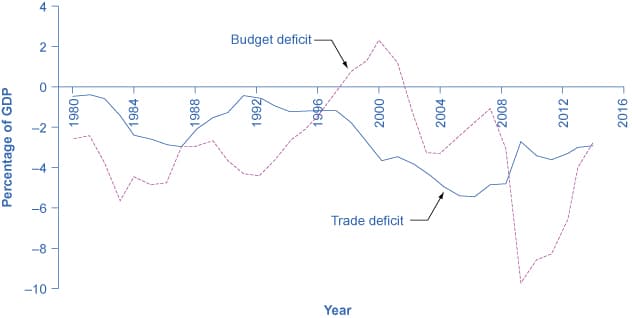
Fiscal Policy and the Trade Balance | OpenStax Macroeconomics 2e View original
Is this image relevant?
Fiscal Policy and the Trade Balance – Principles of Economics: Scarcity and Social Provisioning ... View original
Is this image relevant?
The Foreign Exchange Market | Macroeconomics View original
Is this image relevant?
Fiscal Policy and the Trade Balance | OpenStax Macroeconomics 2e View original
Is this image relevant?
Trade Deficits and Foreign Borrowing
A trade deficit means a country is spending more on foreign goods and services than it earns from selling its own goods abroad. That gap has to be covered somehow. The country must either borrow from foreign lenders or attract foreign investment, both of which create an inflow of foreign capital.
In the short run, this can actually stimulate growth. More imported goods increase consumption, and foreign-financed investment adds to aggregate demand, boosting GDP. Think of it like a household that borrows to buy a car so it can commute to a higher-paying job. The debt makes sense if it leads to higher future income.
The problems show up when deficits persist without productive returns:
- Unsustainable debt accumulation — If borrowed money funds consumption rather than productive investment, the country may struggle to repay. Debt grows, but the economy doesn't grow fast enough to keep up.
- Vulnerability to capital flight — Foreign investors can pull their money out quickly if they lose confidence. A sudden outflow of capital can trigger a financial crisis almost overnight.
- Currency depreciation — Large, sustained deficits tend to push the domestic currency's value down. That makes imports more expensive (contributing to inflation) and makes foreign-denominated debt harder to repay, since each unit of domestic currency now buys less foreign currency.

Benefits and Risks of Foreign Capital
Foreign capital inflows aren't inherently dangerous. They become a problem when a country depends on them too heavily or uses them unproductively.
Benefits:
- Access to a larger pool of savings, allowing the country to invest more than domestic savings alone would permit
- Financing for infrastructure, factories, and technology that raise long-term productivity
- Technology and knowledge transfer from foreign firms operating domestically
- Greater competition in domestic markets, which can push local firms to become more efficient
Risks:
- Sudden capital outflows if investor sentiment shifts, potentially sparking financial crises
- Foreign debt that becomes unsustainable when the economy slows or the currency weakens
- Loss of domestic control over key industries or strategic assets
- Overdependence on foreign capital that crowds out the development of domestic savings habits
- Greater exposure to global economic shocks, since foreign investors may withdraw during worldwide downturns regardless of local conditions
The key distinction: foreign capital that finances productive investment (factories, infrastructure, education) tends to pay for itself over time. Foreign capital that finances consumption or government spending without corresponding growth is where trouble starts.

Country Case Studies
These four cases illustrate how the same basic tool (foreign borrowing) can lead to very different outcomes depending on policy choices.
South Korea (1960s–1970s) — Effective use of foreign borrowing
South Korea attracted foreign capital specifically to finance export-oriented industrialization. The government channeled investment into education, infrastructure, and technology, all of which raised productivity and made Korean exports globally competitive. As the economy grew and domestic savings increased, the country gradually reduced its reliance on foreign debt. The result was decades of sustained high growth and an eventual transition from a low-income to a high-income economy.
Chile — Effective use of foreign borrowing
Chile used foreign capital to develop its mining sector and other export industries while maintaining sound macroeconomic policies and a stable regulatory environment. Foreign borrowing complemented domestic savings rather than replacing them. This approach produced steady growth, improved living standards, and reduced vulnerability to external shocks.
Greece — Struggling with debt burdens
Greece borrowed heavily from foreign lenders, but much of the money financed government spending and consumption rather than productive investment. The export sector remained weak, so the economy couldn't generate enough growth to service the debt. When the 2008 global financial crisis hit, unsustainable debt levels were exposed. The result was a prolonged recession, unemployment above 25%, and painful austerity measures imposed by international creditors.
Argentina (1990s–2002) — Struggling with debt burdens
Argentina relied on foreign borrowing to fund government spending and prop up an overvalued exchange rate throughout the 1990s. Fiscal discipline was lacking, and structural economic weaknesses went unaddressed. By 2001, debt levels were unsustainable. Argentina defaulted on its foreign debt in 2001–2002, triggering a severe recession, political instability, high inflation, and years of isolation from international capital markets.
Pattern to notice: The successful cases (South Korea, Chile) used foreign capital for productive, export-boosting investment and maintained disciplined economic policies. The struggling cases (Greece, Argentina) used foreign capital to fund consumption or government spending without building the productive capacity needed to repay the debt.
See Fiveable more often in Google
Mark Fiveable as a preferred source and Google is more likely to show you our guides in Top Stories, with a "preferred" badge in AI Mode and AI Overviews.