14.3 Market Power on the Supply Side of Labor Markets: Unions

💸Principles of Economics Unit 14 Review
14.3 Market Power on the Supply Side of Labor Markets: Unions
💸 Principles of Economics
Labor Unions
Labor unions exist to solve a fundamental problem: individual workers have very little bargaining power when negotiating with a large employer. By organizing collectively, workers can negotiate as a group, which shifts the balance of power in the labor market. This section covers how unions function, why their membership has declined, and the ongoing debate about their economic effects.

Top images from around the web for Role in Negotiating Wages and Working Conditions
The Labor Movement | HIST 1302: US after 1877 View original
Is this image relevant?
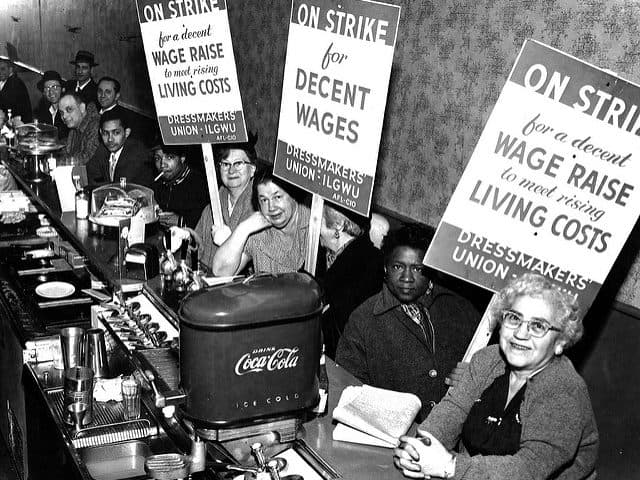
Labor unions and income inequality in America - Journalist's Resource View original
Is this image relevant?
Progressive Charlestown: The Workers First Agenda View original
Is this image relevant?
The Labor Movement | HIST 1302: US after 1877 View original
Is this image relevant?
Labor unions and income inequality in America - Journalist's Resource View original
Is this image relevant?
Role in Negotiating Wages and Working Conditions
Collective bargaining is the core function of a union. Instead of each worker negotiating individually, the union negotiates a single contract on behalf of all its members. These contracts typically cover wages, health insurance, pensions, working hours, and safety standards.
Union workers tend to earn higher wages and receive better benefits than comparable non-union workers. This difference is called the union wage premium. Unions achieve this through their collective leverage: if negotiations break down, the union can organize a strike (workers refuse to work) or a work slowdown to pressure the employer.
Beyond wages, union contracts often include:
- Seniority systems that determine the order of promotions and layoffs
- Grievance procedures that give workers a formal process to challenge unfair treatment
- Job classifications and pay scales that standardize compensation across similar roles
- Just cause provisions requiring employers to have a legitimate reason before firing a worker
Unions also engage in political activity, lobbying for labor-friendly legislation and contributing to political campaigns that support worker protections.

Decline in U.S. Union Membership Rates
Union membership peaked at roughly 35% of the workforce in the mid-1950s. By 2020, that figure had fallen below 11%. Several forces drove this decline:
Structural economic shifts. The U.S. economy moved away from heavily unionized industries like steel and automotive manufacturing toward service-sector jobs in retail, healthcare, and technology, where unions have historically had less presence.
Globalization and competition. Companies began outsourcing production to lower-cost regions, both domestically (to non-union facilities) and overseas. This put pressure on unionized firms to cut labor costs or risk losing business.
Technological change. Automation and computerization reduced the number of workers needed in many traditionally unionized industries, shrinking the pool of potential union members.
Legal and regulatory changes. Right-to-work laws, enacted in 27 states as of 2021, prohibit contracts that require workers to join a union or pay union dues as a condition of employment. These laws reduce union revenue and membership.
Employer opposition. Many companies actively resist unionization efforts through anti-union campaigns, hiring consultants who specialize in discouraging union votes, and other legal strategies.
Shifting public attitudes. Over time, some workers and voters came to view unions as less necessary or even as obstacles to economic flexibility.

Arguments For and Against Union Representation
The debate over unions centers on a tradeoff between worker protection and economic efficiency.
Arguments in favor of unions:
- Unions help balance the power asymmetry between individual workers and large employers. Without collective bargaining, employers can often dictate terms.
- Collective bargaining leads to higher wages, better benefits (health insurance, retirement plans), and safer working conditions.
- Union contracts protect workers from arbitrary dismissal by requiring just cause for termination and providing formal grievance procedures.
- Unions can advocate for stronger workplace safety standards and monitor whether employers comply with existing regulations.
Arguments against unions:
- The union wage premium can raise labor costs, potentially making firms less competitive and leading to reduced employment in unionized sectors.
- Rigid work rules and detailed job classifications can limit a firm's flexibility and slow down innovation.
- Strikes and lockouts disrupt production and services, imposing costs on employers, workers, and consumers.
- Mandatory union membership (in states without right-to-work laws) may conflict with individual workers' freedom of association.
- Unions sometimes prioritize the interests of senior, current members over new hires or unemployed workers. Seniority systems and entry barriers can reinforce this dynamic.
Context matters. The case for or against unions varies by industry. In manufacturing sectors facing intense international competition, high union labor costs can be a serious competitive disadvantage. In occupations that rely on individual creativity or rapid adaptation (startups, creative fields), standardized contracts may be a poor fit compared to performance-based pay. On the other hand, industries where workers face dangerous conditions or have little individual leverage may benefit most from union representation.
See Fiveable more often in Google
Mark Fiveable as a preferred source and Google is more likely to show you our guides in Top Stories, with a "preferred" badge in AI Mode and AI Overviews.