12.2 Command-and-Control Regulation

💸Principles of Economics Unit 12 Review
12.2 Command-and-Control Regulation
💸 Principles of Economics
Command-and-Control Regulation
Environmental regulations exist to address negative externalities from pollution, where the social cost of production exceeds the private cost. Command-and-control regulation is one major approach; market-based tools are the other. Understanding how they compare is central to this unit.

Top images from around the web for Command-and-control environmental regulations
Pollution Control - Free of Charge Creative Commons Chalkboard image View original
Is this image relevant?
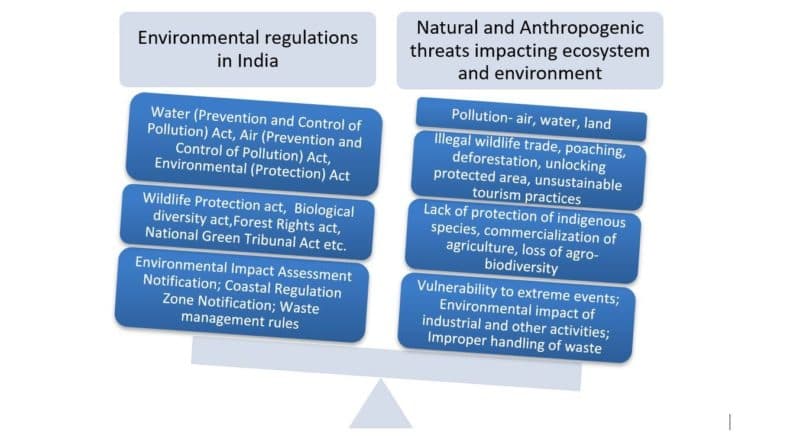
India's environmental laws and COVID-19 | Green Economy Coalition View original
Is this image relevant?
Discharges from offshore oil and gas installations have decreased due to OSPAR measures - OSPAR ... View original
Is this image relevant?
Pollution Control - Free of Charge Creative Commons Chalkboard image View original
Is this image relevant?
India's environmental laws and COVID-19 | Green Economy Coalition View original
Is this image relevant?
Command-and-Control Regulation
Command-and-control regulation means the government directly dictates how much pollution firms can emit or what technology they must use. There's no negotiation or trading involved: the government sets the rule, and firms must comply.
These regulations typically take one of three forms:
- Emission standards set maximum levels of specific pollutants a firm can release (e.g., a power plant can emit no more than X tons of sulfur dioxide per year)
- Technology mandates require firms to install particular pollution-control equipment (e.g., requiring catalytic converters on vehicles or scrubbers on smokestacks)
- Input or process requirements dictate the production methods or materials firms must use (e.g., requiring low-sulfur coal)
Compliance is enforced through government monitoring, inspections, and penalties for violations.
Limitations of Command-and-Control Approaches
The biggest drawback is inefficiency. Different firms face very different costs to reduce pollution. A command-and-control rule treats them all the same, which means the economy spends more than necessary to achieve a given level of pollution reduction. For example, if Firm A can cut a ton of emissions for and Firm B can do it for , a blanket rule forcing both to cut equally ignores that cheaper opportunity at Firm A.
Other key limitations:
- No incentive to go beyond compliance. Once a firm meets the standard, there's zero economic reason to reduce pollution further or invest in cleaner technology.
- High administrative costs. The government must monitor every regulated firm and enforce compliance, which requires significant resources.
- Regulatory capture. Regulated industries may influence the rule-making process to get weaker standards, undermining the regulation's purpose.
- Rigidity. Fixed rules don't adapt well when economic conditions shift or better technologies become available.

Market-Based Alternatives
Market-based approaches tackle the same pollution problem but work through economic incentives rather than direct mandates. They change the costs and benefits firms face so that reducing pollution becomes financially attractive.
Pollution Taxes (Pigouvian Taxes)
A Pigouvian tax charges firms a set price per unit of pollution they emit. If a carbon tax is per ton of , every firm decides for itself whether it's cheaper to pay the tax or reduce emissions. Firms that can cut pollution cheaply will do so to avoid the tax; firms facing very high abatement costs may choose to pay instead. This sorts pollution reduction toward the firms that can do it most cheaply.
Tradable Pollution Permits (Cap-and-Trade)
Cap-and-trade works in three steps:
- The government sets a total cap on the amount of pollution allowed across all firms.
- It distributes (or auctions) permits, each allowing the holder to emit a specific amount.
- Firms can buy and sell permits on an open market. A firm that can reduce emissions cheaply will do so and sell its extra permits to a firm that faces higher costs.
The European Union Emissions Trading System (EU ETS) for carbon dioxide is the most prominent real-world example. The cap ensures a specific environmental outcome, while trading ensures that outcome is reached at the lowest total cost.
Pollution Reduction Subsidies
Governments can also subsidize firms for adopting cleaner technologies or cutting emissions. This creates a positive financial incentive rather than imposing a cost, though it raises questions about who bears the expense (taxpayers rather than polluters).
Why Market-Based Approaches Are Favored in Economics
- Cost-effectiveness. Pollution reduction gravitates to firms that can do it most cheaply, lowering the total cost to society for any given level of cleanup.
- Ongoing incentive for innovation. Unlike command-and-control, firms always benefit from finding cheaper ways to reduce pollution, whether to lower their tax bill or free up permits to sell.
- Flexibility. Firms choose the method of reduction that best fits their industry, location, and available technology, rather than following a one-size-fits-all mandate.
The core tradeoff: command-and-control gives the government direct control and certainty about how pollution is reduced, but at a higher economic cost. Market-based tools achieve the same (or better) environmental outcomes more efficiently, but require well-designed markets and monitoring to function properly.
See Fiveable more often in Google
Mark Fiveable as a preferred source and Google is more likely to show you our guides in Top Stories, with a "preferred" badge in AI Mode and AI Overviews.