AMSCO 6.11 Reform in the Gilded Age

🇺🇸AP US History Review
AMSCO 6.11 Reform in the Gilded Age
🇺🇸 AP US History
AMSCO 1.2:Native American Societies Before European Contact Notes
AMSCO 2.1 Context: European Colonization of North America Notes
AMSCO 2.2 European Colonization Notes
AMSCO 2.3 The Regions of the British Colonies Notes
AMSCO 2.4 Transatlantic Trade Notes
AMSCO 2.5 Interactions between American Indians and Europeans Notes
AMSCO 2.6 Slavery in the British Colonies Notes
AMSCO 2.7 Colonial Society and Culture Notes
AMSCO 2.8 Comparison in Period 2 (1607-1754) Notes
AMSCO 3.1 Contextualizing Period 3
AMSCO 3.2 The Seven Year's War
AMSCO 3.3 Taxation Without Representation
AMSCO 3.4 Philosophical Foundations of the American Revolution
AMSCO 3.5 The American Revolution
AMSCO 3.6 The Influence of Revolutionary Ideals
AMSCO 3.7 The Articles of Confederation
AMSCO 3.8 The Constitutional Convention and Debates Over Ratification
AMSCO 3.9 The Constitution
AMSCO 3.10 Shaping a New Republic
AMSCO 3.11 Developing an American Identity
AMSCO 3.12 Movements in the Early Republic
AMSCO 3.13 Continuity and Change in Period 3
AMSCO 4.1 Contextualizing Period 4
AMSCO 4.2 The Rise of Political Parties and the Era of Jefferson
AMSCO 4.3 Politics and Regional Interests
AMSCO 4.4 America on the World Stage
AMSCO 4.5 Market Revolution
AMSCO 4.6 Effects of the Market Revolution on Society and Culture
AMSCO 4.7 Expanding Democracy
AMSCO 4.8 Jackson and Federal Power
AMSCO 4.9 The Development of an American Culture
AMSCO 4.10 The Second Great Awakening
AMSCO 4.11 An Age of Reform
AMSCO 4.12 African Americans in the Early Republic
AMSCO 4.13 Southern Society in the Early Republic
AMSCO 4.14 Causation in Period 4
AMSCO 5.1 Contextualizing Period 5
AMSCO 5.2 The Idea of Manfiest Destiny
AMSCO 5.3 Manifest Destiny and the Mexican-American War
AMSCO 5.4 The Compromise of 1850
AMSCO 5.5 Sectional Conflict: Regional Differences
AMSCO 5.6 Failure of Compromise
AMSCO 5.7 Election of 1860 and Secession
AMSCO 5.8 Military Conflict in the Civil War
AMSCO 5.9 Government Policies During the Civil War
AMSCO 5.10 Reconstruction
AMSCO 5.11 Failure of Reconstruction
AMSCO 5.12 Comparion in Period 5
AMSCO 6.1 Contextualizing Period 6
AMSCO 6.2 Westward Expansion: Economic Development
AMSCO 6.3 Westward Expansion: Social and Cultural Development
AMSCO 6.4 The "New South"
AMSCO 6.5 Technological Innovation
AMSCO 6.6 The Rise of Industrial Capitalism
AMSCO 6.7 Labor in the Gilded Age
AMSCO 6.8 Immigration and Migration in the Gilded Age
AMSCO 6.9 Responses to Immigration in the Gilded Age
AMSCO 6.10 Development of the Middle Class
AMSCO 6.11 Reform in the Gilded Age
AMSCO 6.12 Role of Government in the Gilded Age
AMSCO 6.13 Politics in the Gilded Age
AMSCO 6.14 Continuity and Change Period 6
AMSCO 7.1 Contextualizing Period 7
AMSCO 7.2 Imperialism: Debates
AMSCO 7.3 The Spanish-American War and U.S. Foreign Policy to 1917
AMSCO 7.4 The Progressives
AMSCO 7.5 World War I: Military and Diplomacy
AMSCO 7.6 World War I: Home Front
AMSCO 7.7 1920s: Innovations in Communication and Technology
AMSCO 7.8 1920s: Cultural and Political Controversies
AMSCO 7.9 The Great Depression
AMSCO 7.10 The New Deal
AMSCO 7.11 Inerwar Foreign Policy
AMSCO 7.12 World War II Mobilization
AMSCO 7.13 World War II Military
AMSCO 7.14 World War II and Postwar Diplomacy
AMSCO 7.15 Comparison in Period 7
AMSCO 8.1 Contextualizing Period 8
AMSCO 8.2 The Cold War from 1945 to 1980
AMSCO 8.3 The Red Scare
AMSCO 8.4 Economy after 1945
AMSCO 8.5 Culture after 1945
AMSCO 8.6 Early Steps in the Civil Rights Movement, 1945-1960
AMSCO 8.7 America as a World Power
AMSCO 8.8 The Vietnam War
AMSCO 8.9 The Great Society
AMSCO 8.10 The African American Civil Rights Movement in the 1960s
AMSCO 8.11 The Civil Rights Movement Expands
AMSCO 8.12 Youth Culture of the 1960s
AMSCO 8.13 The Environment and Natural Resources from 1968 to 1980
AMSCO 8.14 Society in Transition
AMSCO 8.15 Continuity and Change in Period 8
AMSCO 9.1 Contextualizing Period 9
AMSCO 9.2 Reagan and Conservatism
AMSCO 9.3 The End of the Cold War
AMSCO 9.4 A Changing Economy
AMSCO 9.5 Migration and Immgiration in the 1990s and 2000s
AMSCO 9.6 Challenges of the 21st Century
AMSCO 9.7 Causation in Period 9
AMSCO 1.1 Contextualizing Period 1 Notes
AMSCO 1.3 European Exploration in the Americas Notes
AMSCO 1.4 Columbian Exchange, Spanish Exploration, and Conquest Notes
AMSCO 1.5 Labor, Slavery, and Caste in the Spanish Colonial System Notes
AMSCO 1.6 Cultural Interactions in the Americas Notes
AMSCO 1.7 Causation in Period 1 Notes
Overview
AMSCO Topic 6.11, "Reform in the Gilded Age," covers how reformers, religious leaders, writers, and artists responded to the problems created by industrialization and urbanization between roughly 1865 and 1898. Early attempts at change failed (farmers couldn't regulate railroads, unions kept losing strikes), but a growing educated middle class had the time and money to join organizations pushing for reform. This chapter tracks two big threads: the awakening of social reform movements (Social Gospel, settlement houses, women's suffrage, temperance) and the shift in literature, painting, and architecture toward realism and a distinctly American style. None of these reforms fully succeeded during the Gilded Age itself, but they laid the groundwork for the Progressive Era you'll see in Unit 7.
Key Takeaways
- Henry George and Edward Bellamy challenged laissez-faire economics, and their books helped build support for government regulation.
- Social Gospel preachers urged Christians to address poverty and public health, while Jane Addams and other settlement workers built social work and pushed for reform.
- Urban life reduced extended-family support and made children more costly, while Stanton and Anthony helped found NAWSA to campaign for women's suffrage.
- Temperance reformers linked drinking to family poverty; the WCTU promoted abstinence, and the Anti-Saloon League pressed states to close saloons.
- Realist writers such as Mark Twain exposed social problems, naturalists stressed how environment shaped lives, and Ashcan School painters depicted poor urban neighborhoods.
- Louis Sullivan designed steel-framed office buildings around function, while Frank Lloyd Wright developed prairie-style houses in harmony with their natural surroundings.
Books of Social Criticism
Two bestselling books pushed Americans to question laissez-faire economics. Henry George's Progress and Poverty (1879) called out the alarming wealth inequality caused by industrialization and proposed an unusual fix: replace all taxes with a single tax on land. Edward Bellamy's Looking Backward, 2000-1887 (1888) imagined the year 2000, when a cooperative society had eliminated poverty, greed, and crime.
George and Bellamy had a lot in common:
- Both were dismissed as utopians (and sometimes labeled socialists) for criticizing the economic system
- Both inspired enthusiastic followers who joined other reform movements
- Both helped shift public opinion away from laissez-faire and toward government regulation
That last point is the one to remember. These books mattered less for their specific proposals and more for making middle-class readers comfortable with the idea that government should fix economic problems.
Religion Responds to the City
Every major religion adapted to urban life, and several turned faith into a tool for social reform.
Catholic and Protestant Responses
Roman Catholicism grew rapidly thanks to immigrants from Ireland, Italy, and eastern Europe. Cardinal James Gibbons of Baltimore won the loyalty of old and new immigrants by defending the Knights of Labor and organized labor generally. Among Protestants, Dwight Moody founded the Moody Bible Institute in Chicago in 1889, training generations of urban evangelists to adapt traditional Christianity to city life. The Salvation Army, imported from England in 1879, gave the homeless and poor basic necessities while preaching the Christian gospel.
The Social Gospel Movement
In the 1880s and 1890s, Protestant clergy preached the Social Gospel: applying Christian principles to social problems by improving housing, raising wages, and supporting public health. Their logic flipped traditional Christianity on its head. Traditional Christians said focus on individual salvation and society will improve. Social Gospel preachers said fix poverty first, and then people can find individual salvation.
The movement's leader was Walter Rauschenbusch, a Baptist minister who worked in Hell's Kitchen, a poverty-stricken New York City neighborhood. His preaching linked Christianity to Progressive reform and pushed middle-class Protestants to take on urban problems.
Settlement Workers
Settlement workers like Jane Addams of Hull House in Chicago were civic-minded volunteers who laid the foundation for the profession of social work. Many doubled as political activists, crusading for child-labor laws, housing reform, and women's rights. Two settlement workers, Frances Perkins and Harry Hopkins, later became leaders in Franklin Roosevelt's New Deal in the 1930s. That's a great continuity-and-change connection for essays.
Families, Suffrage, and Temperance
Reform also reached into private life, especially for women, who joined voluntary organizations and pushed for social and political change in growing numbers.
Strains on the Urban Family
City life isolated parents and children from the extended family and village support networks they'd had in rural areas. Two measurable results:
- Divorce rates rose to 1 in 12 marriages by 1900, partly because state legislatures expanded the grounds for divorce to include cruelty and desertion
- Family size and birthrates dropped. Children were an economic asset on the farm (free labor) but an economic liability in the city
Voting Rights for Women
The suffrage movement launched at Seneca Falls in 1848 kept moving forward. In 1890, pioneer feminists Elizabeth Cady Stanton and Susan B. Anthony helped found the National American Woman Suffrage Association (NAWSA) to secure the vote. Wyoming became the first state to grant women full suffrage, in 1869. By 1900, some states let women vote in local elections, and most allowed women to own and control property after marriage. Full national suffrage was still decades away, but the organizational machinery was now in place.
The Temperance Movement
Reformers blamed excessive drinking by male factory workers for much of the poverty in immigrant and working-class families. Three forces drove the temperance push:
- The Woman's Christian Temperance Union (WCTU), formed in 1874 and led by Frances E. Willard, advocated total abstinence from alcohol and reached 500,000 members by 1898
- The Anti-Saloon League, founded in 1893, became a powerful political force and by 1916 had persuaded 21 states to close all saloons and bars
- Carry A. Nation of Kansas skipped the legislative route entirely, raiding saloons and smashing beer barrels with a hatchet
Early Urban Reform
Grassroots efforts to fight corruption in city governments popped up nationwide. In New York, a reformer named Theodore Roosevelt tried to clean up the New York City Police Department, which boosted him toward the vice presidency (he was a vice-presidential nominee in 1896) and eventually the presidency. The chapter's big caveat: most Gilded Age reformers wouldn't see real national results until the early 20th century.
Literature and the Arts: Realism Takes Over
American writers and artists broke from romantic, idealized art and moved toward realism, depicting life as it actually was, often in a distinctly American style.
Realism and Naturalism in Literature
Popular post-Civil War fiction featured ideal heroes and heroines. Regionalist writers like Bret Harte broke that mold by depicting life in rough Western mining camps. Mark Twain (pen name of Samuel L. Clemens) became the first great realist author; his classic The Adventures of Huckleberry Finn (1884) exposed the greed, violence, and racism in American society.
A younger 1890s generation went further with naturalism, which focused on how environment and experience shaped human lives:
- Stephen Crane's Maggie: A Girl of the Streets (1893) showed a brutal urban environment destroying young people; he also wrote The Red Badge of Courage about fear on the Civil War battlefield before dying of tuberculosis at 29
- Jack London portrayed the conflict between nature and civilization in novels like The Call of the Wild (1903)
- Theodore Dreiser's Sister Carrie (1900), about a poor working girl in Chicago, shocked the moral sensibilities of the era
Painting
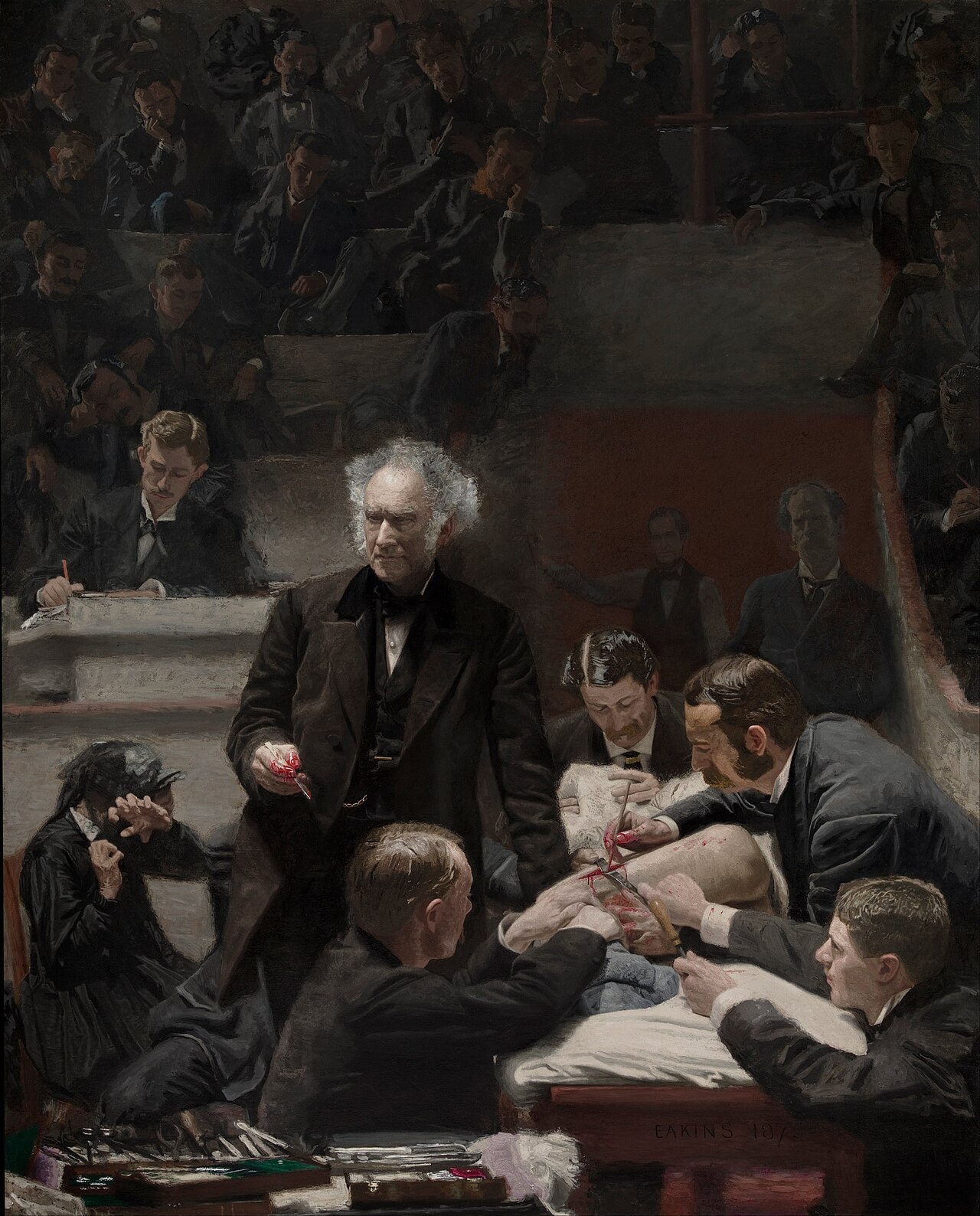
Realism reshaped American painting too. Winslow Homer, the foremost painter of seascapes and watercolors, rendered nature matter-of-factly. Thomas Eakins painted surgical scenes and working-class daily life, even using serial-action photographs to study human anatomy. James McNeill Whistler, working mostly in Paris and London, painted Arrangement in Grey and Black, No. 1 ("Whistler's Mother"), a study of color rather than subject that influenced modern art. Mary Cassatt learned impressionist techniques in France, especially the use of pastel colors. By century's end, social realists like George Bellows of the Ashcan School painted everyday life in poor urban neighborhoods.
Abstract, nonrepresentational painting upset romanticists and realists alike. The Armory Show in New York City in 1913 shocked the artistic community, and most Americans rejected abstract art until the 1950s.
Architecture
American architects searched for styles that fit the industrial age:
- Henry Hobson Richardson changed American architecture in the 1870s with designs based on the medieval Romanesque style (massive stone walls, rounded arches)
- Louis Sullivan of Chicago rejected historical styles entirely for the tall, steel-framed office buildings of the 1880s and 1890s; his idea that form should flow from function defined the Chicago School
- Frank Lloyd Wright, who worked for Sullivan in the 1890s, developed an "organic" style in harmony with natural surroundings, seen in his long, horizontal prairie-style houses; he became the most famous American architect of the 20th century
- Daniel H. Burnham went the other way, reviving classical Greek and Roman styles for the World's Columbian Exposition of 1893
Frederick Law Olmsted, the originator of landscape architecture, designed Central Park in New York City and the grounds of the U.S. Capitol, setting the model for later urban landscaping.
Why This Chapter Matters for Period 6
Laissez-faire still dominated business and politics in the Gilded Age, but the foundations for early 20th-century reform were laid in the 1880s and 1890s. Critics and artists gave the expanding middle class alternative visions for the economy and society. When the College Board asks how reform movements responded to industrial capitalism, this is your evidence bank: utopians like George and Bellamy, Social Gospel advocates like Rauschenbusch, and women's organizations like NAWSA and the WCTU.
Key Terms to Know
| Term | Why it matters |
|---|---|
| Henry George | Wrote Progress and Poverty (1879), proposing a single tax on land to fix wealth inequality |
| Edward Bellamy | His Looking Backward (1888) imagined a cooperative society without poverty, fueling reform sentiment |
| Social Gospel | Movement to apply Christian principles to social problems like housing, wages, and public health |
| Walter Rauschenbusch | Baptist minister in Hell's Kitchen who linked Christianity to Progressive reform |
| Jane Addams | Founded Hull House in Chicago; settlement workers there pioneered social work and activism |
| Salvation Army | Imported from England in 1879; gave the urban poor necessities while preaching the gospel |
| Cardinal James Gibbons | Catholic leader in Baltimore who defended the Knights of Labor and organized labor |
| NAWSA | Suffrage organization founded in 1890 with help from Stanton and Anthony to win women the vote |
| WCTU | Woman's Christian Temperance Union (1874); under Frances Willard, hit 500,000 members by 1898 |
| Anti-Saloon League | Founded 1893; political pressure group that got 21 states to close saloons by 1916 |
| Carry A. Nation | Kansas temperance crusader famous for smashing saloon beer barrels with a hatchet |
| Realism and naturalism | Literary movements depicting life honestly; naturalism stressed how environment shapes people |
| Mark Twain | First great realist author; Huckleberry Finn (1884) exposed greed, violence, and racism |
| Stephen Crane | Naturalist whose Maggie: A Girl of the Streets showed the city destroying young lives |
| Ashcan School | Social realist painters (like George Bellows) who depicted poor urban neighborhoods |
| Louis Sullivan | Chicago architect whose "form follows function" steel skyscrapers defined the Chicago School |
| Frank Lloyd Wright | Developed "organic" prairie-style architecture; the most famous 20th-century American architect |
| Frederick Law Olmsted | Originator of landscape architecture; designed Central Park and the U.S. Capitol grounds |
Practice and Next Steps
Pair these AMSCO notes with the 6.11 Reform in the Gilded Age course topic study guide for the College Board's framing of the same material. This chapter connects directly to labor in the Gilded Age and the failures that sparked reform, so review those notes together.
To check your understanding, run through APUSH guided practice questions on Period 6, or browse the rest of the AMSCO notes collection to keep moving through the unit. When you're ready for essay work, try FRQ practice with instant scoring. Reform movements responding to industrialization are a classic prompt theme.
Frequently Asked Questions
What was the Social Gospel movement in the Gilded Age?
The Social Gospel was a movement among Protestant clergy in the 1880s and 1890s to apply Christian principles to social problems by improving housing, raising wages, and supporting public health. Its leader was Walter Rauschenbusch, a Baptist minister who worked in New York's Hell's Kitchen. Unlike traditional Christians, Social Gospel preachers believed fixing poverty would help people find individual salvation, not the other way around.
How were Henry George and Edward Bellamy similar?
Both wrote bestselling books of social criticism (George's Progress and Poverty in 1879, Bellamy's Looking Backward in 1888), both were criticized as utopians and sometimes labeled socialists, and both inspired followers who joined other reform movements. Most importantly, both shifted American public opinion away from laissez-faire and toward greater government regulation of the economy.
Did Gilded Age reform movements actually succeed?
Mostly not during the Gilded Age itself. Farmers' efforts to regulate railroads and workers' efforts to build unions largely failed, and most urban reformers didn't see national results until the early 20th century. The real payoff was laying foundations for the Progressive Era, like settlement workers Frances Perkins and Harry Hopkins later leading parts of FDR's New Deal.
What is the difference between realism and naturalism in APUSH?
Realism depicted life honestly instead of romanticizing it; Mark Twain was the first great realist, exposing greed, violence, and racism in Huckleberry Finn (1884). Naturalism, from a younger 1890s generation, went further by focusing on how environment and experience shaped human lives, like Stephen Crane's Maggie: A Girl of the Streets showing the city destroying young people.
How does Topic 6.11 show up on the AP US History exam?
The exam asks you to explain how different reform movements responded to the rise of industrial capitalism, so know your categories: utopians (George, Bellamy), Social Gospel advocates (Rauschenbusch), settlement workers (Jane Addams), and women's organizations (NAWSA, WCTU). Reform-and-response is a classic essay theme, and you can practice it with FRQ practice and instant scoring.
See Fiveable more often in Google
Mark Fiveable as a preferred source and Google is more likely to show you our guides in Top Stories, with a "preferred" badge in AI Mode and AI Overviews.