AMSCO 4.3 Politics and Regional Interests

🇺🇸AP US History Review
AMSCO 4.3 Politics and Regional Interests
🇺🇸 AP US History
AMSCO 1.2:Native American Societies Before European Contact Notes
AMSCO 2.1 Context: European Colonization of North America Notes
AMSCO 2.2 European Colonization Notes
AMSCO 2.3 The Regions of the British Colonies Notes
AMSCO 2.4 Transatlantic Trade Notes
AMSCO 2.5 Interactions between American Indians and Europeans Notes
AMSCO 2.6 Slavery in the British Colonies Notes
AMSCO 2.7 Colonial Society and Culture Notes
AMSCO 2.8 Comparison in Period 2 (1607-1754) Notes
AMSCO 3.1 Contextualizing Period 3
AMSCO 3.2 The Seven Year's War
AMSCO 3.3 Taxation Without Representation
AMSCO 3.4 Philosophical Foundations of the American Revolution
AMSCO 3.5 The American Revolution
AMSCO 3.6 The Influence of Revolutionary Ideals
AMSCO 3.7 The Articles of Confederation
AMSCO 3.8 The Constitutional Convention and Debates Over Ratification
AMSCO 3.9 The Constitution
AMSCO 3.10 Shaping a New Republic
AMSCO 3.11 Developing an American Identity
AMSCO 3.12 Movements in the Early Republic
AMSCO 3.13 Continuity and Change in Period 3
AMSCO 4.1 Contextualizing Period 4
AMSCO 4.2 The Rise of Political Parties and the Era of Jefferson
AMSCO 4.3 Politics and Regional Interests
AMSCO 4.4 America on the World Stage
AMSCO 4.5 Market Revolution
AMSCO 4.6 Effects of the Market Revolution on Society and Culture
AMSCO 4.7 Expanding Democracy
AMSCO 4.8 Jackson and Federal Power
AMSCO 4.9 The Development of an American Culture
AMSCO 4.10 The Second Great Awakening
AMSCO 4.11 An Age of Reform
AMSCO 4.12 African Americans in the Early Republic
AMSCO 4.13 Southern Society in the Early Republic
AMSCO 4.14 Causation in Period 4
AMSCO 5.1 Contextualizing Period 5
AMSCO 5.2 The Idea of Manfiest Destiny
AMSCO 5.3 Manifest Destiny and the Mexican-American War
AMSCO 5.4 The Compromise of 1850
AMSCO 5.5 Sectional Conflict: Regional Differences
AMSCO 5.6 Failure of Compromise
AMSCO 5.7 Election of 1860 and Secession
AMSCO 5.8 Military Conflict in the Civil War
AMSCO 5.9 Government Policies During the Civil War
AMSCO 5.10 Reconstruction
AMSCO 5.11 Failure of Reconstruction
AMSCO 5.12 Comparion in Period 5
AMSCO 6.1 Contextualizing Period 6
AMSCO 6.2 Westward Expansion: Economic Development
AMSCO 6.3 Westward Expansion: Social and Cultural Development
AMSCO 6.4 The "New South"
AMSCO 6.5 Technological Innovation
AMSCO 6.6 The Rise of Industrial Capitalism
AMSCO 6.7 Labor in the Gilded Age
AMSCO 6.8 Immigration and Migration in the Gilded Age
AMSCO 6.9 Responses to Immigration in the Gilded Age
AMSCO 6.10 Development of the Middle Class
AMSCO 6.11 Reform in the Gilded Age
AMSCO 6.12 Role of Government in the Gilded Age
AMSCO 6.13 Politics in the Gilded Age
AMSCO 6.14 Continuity and Change Period 6
AMSCO 7.1 Contextualizing Period 7
AMSCO 7.2 Imperialism: Debates
AMSCO 7.3 The Spanish-American War and U.S. Foreign Policy to 1917
AMSCO 7.4 The Progressives
AMSCO 7.5 World War I: Military and Diplomacy
AMSCO 7.6 World War I: Home Front
AMSCO 7.7 1920s: Innovations in Communication and Technology
AMSCO 7.8 1920s: Cultural and Political Controversies
AMSCO 7.9 The Great Depression
AMSCO 7.10 The New Deal
AMSCO 7.11 Inerwar Foreign Policy
AMSCO 7.12 World War II Mobilization
AMSCO 7.13 World War II Military
AMSCO 7.14 World War II and Postwar Diplomacy
AMSCO 7.15 Comparison in Period 7
AMSCO 8.1 Contextualizing Period 8
AMSCO 8.2 The Cold War from 1945 to 1980
AMSCO 8.3 The Red Scare
AMSCO 8.4 Economy after 1945
AMSCO 8.5 Culture after 1945
AMSCO 8.6 Early Steps in the Civil Rights Movement, 1945-1960
AMSCO 8.7 America as a World Power
AMSCO 8.8 The Vietnam War
AMSCO 8.9 The Great Society
AMSCO 8.10 The African American Civil Rights Movement in the 1960s
AMSCO 8.11 The Civil Rights Movement Expands
AMSCO 8.12 Youth Culture of the 1960s
AMSCO 8.13 The Environment and Natural Resources from 1968 to 1980
AMSCO 8.14 Society in Transition
AMSCO 8.15 Continuity and Change in Period 8
AMSCO 9.1 Contextualizing Period 9
AMSCO 9.2 Reagan and Conservatism
AMSCO 9.3 The End of the Cold War
AMSCO 9.4 A Changing Economy
AMSCO 9.5 Migration and Immgiration in the 1990s and 2000s
AMSCO 9.6 Challenges of the 21st Century
AMSCO 9.7 Causation in Period 9
AMSCO 1.1 Contextualizing Period 1 Notes
AMSCO 1.3 European Exploration in the Americas Notes
AMSCO 1.4 Columbian Exchange, Spanish Exploration, and Conquest Notes
AMSCO 1.5 Labor, Slavery, and Caste in the Spanish Colonial System Notes
AMSCO 1.6 Cultural Interactions in the Americas Notes
AMSCO 1.7 Causation in Period 1 Notes
Overview
AMSCO Topic 4.3, "Politics and Regional Interests," covers the Era of Good Feelings under President James Monroe and explains why that nickname is misleading. Beneath the surface of one-party harmony, Americans fought over tariffs, the national bank, internal improvements, and (most dangerously) slavery, leading to the Missouri Compromise of 1820. The chapter fits Period 4 (1800-1848), where the big tension is nationalism versus sectionalism: loyalty to the Union pulling against loyalty to your own region.
Jefferson called the Missouri question "a firebell in the night" that filled him with terror, "the knell of the Union." That quote opens the chapter for a reason. This is the moment slavery becomes an openly sectional political crisis.
Key Takeaways
- Monroe's Era of Good Feelings looked unified because the Federalists faded, but disputes over economic policies and slavery divided Americans.
- The Tariff of 1816 protected American factories, while Henry Clay's American System paired tariffs with a national bank and internal improvements; Monroe vetoed federal road and canal bills.
- The Panic of 1819 hit indebted westerners especially hard after the national bank tightened credit, fueling demands for land reform and opposition to the bank.
- The Federalists ceased to be a national party, but the Democratic-Republicans split over government power and eventually fielded four presidential candidates in 1824.
- Western settlement grew after the War of 1812, and western states sought easy credit, low federal land prices, and better transportation while settlers disagreed over slavery.
- The defeated Tallmadge Amendment exposed the slavery fight over Missouri. The Missouri Compromise admitted Missouri as a slave state and Maine as a free state, banned slavery north of 36°30' in the remaining Louisiana Territory, and temporarily preserved sectional balance.
The Era of Good Feelings and James Monroe
The "Era of Good Feelings" refers to the Monroe presidency, when the Federalist Party faded away and the Democratic-Republicans dominated politics. With one party and a popular war hero generation in charge, the period looked nationalistic, optimistic, and unified.
The chapter's main argument is that this unity was an oversimplification. People had heated debates over tariffs, the national bank, internal improvements, and public land sales, and sectional tension over slavery was rising. AMSCO suggests the actual "good feelings" lasted only from the election of 1816 to the Panic of 1819.
Key facts about Monroe:
- A Revolutionary War veteran who survived the Valley Forge winter; later Jefferson's minister to Britain and Madison's secretary of state.
- Continued the Virginia dynasty. Four of the first five presidents were Virginians (John Adams of Massachusetts was the exception).
- Beat Federalist Rufus King in 1816, 183 electoral votes to 34. In 1820 he won every electoral vote except one because the Federalists had practically vanished.
- Under Monroe, the U.S. acquired Florida, agreed on the Missouri Compromise, and adopted the Monroe Doctrine (the foreign policy side gets covered in AMSCO 4.4 America on the World Stage).
Economic Nationalism: Tariff of 1816 and Clay's American System
After the War of 1812, a political movement pushed to grow the national economy through internal improvements (roads and canals) and protection for new American industries. The catch, and the heart of this topic: opinions on these policies usually followed what was best for one's own region.
Tariff of 1816
The Tariff of 1816 was the first protective tariff in U.S. history. Before the war, tariffs were low and meant to raise revenue. During the war, Americans built factories to replace British imports. When peace came, manufacturers feared Britain would dump cheap goods on American markets, so Congress raised tariffs specifically to protect U.S. industry, not just to fund the government.
The regional reactions are exam gold:
- New England opposed it because it had little manufacturing at the time.
- The South and West, which opposed tariffs before and after, supported this one, believing it was needed for national prosperity. (Watch how fast that flips in later topics.)
Henry Clay's American System
Henry Clay of Kentucky, a House leader, proposed the American System, a three-part plan for national economic growth:
- Protective tariffs to promote American manufacturing and raise revenue
- A national bank to provide a stable national currency
- Internal improvements (federally built roads and canals)
Clay's pitch was that everyone wins: tariffs chiefly benefit the East, internal improvements promote growth in the West and South, and the bank helps all sections. Critics debated whether the plan really benefited the whole nation or just certain regions, which is exactly the regional-interests theme of this topic.
Two of the three parts were in place by 1816: Congress passed the protective tariff and chartered the Second Bank of the United States (the First Bank's charter had expired in 1811). The third part stalled. Both Madison and Monroe believed the Constitution did not explicitly allow federal spending on roads and canals, so Monroe consistently vetoed internal improvement bills. States had to build improvements on their own.
The Panic of 1819
The Panic of 1819 was the first major financial panic since the Constitution was ratified, and it cracked the era's nationalist mood. The Second Bank of the United States tightened credit to control inflation, and the economy collapsed: state banks closed, and unemployment, bankruptcies, and imprisonment for debt rose sharply.
The West got hit hardest. Many westerners had gone into debt speculating on land after the War of 1812, and in 1819 the Bank of the United States foreclosed on large amounts of western farmland. The political fallout shaped the next decade:
- Westerners began demanding land reform.
- They turned strongly against the national bank and debtors' prisons.
Remember this when you get to AMSCO 4.8 Jackson and Federal Power. Western hatred of the Bank starts here.
Political Changes: The Federalists Fade, the Democratic-Republicans Split
The Federalist Party died because it failed to adapt to a growing, nationalistic country. Opposing the War of 1812 and leading the secessionist Hartford Convention made the party look out of step. After its crushing defeat in 1816, it stopped being a national party and didn't even nominate a candidate in 1820. (For the backstory, see AMSCO 4.2 The Rise of Political Parties and the Era of Jefferson.)
One party didn't mean one viewpoint. The Democratic-Republicans developed serious internal strains:
- Old-school members like John Randolph clung to limited government and strict construction of the Constitution.
- Most members adopted formerly Federalist ideas, like a large army and navy and a national bank.
- Some leaders flipped entirely. Daniel Webster of Massachusetts opposed the tariffs of 1816 and 1824, then supported even higher rates in 1828. John C. Calhoun of South Carolina was a war hawk nationalist in 1812 but championed states' rights after 1828.
When Monroe honored the two-term tradition and stepped aside, four Democratic-Republicans ran for president in 1824, splitting the party. That story, and the two rival parties that emerged, is covered in Topic 4.8.
Western Settlement and the Missouri Compromise
In the ten years after the War of 1812 began, the settler population west of the Appalachians doubled. Most settlers moved between the Appalachians and the Mississippi River, with some pushing into the Louisiana Territory.
Why people moved west
- Acquisition of lands: military victories over American Indians by William Henry Harrison in the Indiana Territory and Andrew Jackson in Florida and the South opened vast territory to White settlers.
- Economic pressures: the embargo and the war hurt the Northeast, pushing people west, while southern tobacco planters with exhausted soil found good cotton land in Alabama, Mississippi, and Arkansas.
- Improved transportation: roads, canals, steamboats, and railroads made the trip easier.
- Immigrants: speculators lured Europeans with cheap land in the Great Lakes region and the Ohio, Cumberland, and Mississippi river valleys.
What the West wanted
Western states were small in population, so their representatives bargained with other sections to gain influence. Their priorities: (1) "cheap money" (easy credit) from state banks rather than the Bank of the United States, (2) low prices on federal land, and (3) improved transportation. On slavery, westerners split: settlers in the south wanted enslaved labor for cotton fields, while northern settlers had no use for slavery.
The Missouri crisis and compromise
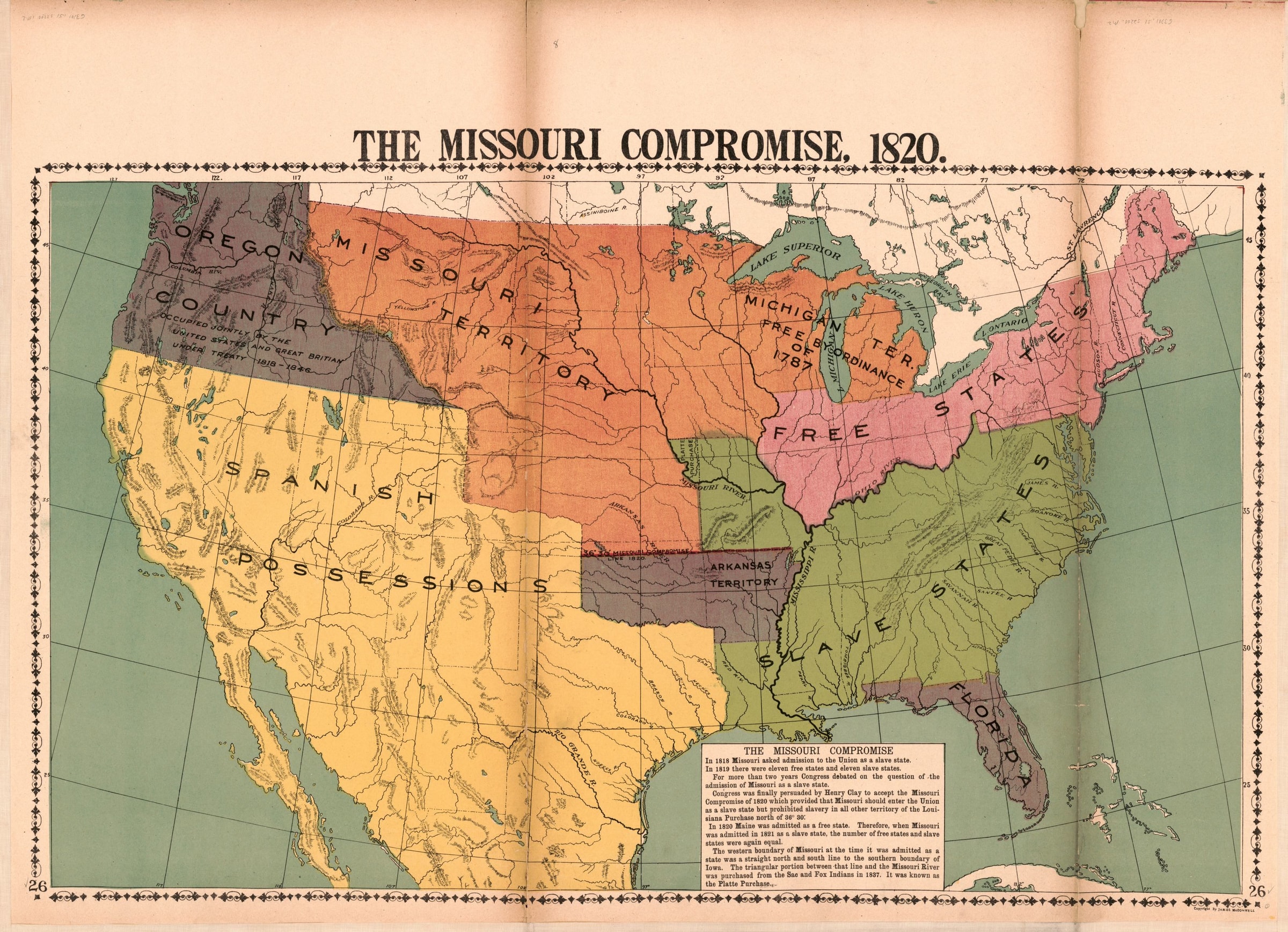
Since Vermont (free) and Kentucky (slave) entered the Union in 1791-1792, Congress had tried to keep a sectional balance. The North's faster-growing population gave it a House majority of 105 to 81 by 1818, but the Senate stayed even at 11 slave states and 11 free states. That Senate balance let southern senators block any legislation threatening their section.
Missouri's 1819 statehood application alarmed the North because slavery was already well established there. Missouri as a slave state would tip the balance south. It was also the first piece of the Louisiana Purchase to apply for statehood, so both sides worried about the precedent for the rest of that vast territory.
The Tallmadge Amendment, proposed by Representative James Tallmadge of New York, ignited the fight. It would have (1) prohibited bringing more enslaved people into Missouri and (2) freed the children of Missouri slaves at age 25, gradually ending slavery there. Enraged southerners saw it as step one toward abolishing slavery everywhere, and the Senate defeated it.
After months of angry debate, Henry Clay won majority support for three bills that together formed the Missouri Compromise, signed by Monroe in March 1820:
- Admit Missouri as a slave-holding state
- Admit Maine as a free state (keeping the Senate at 12-12)
- Prohibit slavery in the rest of the Louisiana Territory north of latitude 36°30'
The aftermath cuts both ways, and the exam loves that nuance. The compromise preserved sectional balance for more than 30 years and bought the nation time to mature. But it only temporarily stemmed the tension between opponents and defenders of slavery, and the crisis left Americans torn between nationalism and sectionalism. That tension drives everything through the Civil War.
Key Terms to Know
| Term | Why it matters |
|---|---|
| Era of Good Feelings | Nickname for the Monroe years of one-party nationalism, misleading because sectional and factional fights raged underneath. |
| James Monroe | Fifth president (fourth Virginian of the first five); his terms saw Florida's acquisition, the Missouri Compromise, and the Monroe Doctrine. |
| Economic nationalism | Post-War of 1812 movement to grow the national economy through tariffs and internal improvements. |
| Sectionalism | Loyalty to your own region over the nation, the force pulling against nationalism throughout this topic. |
| Tariff of 1816 | The first protective tariff in U.S. history, designed to shield new American factories from British dumping. |
| Protective tariff | A tariff meant to protect domestic industry from foreign competition, not just raise revenue. |
| Henry Clay | Kentucky House leader who designed the American System and brokered the Missouri Compromise. |
| American System | Clay's three-part plan: protective tariffs, a national bank, and internal improvements, pitched as benefiting every section. |
| Internal improvements | Federally funded roads and canals; Madison and Monroe vetoed them as unconstitutional, leaving the work to states. |
| Second Bank of the United States | Chartered in 1816; its credit tightening triggered the Panic of 1819 and made it a western villain. |
| Panic of 1819 | First major financial panic under the Constitution; foreclosures hit the West hardest and turned it against the Bank. |
| Tallmadge Amendment | New York congressman's plan to gradually end slavery in Missouri; its defeat exposed raw sectional anger. |
| Missouri Compromise (1820) | Missouri enters slave, Maine enters free, slavery banned in the Louisiana Territory north of 36°30'; preserved balance for 30+ years. |
| 36°30' line | The latitude dividing future free and slave territory in the Louisiana Purchase under the compromise. |
| Sectional balance | The 11-11 (then 12-12) split of slave and free states in the Senate that let the South block threatening legislation. |
Practice and Next Steps
Pair these notes with the Fiveable Topic 4.3 Politics and Regional Interests study guide for the course-aligned version of this material, and browse the full set of APUSH AMSCO notes to keep moving through Unit 4. If you skipped the setup, AMSCO 4.1 Contextualizing Period 4 frames the whole period in a few minutes.
To check yourself, run some APUSH multiple-choice practice questions on Unit 4, then try writing about nationalism vs. sectionalism with FRQ practice and instant scoring. The APUSH key terms glossary is handy for quick definition checks before a quiz.
Frequently Asked Questions
What is AMSCO 4.3 Politics and Regional Interests about?
AMSCO 4.3 covers the Era of Good Feelings under James Monroe and the regional conflicts hiding beneath it: the Tariff of 1816, Henry Clay's American System, the Panic of 1819, and the Missouri Compromise of 1820. The big theme is nationalism versus sectionalism, with regional interests shaping leaders' positions on slavery and economic policy.
What were the three parts of Henry Clay's American System?
The American System had three parts: protective tariffs, a national bank, and internal improvements (federally built roads and canals). Two parts existed by 1816 with the protective tariff and the Second Bank of the United States, but Madison and Monroe vetoed federal internal improvements as unconstitutional, so states built them on their own.
What did the Missouri Compromise of 1820 actually do?
It admitted Missouri as a slave state, admitted Maine as a free state to keep the Senate balanced at 12-12, and banned slavery in the rest of the Louisiana Territory north of latitude 36°30'. It preserved sectional balance for more than 30 years but only temporarily calmed the fight between opponents and defenders of slavery.
Was the Era of Good Feelings actually peaceful?
Not really, and that's the point AMSCO makes. One party (the Democratic-Republicans) dominated after the Federalists collapsed, but Americans fought hard over tariffs, the national bank, internal improvements, and slavery, and the party itself split into factions. AMSCO suggests the real 'good feelings' lasted only from the election of 1816 to the Panic of 1819.
How does Topic 4.3 show up on the APUSH exam?
It feeds directly into questions about how regional interests shaped debates over the federal government's role, like sectional reactions to the Tariff of 1816, whether the American System helped the whole nation or specific regions, and why the Missouri Compromise was only a temporary fix for slavery tensions. Try Unit 4 questions in APUSH guided practice to test these themes.
Why did the South and West support the Tariff of 1816 but oppose later tariffs?
In 1816, the South and West believed a protective tariff was needed for national prosperity after the War of 1812, so they backed it even though they had opposed tariffs before. New England, with little manufacturing yet, was the only section opposed. As sectional interests sharpened, leaders like Calhoun and Webster flipped their tariff positions by the 1820s.
See Fiveable more often in Google
Mark Fiveable as a preferred source and Google is more likely to show you our guides in Top Stories, with a "preferred" badge in AI Mode and AI Overviews.