Earning the APUSH LEQ Complexity Point

🇺🇸AP US History Review
Earning the APUSH LEQ Complexity Point
Overview
The complexity point is the final point on the 6-point APUSH LEQ rubric, awarded under the Analysis and Reasoning category for demonstrating "a complex understanding of the historical development that is the focus of the prompt through sophisticated argumentation and/or effective use of evidence." It is widely considered the hardest point to earn because it rewards nuance, not a checklist item you can drop in with one sentence. This guide covers only the complexity point; for the full essay format, timing, and all six rubric points, start with the main APUSH LEQ guide.
Quick recap: the LEQ is the last question on the exam, worth 15% of your score, with a recommended 40 minutes. You pick one of three prompts, each covering a different time span.
One honest note before you stress: plenty of students earn 5s without the complexity point. If you're tight on time, lock in the other five points first. This guide is for squeezing out that sixth point once the rest of your essay is solid.
What the Rubric Requires
The complexity point is worth 1 point and sits in the Analysis and Reasoning category of the LEQ rubric (the other Analysis and Reasoning point goes to using historical reasoning like comparison, causation, or continuity and change to structure your argument). The full rubric breaks down as Thesis (1 point), Contextualization (1 point), Evidence (2 points), and Analysis and Reasoning (2 points).
To earn the complexity point, your response must demonstrate a complex understanding through sophisticated argumentation and/or effective use of evidence. The College Board lists several ways to do this through argumentation, such as:
- Explaining multiple themes or perspectives to explore complexity or nuance
- Explaining multiple causes or effects, multiple similarities or differences, or multiple continuities or changes
- Explaining both cause and effect, both similarity and difference, or both continuity and change
- Explaining relevant and insightful connections within and across periods or geographical areas, where those connections clearly relate to an argument that responds to the prompt
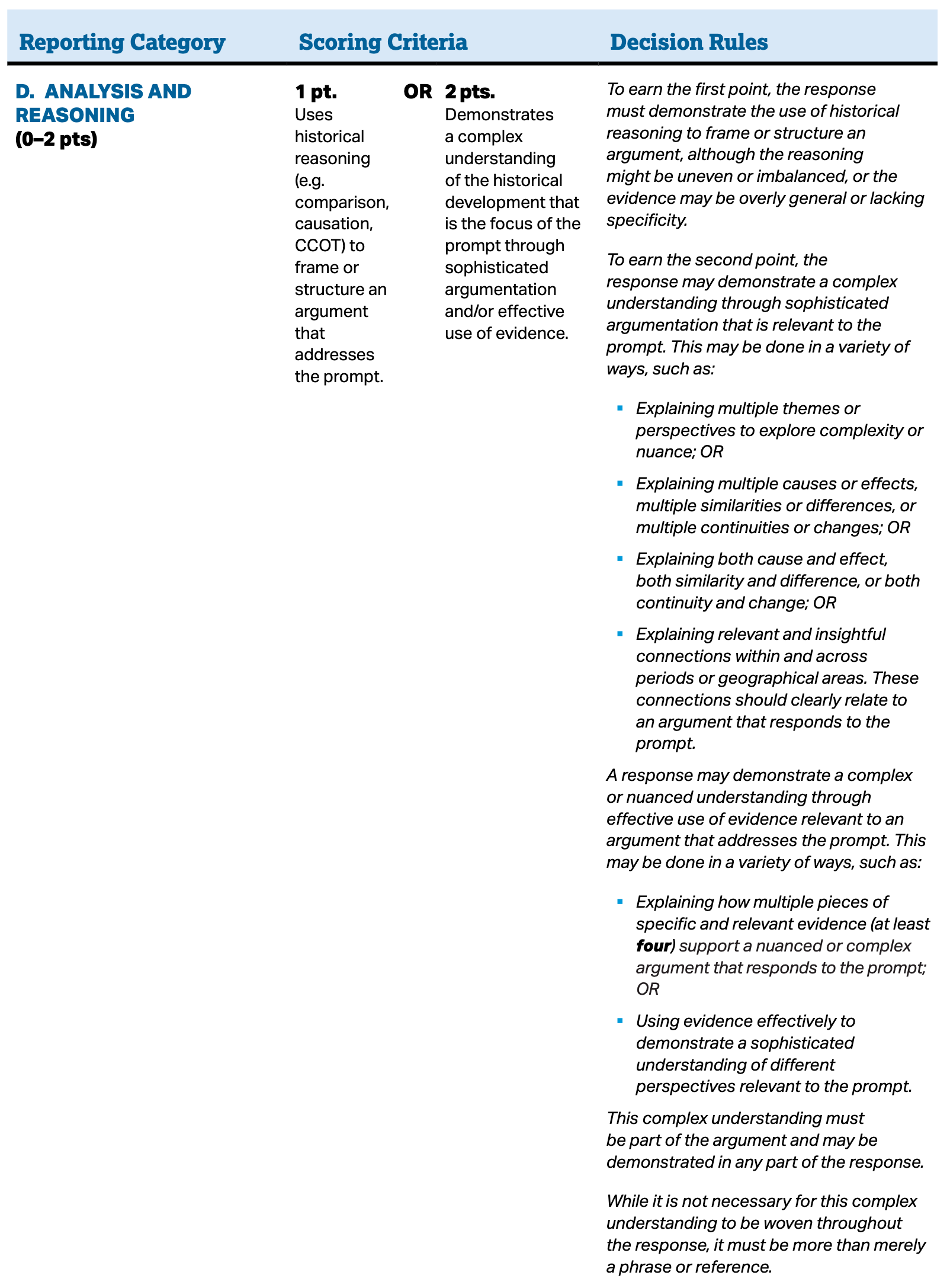
A snapshot of the Analysis and Reasoning section of the rubric, which includes the complexity point. Image courtesy of College Board, APUSH Course and Exam Description.
Two decision rules matter a lot here:
- The complex understanding must be part of your argument. It can appear in any part of the response, but it has to connect to the case you're making, not float on its own.
- It must be more than a phrase or reference. Tacking "however, some continuity remained" onto your conclusion will not earn the point. You have to actually explain the nuance.
The good news hiding in rule 1: complexity does not have to be woven through every paragraph. A well-developed counterargument paragraph, or a sustained "both change AND continuity" structure, can do the job.
How to Earn It, Step by Step
The most reliable path to complexity is to build it into your essay's architecture from the start, then develop it with real evidence and explanation. Here's the process.
Step 1: Write a thesis that sets up complexity
A complex argument starts with a complex thesis. A complex thesis is nuanced (it accounts for factors beyond the obvious one-line answer) and multifaceted (it approaches the prompt from more than one angle). The easiest way to do this is to build a counterclaim or limitation directly into the thesis, which carves out space in your essay structure to engage with multiple ideas.
Take the sample LEQ prompt from the College Board: "Evaluate the extent to which the ratification of the United States Constitution fostered change in the function of the federal government in the period from 1776 to 1800."
Here's an editorial example of a simple thesis that would earn the thesis point but sets up nothing complex:
The ratification of the Constitution significantly changed the function of the federal government by creating a stronger central authority with the power to tax and regulate commerce.
One claim, one direction. Now an editorial example of a thesis that sets up complexity:
While the ratification of the Constitution transformed the federal government from the weak coordinator of the Articles of Confederation into a national authority that could tax, regulate commerce, and enforce its own laws, deep-rooted fears of centralized power persisted, producing the Bill of Rights and a Democratic-Republican opposition that kept the government's reach contested through 1800.
This thesis argues both change and continuity, which is one of the College Board's listed pathways to the point. It also commits you to body paragraphs that explore each side.
One warning: only attempt this if you can follow through. A clear, cohesive simple argument beats a long-winded "complex" one that confuses the reader and loses you other points. Make sure your body paragraphs actually deliver what the thesis promises.
Step 2: Pick one complexity pathway and commit
Don't try to do all four bullet points from the rubric. Pick the pathway that fits the prompt's reasoning process and develop it fully:
- For a "turning point" or change-over-time prompt, argue both change AND continuity.
- For a causation prompt, explain multiple causes or both cause and effect.
- For a comparison prompt, explain both similarity and difference.
- If you know material from other periods well, draw an insightful connection across periods that genuinely supports your argument (for example, connecting Reconstruction-era federal power debates back to the ratification fights of the 1780s).
Whichever you choose, frame it with the historical reasoning process the prompt asks for. That reasoning structure also earns you the other Analysis and Reasoning point, so the two points reinforce each other. The Analysis and Reasoning guide covers that companion point in depth.
Step 3: Develop nuance with modification, corroboration, and qualification
These three moves (think "MCQ") are how complexity actually shows up in your paragraphs.
Modification means using evidence to refine your claim as the essay develops, showing that the initial claim was too simple to capture historical reality. Editorial example for a prompt on the causes of the American Revolution: open by arguing that Enlightenment ideas about natural rights drove the Revolution, then modify the argument to acknowledge that economic grievances like the Stamp Act and Townshend duties did just as much to mobilize ordinary colonists. The argument grows more accurate as it goes.
Corroboration means stacking multiple pieces of evidence that confirm your claim, each one fully explained. Editorial example for the prompt "Evaluate the extent to which the Civil War was a turning point in the lives of African Americans": describe the Emancipation Proclamation, the formation of Black regiments like the 54th Massachusetts, and the ratification of the 13th Amendment, and explain how each one supports the claim that the war catalyzed a movement toward legal freedom. On the LEQ all evidence comes from your own knowledge, so the explanation connecting each example to the thesis is doing the heavy lifting. (This also strengthens your evidence points.)
Qualification means showing the limits of your claim, the conditions under which it doesn't hold. This isn't weakening your argument; it's showing the claim doesn't apply to everything. Continuing the Civil War example: qualify the "turning point" claim by explaining that Black Codes, sharecropping, and the collapse of Reconstruction meant that for many African Americans in the South, daily economic and social conditions changed far less than the constitutional amendments suggest. A turning point on paper, contested in practice. That's a complex understanding.
Step 4: Make it more than a phrase
Wherever your complexity lives, develop it for at least several sentences with specific evidence attached. Test yourself: if you deleted the nuance, would a body paragraph collapse? If yes, it's woven into the argument. If you'd only lose one sentence in the conclusion, it's a phrase, and it won't earn the point. The same "more than a phrase" standard applies to contextualization, so readers are trained to spot drive-by references.
Common Mistakes
- The one-liner counterargument. Writing "however, others disagree" or "some continuity remained" in the conclusion. Fix: develop the counterpoint with at least one specific piece of evidence and a few sentences of explanation tied to your thesis.
- Complexity that contradicts the thesis. Arguing change for three paragraphs, then suddenly arguing nothing changed. Fix: build the tension into your thesis up front ("significant change in X, but continuity in Y") so the nuance reads as one coherent argument.
- Chasing complexity before securing the basics. Spending ten minutes crafting nuance while the essay lacks two pieces of specific evidence. Fix: earn the thesis, contextualization, and evidence points first. Complexity is the bonus, not the foundation.
- Listing instead of explaining. Naming three causes of an event without explaining how each operated. Fix: the rubric pathways all start with "explaining." Every cause, effect, similarity, or continuity you raise needs a how-or-why sentence.
- Off-topic connections. Jumping to another time period just to show off knowledge. Fix: cross-period connections only count when they clearly support an argument that responds to the prompt. If the connection doesn't strengthen your answer, cut it.
- A confusing "complex" thesis. Cramming so many clauses into the thesis that the line of reasoning disappears. Fix: a clear two-part structure (strong claim plus one well-chosen qualification) beats a tangled four-part one every time.
Practice and Next Steps
The complexity point only comes from reps. Pick a released prompt, write a thesis with a built-in qualification, and draft one paragraph that develops the counterpoint with specific evidence. Then check it against the rubric: is it explained, evidenced, and tied to your argument, or is it a phrase?
- Write full timed essays with FRQ practice and instant scoring to see whether your nuance is landing.
- Pull real prompts from past APUSH exams and practice writing complex theses in 5 minutes each, no full essay required.
- Review the other five points in the APUSH LEQ hub guide so complexity sits on top of a complete essay.
- Shore up the specific evidence you'll need for corroboration with the APUSH key terms glossary.
Frequently Asked Questions
What is the complexity point on the APUSH LEQ?
It's the final point on the 6-point LEQ rubric, awarded for demonstrating a complex understanding of the historical development in the prompt through sophisticated argumentation and/or effective use of evidence. Listed pathways include explaining both change and continuity, both cause and effect, multiple perspectives, or insightful connections across time periods. It must be part of your argument and more than a single phrase or reference.
Do you need the complexity point to get a 5 on APUSH?
No. Plenty of students earn 5s without the complexity point, since the LEQ is only worth 15% of the exam and the other five rubric points (thesis, contextualization, two evidence points, and historical reasoning) are far more reliable to earn. Secure those first, then treat complexity as a bonus.
Can one sentence earn the complexity point on the LEQ?
Almost never. The rubric's decision rules say the complex understanding must be more than merely a phrase or reference and must be part of the argument, so a throwaway 'however, some disagree' line in your conclusion won't count. Develop the nuance across several sentences with specific evidence, like a full counterargument or qualification paragraph.
How is the APUSH LEQ rubric broken down?
The LEQ is scored out of 6 points: Thesis (1), Contextualization (1), Evidence (2), and Analysis and Reasoning (2). The Analysis and Reasoning category splits into one point for using historical reasoning like causation or continuity and change, and one point for complex understanding. The full LEQ guide walks through all six points.
What's the easiest way to show complex understanding on the LEQ?
Build a counterclaim or qualification directly into your thesis, then develop it in a body paragraph with specific evidence. For example, on a turning point prompt, argue both significant change and meaningful continuity, which matches one of the College Board's listed pathways to the point. Modification, corroboration, and qualification of your claims are the three concrete moves that make nuance show up in your writing.
See Fiveable more often in Google
Mark Fiveable as a preferred source and Google is more likely to show you our guides in Top Stories, with a "preferred" badge in AI Mode and AI Overviews.