AMSCO 4.2 The Rise of Political Parties and the Era of Jefferson

🇺🇸AP US History Review
AMSCO 4.2 The Rise of Political Parties and the Era of Jefferson
🇺🇸 AP US History
AMSCO 1.2:Native American Societies Before European Contact Notes
AMSCO 2.1 Context: European Colonization of North America Notes
AMSCO 2.2 European Colonization Notes
AMSCO 2.3 The Regions of the British Colonies Notes
AMSCO 2.4 Transatlantic Trade Notes
AMSCO 2.5 Interactions between American Indians and Europeans Notes
AMSCO 2.6 Slavery in the British Colonies Notes
AMSCO 2.7 Colonial Society and Culture Notes
AMSCO 2.8 Comparison in Period 2 (1607-1754) Notes
AMSCO 3.1 Contextualizing Period 3
AMSCO 3.2 The Seven Year's War
AMSCO 3.3 Taxation Without Representation
AMSCO 3.4 Philosophical Foundations of the American Revolution
AMSCO 3.5 The American Revolution
AMSCO 3.6 The Influence of Revolutionary Ideals
AMSCO 3.7 The Articles of Confederation
AMSCO 3.8 The Constitutional Convention and Debates Over Ratification
AMSCO 3.9 The Constitution
AMSCO 3.10 Shaping a New Republic
AMSCO 3.11 Developing an American Identity
AMSCO 3.12 Movements in the Early Republic
AMSCO 3.13 Continuity and Change in Period 3
AMSCO 4.1 Contextualizing Period 4
AMSCO 4.2 The Rise of Political Parties and the Era of Jefferson
AMSCO 4.3 Politics and Regional Interests
AMSCO 4.4 America on the World Stage
AMSCO 4.5 Market Revolution
AMSCO 4.6 Effects of the Market Revolution on Society and Culture
AMSCO 4.7 Expanding Democracy
AMSCO 4.8 Jackson and Federal Power
AMSCO 4.9 The Development of an American Culture
AMSCO 4.10 The Second Great Awakening
AMSCO 4.11 An Age of Reform
AMSCO 4.12 African Americans in the Early Republic
AMSCO 4.13 Southern Society in the Early Republic
AMSCO 4.14 Causation in Period 4
AMSCO 5.1 Contextualizing Period 5
AMSCO 5.2 The Idea of Manfiest Destiny
AMSCO 5.3 Manifest Destiny and the Mexican-American War
AMSCO 5.4 The Compromise of 1850
AMSCO 5.5 Sectional Conflict: Regional Differences
AMSCO 5.6 Failure of Compromise
AMSCO 5.7 Election of 1860 and Secession
AMSCO 5.8 Military Conflict in the Civil War
AMSCO 5.9 Government Policies During the Civil War
AMSCO 5.10 Reconstruction
AMSCO 5.11 Failure of Reconstruction
AMSCO 5.12 Comparion in Period 5
AMSCO 6.1 Contextualizing Period 6
AMSCO 6.2 Westward Expansion: Economic Development
AMSCO 6.3 Westward Expansion: Social and Cultural Development
AMSCO 6.4 The "New South"
AMSCO 6.5 Technological Innovation
AMSCO 6.6 The Rise of Industrial Capitalism
AMSCO 6.7 Labor in the Gilded Age
AMSCO 6.8 Immigration and Migration in the Gilded Age
AMSCO 6.9 Responses to Immigration in the Gilded Age
AMSCO 6.10 Development of the Middle Class
AMSCO 6.11 Reform in the Gilded Age
AMSCO 6.12 Role of Government in the Gilded Age
AMSCO 6.13 Politics in the Gilded Age
AMSCO 6.14 Continuity and Change Period 6
AMSCO 7.1 Contextualizing Period 7
AMSCO 7.2 Imperialism: Debates
AMSCO 7.3 The Spanish-American War and U.S. Foreign Policy to 1917
AMSCO 7.4 The Progressives
AMSCO 7.5 World War I: Military and Diplomacy
AMSCO 7.6 World War I: Home Front
AMSCO 7.7 1920s: Innovations in Communication and Technology
AMSCO 7.8 1920s: Cultural and Political Controversies
AMSCO 7.9 The Great Depression
AMSCO 7.10 The New Deal
AMSCO 7.11 Inerwar Foreign Policy
AMSCO 7.12 World War II Mobilization
AMSCO 7.13 World War II Military
AMSCO 7.14 World War II and Postwar Diplomacy
AMSCO 7.15 Comparison in Period 7
AMSCO 8.1 Contextualizing Period 8
AMSCO 8.2 The Cold War from 1945 to 1980
AMSCO 8.3 The Red Scare
AMSCO 8.4 Economy after 1945
AMSCO 8.5 Culture after 1945
AMSCO 8.6 Early Steps in the Civil Rights Movement, 1945-1960
AMSCO 8.7 America as a World Power
AMSCO 8.8 The Vietnam War
AMSCO 8.9 The Great Society
AMSCO 8.10 The African American Civil Rights Movement in the 1960s
AMSCO 8.11 The Civil Rights Movement Expands
AMSCO 8.12 Youth Culture of the 1960s
AMSCO 8.13 The Environment and Natural Resources from 1968 to 1980
AMSCO 8.14 Society in Transition
AMSCO 8.15 Continuity and Change in Period 8
AMSCO 9.1 Contextualizing Period 9
AMSCO 9.2 Reagan and Conservatism
AMSCO 9.3 The End of the Cold War
AMSCO 9.4 A Changing Economy
AMSCO 9.5 Migration and Immgiration in the 1990s and 2000s
AMSCO 9.6 Challenges of the 21st Century
AMSCO 9.7 Causation in Period 9
AMSCO 1.1 Contextualizing Period 1 Notes
AMSCO 1.3 European Exploration in the Americas Notes
AMSCO 1.4 Columbian Exchange, Spanish Exploration, and Conquest Notes
AMSCO 1.5 Labor, Slavery, and Caste in the Spanish Colonial System Notes
AMSCO 1.6 Cultural Interactions in the Americas Notes
AMSCO 1.7 Causation in Period 1 Notes
Overview
AMSCO Topic 4.2, The Rise of Political Parties and the Era of Jefferson, covers the election of 1800, Jefferson's presidency, the Louisiana Purchase, Aaron Burr's schemes, John Marshall's landmark Supreme Court decisions, and Madison's election in 1808. This chapter kicks off the political story of Period 4 (1800-1848): two parties, the Federalists and Democratic-Republicans, fighting over how strong the federal government should be, and a Supreme Court quietly deciding that question for them. For the AP exam, the two biggest takeaways are the peaceful transfer of power in 1800 and judicial review from Marbury v. Madison.
Key Takeaways
- In 1800, the Democratic-Republicans defeated the Federalists for the presidency and Congress, and power passed between the parties without violence.
- Jefferson kept the national bank and neutrality policies while reducing the military, federal jobs, taxes, and national debt.
- The Louisiana Purchase more than doubled U.S. territory, but Jefferson had to justify buying land despite his belief in strict constitutional interpretation.
- Jefferson's effort to remove Federalist judges mostly failed, while Burr's secession plot collapsed and a jury later acquitted him of treason.
- Marshall's Marbury v. Madison ruling established judicial review, and his other major decisions strengthened federal power over the states.
- With Jefferson's backing, Madison won the presidency in 1808 despite rival Democratic-Republican candidates.
The Election of 1800 and the Revolution of 1800
The election of 1800 was the first presidential election with a clear choice between political parties, and it ended with the Federalists losing both the presidency and Congress to the Democratic-Republicans.
Why the Federalists lost popularity under Adams:
- People hated the Alien and Sedition Acts
- New taxes to pay for a possible war with France angered voters
- Adams avoided war but pushed Congress to build up the U.S. Navy, which cost money
What each party stood for:
- Federalists (Hamilton's vision): stronger national government, leaned toward Great Britain
- Democratic-Republicans (Jefferson's vision): powers reserved to the states, leaned toward France
- Both parties supported tariffs on imports for revenue. Tariffs were the largest single source of federal revenue throughout the 19th century. The debate split regionally: Northern industrialists wanted high tariffs to block foreign competition, while Southerners who exported cotton wanted low tariffs to encourage trade.
The Jefferson-Burr Tie
Under the original Constitution, each elector cast two votes for president, with the runner-up becoming vice president. In 1800, electors gave equal votes to two Democratic-Republicans, Thomas Jefferson and Aaron Burr, producing a tie. The House of Representatives, voting by state, debated for days before choosing Jefferson. Alexander Hamilton urged his followers to back Jefferson, whom he considered less dangerous and of higher character than Burr.
Why It's Called a "Revolution"
Power passed from one party to another in 1801 without violence. The Federalists quietly accepted defeat and handed over the government. For the era, this was rare, and it signaled that the U.S. constitutional system could survive serious strain. That peaceful transfer is why historians call it the Revolution of 1800. Expect this concept on multiple choice and as continuity/change evidence in essays.
Jefferson's Presidency
Jefferson governed as a moderate in his first term, keeping some Federalist policies while shrinking the government to satisfy his own party.
What he kept (to win over Federalists):
- Hamilton's national bank and debt-repayment plan
- Washington's and Adams's neutrality policies in foreign affairs
What he changed (to keep Democratic-Republicans happy):
- Reduced the size of the military
- Eliminated federal jobs
- Repealed excise taxes, including the whiskey tax
- Lowered the national debt
- Suspended the Alien and Sedition Acts and released those jailed under them
One non-moderate move: he appointed only Democratic-Republicans to his cabinet, hoping to avoid the internal divisions that distracted Washington. Compared to Adams's troubled administration, Jefferson's first term was relatively calm.
The Louisiana Purchase
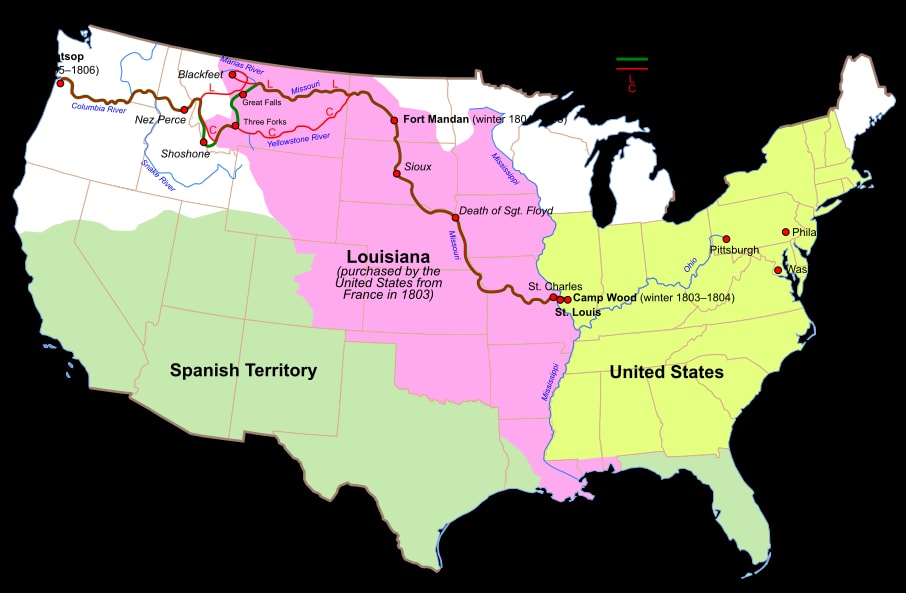
The Louisiana Purchase (1803) was the single most important achievement of Jefferson's first term. The U.S. bought the entire Louisiana Territory from France for $15 million, more than doubling the size of the country.
How It Happened
- France had lost Louisiana to Spain, but in 1800 Napoleon secretly forced Spain to give it back, hoping to rebuild a French empire in the Americas.
- By 1803 Napoleon gave up on that plan. He wanted to concentrate French resources on fighting Britain, and Toussaint L'Ouverture's rebellion against French rule on Santo Domingo had cost France heavily.
- Meanwhile, western American settlers depended on shipping goods down the Mississippi to New Orleans. In 1802, Spanish officials closed the port to Americans, revoking the right of deposit from the Pinckney Treaty of 1795. The frontier demanded action.
- Jefferson sent ministers to France with instructions to offer up to $10 million for New Orleans and a strip of land east to Florida. If that failed, they were to discuss a U.S.-Britain alliance. Instead, Napoleon's ministers, needing cash for war with Britain, offered the entire territory for $15 million. The American ministers went beyond their instructions and took the deal.
Jefferson's Constitutional Problem
Here's the irony the AP exam loves. Jefferson believed in strict interpretation of the Constitution and rejected Hamilton's implied powers argument. But no clause says a president can buy foreign land. Jefferson set aside his idealism for the country's good, arguing the purchase fell under the president's treaty-making power. Federalist senators criticized the treaty, but the Democratic-Republican Senate majority quickly ratified it.
Consequences
- More than doubled the size of the United States
- Removed a European presence from the nation's borders and pushed the frontier beyond the Mississippi
- Strengthened Jefferson's vision of an agrarian society of independent farmers over Hamilton's urban, industrial vision
- Boosted Jefferson's popularity and exposed the Federalists as a weak, sectionalist party based in New England
Lewis and Clark Expedition
Even before the purchase, Jefferson convinced Congress to fund an exploration of the trans-Mississippi West led by Meriwether Lewis and William Clark. They left St. Louis in 1804, crossed the Rockies, reached the Oregon coast, and returned by 1806. Benefits: greater geographic and scientific knowledge, stronger U.S. claims to the Oregon Territory, better relations with American Indians, and more accurate maps and routes for fur trappers and future settlers.
Judicial Impeachments and Aaron Burr
Jefferson tried to remove partisan Federalist judges through impeachment, but the campaign mostly failed. One mentally unbalanced district judge was impeached and removed. The House impeached Supreme Court Justice Samuel Chase, but the Senate acquitted him, finding no "high crimes." Nearly all Federalist judges stayed in office, though the threat made them more cautious and less partisan.
Jefferson won reelection in 1804 by a landslide, taking all but 14 of the 176 electoral votes. His second term was rougher: a Burr plot, a party split (the "Quids" accused him of abandoning party principles), and foreign trouble from the Napoleonic wars.
Burr's Downward Spiral
- Federalist conspiracy (1804): After the party caucus dropped him from the ticket, Burr secretly allied with radical New England Federalists to win the New York governorship, then lead New York and New England to secede. Hamilton led most Federalists in opposing him; Burr lost, and the plot collapsed.
- Duel with Hamilton (1804): Angered by an insult attributed to Hamilton, Burr challenged him to a duel and fatally shot him. Hamilton's death cost the Federalists their last great leader.
- Treason trial (1807): Burr's intrigues turned westward, with a plan to take Mexico from Spain and possibly unite it with Louisiana under his rule. Jefferson ordered his arrest, but a jury acquitted Burr based on Chief Justice John Marshall's narrow definition of treason and the lack of witnesses to any "overt act."
John Marshall's Supreme Court and Federal Power
John Marshall, appointed chief justice in the final months of Adams's presidency, served 34 years and consistently ruled in favor of the central government and property rights over states' rights. Even justices appointed by Democratic-Republican presidents often sided with him, persuaded that the Constitution created a federal government with strong, flexible powers. (Bonus irony: Marshall was Jefferson's cousin.)
Marbury v. Madison (1803)
The big one. Adams made "midnight appointments" of Federalist judges, but some commissions weren't delivered before Jefferson took office. Jefferson ordered Secretary of State James Madison not to deliver them, and appointee William Marbury sued. Marshall ruled that Marbury deserved his commission under the Judiciary Act of 1789, but that the act itself gave the Court more power than the Constitution allowed, so the law was unconstitutional and Marbury got nothing. Marshall traded a small Federalist win for a huge long-term one: judicial review, the Supreme Court's power to decide whether acts of Congress or the president are constitutional.
The Other Landmark Cases
- Fletcher v. Peck (1810): A state can't pass legislation invalidating a contract. First time the Court struck down a state law as unconstitutional.
- Martin v. Hunter's Lease (1816): The Supreme Court has jurisdiction over state courts in cases involving constitutional rights.
- Dartmouth College v. Woodward (1819): New Hampshire couldn't convert privately chartered Dartmouth into a public institution; a state can't alter a private corporation's contract.
- McCulloch v. Maryland (1819): Maryland couldn't tax the Second Bank of the United States because "the power to tax is the power to destroy" and federal laws are supreme. Using loose interpretation, Marshall also ruled that implied powers let the federal government create a national bank.
- Cohens v. Virginia (1821): The Supreme Court can review state court decisions involving federal powers.
- Gibbons v. Ogden (1821): New York's steamboat monopoly was unconstitutional because it conflicted with a congressional charter, establishing broad federal control of interstate commerce.
The pattern to remember: every one of these decisions strengthened the federal government over the states and established the judiciary as the final word on what the Constitution means.
Madison's Presidency Begins
James Madison won the presidency in 1808 with Jefferson's backing. Jefferson followed Washington's precedent of retiring after two terms and supported his close friend and secretary of state for the Democratic-Republican nomination. Madison was a brilliant thinker (he had led the writing and ratification of the Constitution and built the party with Jefferson), but he was a weak public speaker with a stubborn temperament and lacked Jefferson's political skills. Other Democratic-Republican factions nominated two rival candidates, yet Madison still won a majority of electoral votes, defeating them and the Federalist Charles Pinckney. His foreign-policy troubles pick up in AMSCO 4.4 America on the World Stage.
Key Terms to Know
| Term | Why it matters |
|---|---|
| Thomas Jefferson | Democratic-Republican president (1801-1809) who shrank the federal government but doubled the nation's size. |
| Revolution of 1800 | The peaceful transfer of power from Federalists to Democratic-Republicans, proving the constitutional system could endure. |
| Louisiana Purchase | The 1803 deal with France ($15 million) that more than doubled U.S. territory. |
| Aaron Burr | Vice president who killed Hamilton in a duel, plotted secession, and was acquitted of treason. |
| Lewis and Clark | Explorers (1804-1806) whose expedition mapped the West and strengthened U.S. claims to Oregon. |
| Strict interpretation | Jefferson's view that the government can only do what the Constitution explicitly allows, tested by the Louisiana Purchase. |
| John Marshall | Federalist chief justice for 34 years whose rulings consistently strengthened the federal government. |
| Judicial review | The Supreme Court's power to rule acts of Congress or the president unconstitutional, established in Marbury v. Madison. |
| Marbury v. Madison (1803) | The case that established judicial review by striking down part of the Judiciary Act of 1789. |
| Fletcher v. Peck (1810) | First Supreme Court ruling declaring a state law unconstitutional; states can't invalidate contracts. |
| Martin v. Hunter's Lease (1816) | Gave the Supreme Court jurisdiction over state courts on constitutional rights. |
| Dartmouth College v. Woodward (1819) | States can't alter contracts of private corporations. |
| McCulloch v. Maryland (1819) | States can't tax federal institutions; confirmed the national bank through implied powers. |
| Gibbons v. Ogden (1821) | Established broad federal control over interstate commerce. |
| Implied powers | Powers not explicitly in the Constitution but justified by loose interpretation, used to uphold the national bank. |
| Samuel Chase | Supreme Court justice impeached by the House but acquitted by the Senate, ending Jefferson's impeachment campaign. |
Practice and Next Steps
Review the course-aligned version of this material in the Topic 4.2 study guide, or back up to AMSCO 4.1 Contextualizing Period 4 for the big-picture setup. The story continues with AMSCO 4.3 Politics and Regional Interests. You can browse all chapter notes on the APUSH AMSCO notes page.
To check your understanding, try guided multiple choice practice on early republic politics, or write a practice essay and get instant feedback with FRQ practice. The key terms glossary is handy for quick definition checks before a quiz.
Frequently Asked Questions
What does AMSCO chapter 4.2 cover in APUSH?
AMSCO 4.2, The Rise of Political Parties and the Era of Jefferson, covers the election of 1800, Jefferson's presidency, the Louisiana Purchase, the Lewis and Clark expedition, Aaron Burr's conspiracies, John Marshall's Supreme Court decisions, and Madison's election in 1808. It opens the political narrative of Period 4 (1800-1848). You can also review the Topic 4.2 course study guide for the College Board framing.
Why is the election of 1800 called the Revolution of 1800?
Because power passed peacefully from one political party (the Federalists) to another (Jefferson's Democratic-Republicans) without violence, which was rare for the era. The Federalists quietly accepted defeat and gave up control of both the presidency and Congress. It showed the U.S. constitutional system could survive a major political transition, which is the key point APUSH essays expect you to make.
Why was the Louisiana Purchase a constitutional problem for Jefferson?
Jefferson believed in strict interpretation of the Constitution, and no clause explicitly gives the president power to purchase foreign land. He set aside that principle and justified the $15 million purchase under the president's treaty-making power, and the Democratic-Republican Senate ratified it. The contradiction between Jefferson's stated principles and his actions is a favorite APUSH exam angle.
What did Marbury v. Madison establish and why does it matter?
Marbury v. Madison (1803) established judicial review, the Supreme Court's power to declare acts of Congress or the president unconstitutional. Marshall ruled that Marbury deserved his commission but struck down part of the Judiciary Act of 1789, sacrificing a small Federalist win for a permanent expansion of judicial power. From then on, the Court could overrule the other two branches of the federal government.
What's the difference between Marbury v. Madison and Fletcher v. Peck?
In Marbury v. Madison (1803), the Supreme Court ruled a federal law unconstitutional for the first time. In Fletcher v. Peck (1810), it ruled a state law unconstitutional for the first time, holding that a state couldn't pass legislation invalidating a contract. Both decisions strengthened the federal judiciary, but they targeted different levels of government, a distinction multiple-choice questions like to test.
What Marshall Court cases should I know for the APUSH exam?
The big ones from AMSCO 4.2 are Marbury v. Madison (judicial review), McCulloch v. Maryland (implied powers and federal supremacy over state taxation), and Gibbons v. Ogden (federal control of interstate commerce), plus Fletcher v. Peck, Dartmouth College v. Woodward, Martin v. Hunter's Lease, and Cohens v. Virginia. The pattern that matters for essays: every decision strengthened federal power over the states. Test yourself with guided practice questions.
See Fiveable more often in Google
Mark Fiveable as a preferred source and Google is more likely to show you our guides in Top Stories, with a "preferred" badge in AI Mode and AI Overviews.