3.7 The Articles of Confederation

🇺🇸AP US History Unit 3 Review
3.7 The Articles of Confederation
🇺🇸 AP US History
3.1
Context: The Revolutionary Period
3.2
The Seven Years’ War (The French and Indian War)
3.3
Taxation without Representation
3.4
Philosophical Foundations of the American Revolution
3.5
The American Revolution
3.6
The Influence of Revolutionary Ideals
3.7
The Articles of Confederation
3.8
The Constitutional Convention and Debates over Ratification
3.9
The Constitution
3.10
Shaping a New Republic
3.11
Developing an American Identity
3.12
Movement in the Early Republic
3.13
Continuity and Change in Period 3 (1754-1800)
After independence, the United States had to create a government that reflected republican ideals while holding the states together. The Articles of Confederation created a weak central government, and its limits became clear through debt, trade disputes, and Shays' Rebellion.
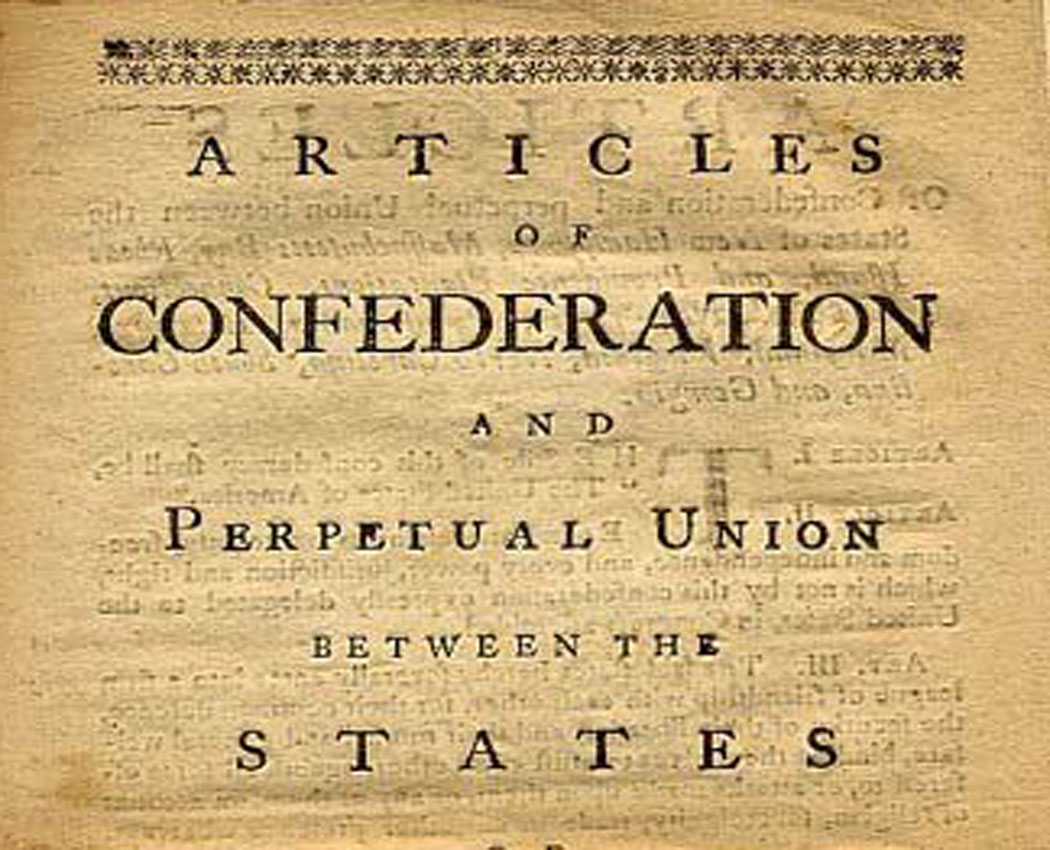
What to Know About the Articles of Confederation
- State constitutions included bills of rights, yearly legislative elections, and weak executive branches; Massachusetts submitted its constitution to voters for ratification.
- The Articles of Confederation created a loose union with a weak central government that could not tax or regulate commerce.
- The Land Ordinance of 1785 used western land sales to pay debt and support public schools, while the Northwest Ordinance of 1787 set a process for admitting new states.
- Farmers facing debt and foreclosure closed county courts, and Daniel Shays led an attack on the federal arsenal at Springfield.
- A Massachusetts militia defeated Shays' forces, but the rebellion showed that the national government could not raise troops and persuaded many elites that it needed more power.
State Constitutions
So what kind of laws did the U.S. have before the Constitution? After declaring independence from Britain, the Second Continental Congress asked each state to create its own state constitution. The states would write laws that reflected the new ideas of democracy.
The newly written laws would include bills of rights and yearly elections of legislators and weak executive branches. Massachusetts drafted its constitution and then submitted it to the people for ratification. This would later be copied in ratifying the national Constitution. Many state constitutions also vested most authority in the legislature, and many kept property-ownership requirements for voting and holding office.
Articles of Confederation
Just before the Declaration of Independence in 1776, a committee from the Second Continental Congress wrote a set of laws called the Articles of Confederation. These articles were the first constitution of the United States, and they established a loose confederation of states with a weak central government. The central government was given only limited powers, such as conducting foreign relations and waging war. Each state retained most of its power, and the central government could not tax or regulate commerce.
👎 Weaknesses of the Articles
The government under the Articles of Confederation proved to be ineffective in many ways, and it was soon clear that a new government needed to be established. Be sure to be familiar with the weaknesses of the Articles of Confederation:
| Weaknesses | Outcome |
|---|---|
| Congress had no power to levy or collect taxes | The government was always short of money |
| Congress had no power to regulate foreign trade | Quarrels broke out among states and trading with other countries was difficult |
| Congress had no power to enforce laws | The government depended on the states for law enforcement |
| Approval of 9/13 states was needed to enact laws | It was difficult to enact laws because of disagreements among the states |
| 13/13 states needed to approve amendments to the Articles | There was no practical way to change or amend the powers of the government when problems arose |
| The government had no executive branch, reflecting colonial suspicions of tyranny and federal authority. | There was no effective way to coordinate the work of the government |
| There was no national court system | The central government had no way to settle disputes among the states. |
💪 Strengths of the Articles
Although there were many weaknesses of the Articles, there were two strengths. Congress placed newly acquired western lands under its control for the benefit of all states:
- The Land Ordinance of 1785 - allowed the federal government to sell western lands to pay off the national debt and organize these new lands into townships and public schools.1. The new nation was "land rich," but was "money poor." Government leaders looked for ways to use the land to fund services, such as public education! This ordinance set a precedent for the public funding of schools.1. As mentioned, it also established a plan for dividing the land. The government would first survey the land, and then divide it into townships. Individuals could purchase a section of land and even further divide it into smaller units.1. Government leaders hoped the buyers of this land would develop farms and establish communities, developing settlements across the western territories.
- The Northwest Ordinance of 1787 - set a process for new states to join the United States of America, ensuring the country would continue to grow. New states were equal in status to existing states (the 13 colonies).1. Congress would appoint a territorial governor and judges1. When the territory reached 5,000 free adult males, the settlers could elect their own territorial legislature.1. When the population reached 60,000 free inhabitants, the settlers could write a state constitution, which had to be approved by Congress. Once approved, the state would be granted statehood with no slavery allowed. The ordinance's protections applied throughout the Northwest Territory, not only after statehood: it prohibited slavery there, safeguarded private property, and encouraged public education.
Shay's Rebellion
Shays' Rebellion was a series of armed protests that occurred in Massachusetts between 1786 and 1787, led by Revolutionary War veteran Daniel Shays. This uprising highlighted the weaknesses of the Articles of Confederation and helped convince many Americans of the need for a stronger central government.

Causes of the Rebellion
The rebellion emerged from several interconnected economic and political problems:
- War debt crisis - After the Revolutionary War, Massachusetts imposed heavy taxes to pay off its war debts
- Economic hardship - Many farmers faced mounting personal debts and potential foreclosure on their farms
- Currency shortage - A lack of paper money made it difficult for farmers to pay their debts and taxes
- Veteran grievances - Soldiers like Shays had been discharged without receiving promised pay for their service
- Unresponsive government - Many farmers felt the state legislature ignored their petitions for debt relief
The Uprising
The rebellion unfolded in stages as rural discontent escalated into armed conflict:
- Initially, farmers held peaceful conventions and petitioned the state legislature for relief
- When legal measures failed, protesters began forcibly closing county courts to prevent foreclosure proceedings
- Daniel Shays emerged as a leader, organizing several hundred farmers into a more coordinated resistance
- The rebellion reached its peak in January 1787 when Shays led approximately 1,500 men in an attack on the federal arsenal at Springfield
Suppression and Aftermath
The Massachusetts state government responded forcefully to the uprising:
- Governor James Bowdoin raised a private army funded by wealthy merchants
- This militia defeated Shays' forces at Springfield and pursued the rebels
- Many rebels were captured or scattered, and Shays escaped to Vermont
- While some leaders were sentenced to death, most received pardons when a more sympathetic governor took office
Significance for the Early Republic
Shays' Rebellion had profound effects on American political development:
-
Exposed weaknesses in the Articles of Confederation:
- The national government could not raise troops to suppress the rebellion
- It lacked the power to address economic problems that had caused the crisis
- It could not protect states from internal threats
-
Influenced Constitutional Convention:
- The rebellion occurred just months before the Constitutional Convention
- It convinced many elites that a stronger central government was necessary
- It demonstrated the need for a government that could maintain order while addressing legitimate grievances
-
Shaped specific Constitutional provisions:
- Power to tax to pay national debts
- Authority to establish a uniform currency
- Ability to raise an army to "suppress insurrections"
- Limitations on states' abilities to interfere with contracts
Shays' Rebellion marked a major moment in early American history when the ideals of the Revolution confronted the realities of governance. While viewed by some as a dangerous mob, others saw Shays and his followers as upholding the revolutionary principles of resistance to unjust authority. Ultimately, the rebellion helped push the nation toward creating the stronger federal government enshrined in the Constitution.
Shays' Rebellion was one important catalyst, along with broader failures under the Articles, that pushed leaders toward the Constitutional Convention.
Practice Questions for 3.7
1 of 10
The decision by many state legislatures to place most governmental power in the legislative branch rather than in executive offices reflected which of the following developments during the Revolutionary era?
A.
The Articles of Confederation had already proven that weak central governments could not function
B.
Colonial experience with royal governors created distrust of concentrated executive authority
C.
The need to establish property qualifications for voting required a strong legislative body
D.
International trade disputes required states to concentrate power in legislatures to negotiate with foreign nations
Vocabulary
The following words are mentioned explicitly in the AP® course framework for this topic.Term | Definition |
|---|---|
Articles of Confederation | The first constitution of the United States that created a weak central government with limited powers to coordinate the newly independent states. |
central government | The national government that unified the states under the Articles of Confederation, though with severely limited authority. |
foreign relations | Diplomatic and political relationships between the United States and other nations, which were difficult to manage under the weak central government. |
interstate commerce | Trade and economic activity between different states, which created conflicts under the Articles of Confederation. |
legislative branch | The branch of government responsible for making laws, which held primary power in many early state governments. |
Northwest Ordinance | A 1787 law enacted by Congress that established procedures for admitting new states and governed the Northwest Territory. |
Northwest Territory | The region north of the Ohio River and west of Pennsylvania, governed by the Northwest Ordinance. |
property qualifications | Requirements that individuals own a certain amount of property in order to vote or hold citizenship. |
state constitutions | Written documents that established the fundamental laws and structure of government for individual states during and after the Revolutionary period. |
See Fiveable more often in Google
Mark Fiveable as a preferred source and Google is more likely to show you our guides in Top Stories, with a "preferred" badge in AI Mode and AI Overviews.