AMSCO 2.4 Transatlantic Trade Notes

🇺🇸AP US History Review
AMSCO 2.4 Transatlantic Trade Notes
🇺🇸 AP US History
AMSCO 1.2:Native American Societies Before European Contact Notes
AMSCO 2.1 Context: European Colonization of North America Notes
AMSCO 2.2 European Colonization Notes
AMSCO 2.3 The Regions of the British Colonies Notes
AMSCO 2.4 Transatlantic Trade Notes
AMSCO 2.5 Interactions between American Indians and Europeans Notes
AMSCO 2.6 Slavery in the British Colonies Notes
AMSCO 2.7 Colonial Society and Culture Notes
AMSCO 2.8 Comparison in Period 2 (1607-1754) Notes
AMSCO 3.1 Contextualizing Period 3
AMSCO 3.2 The Seven Year's War
AMSCO 3.3 Taxation Without Representation
AMSCO 3.4 Philosophical Foundations of the American Revolution
AMSCO 3.5 The American Revolution
AMSCO 3.6 The Influence of Revolutionary Ideals
AMSCO 3.7 The Articles of Confederation
AMSCO 3.8 The Constitutional Convention and Debates Over Ratification
AMSCO 3.9 The Constitution
AMSCO 3.10 Shaping a New Republic
AMSCO 3.11 Developing an American Identity
AMSCO 3.12 Movements in the Early Republic
AMSCO 3.13 Continuity and Change in Period 3
AMSCO 4.1 Contextualizing Period 4
AMSCO 4.2 The Rise of Political Parties and the Era of Jefferson
AMSCO 4.3 Politics and Regional Interests
AMSCO 4.4 America on the World Stage
AMSCO 4.5 Market Revolution
AMSCO 4.6 Effects of the Market Revolution on Society and Culture
AMSCO 4.7 Expanding Democracy
AMSCO 4.8 Jackson and Federal Power
AMSCO 4.9 The Development of an American Culture
AMSCO 4.10 The Second Great Awakening
AMSCO 4.11 An Age of Reform
AMSCO 4.12 African Americans in the Early Republic
AMSCO 4.13 Southern Society in the Early Republic
AMSCO 4.14 Causation in Period 4
AMSCO 5.1 Contextualizing Period 5
AMSCO 5.2 The Idea of Manfiest Destiny
AMSCO 5.3 Manifest Destiny and the Mexican-American War
AMSCO 5.4 The Compromise of 1850
AMSCO 5.5 Sectional Conflict: Regional Differences
AMSCO 5.6 Failure of Compromise
AMSCO 5.7 Election of 1860 and Secession
AMSCO 5.8 Military Conflict in the Civil War
AMSCO 5.9 Government Policies During the Civil War
AMSCO 5.10 Reconstruction
AMSCO 5.11 Failure of Reconstruction
AMSCO 5.12 Comparion in Period 5
AMSCO 6.1 Contextualizing Period 6
AMSCO 6.2 Westward Expansion: Economic Development
AMSCO 6.3 Westward Expansion: Social and Cultural Development
AMSCO 6.4 The "New South"
AMSCO 6.5 Technological Innovation
AMSCO 6.6 The Rise of Industrial Capitalism
AMSCO 6.7 Labor in the Gilded Age
AMSCO 6.8 Immigration and Migration in the Gilded Age
AMSCO 6.9 Responses to Immigration in the Gilded Age
AMSCO 6.10 Development of the Middle Class
AMSCO 6.11 Reform in the Gilded Age
AMSCO 6.12 Role of Government in the Gilded Age
AMSCO 6.13 Politics in the Gilded Age
AMSCO 6.14 Continuity and Change Period 6
AMSCO 7.1 Contextualizing Period 7
AMSCO 7.2 Imperialism: Debates
AMSCO 7.3 The Spanish-American War and U.S. Foreign Policy to 1917
AMSCO 7.4 The Progressives
AMSCO 7.5 World War I: Military and Diplomacy
AMSCO 7.6 World War I: Home Front
AMSCO 7.7 1920s: Innovations in Communication and Technology
AMSCO 7.8 1920s: Cultural and Political Controversies
AMSCO 7.9 The Great Depression
AMSCO 7.10 The New Deal
AMSCO 7.11 Inerwar Foreign Policy
AMSCO 7.12 World War II Mobilization
AMSCO 7.13 World War II Military
AMSCO 7.14 World War II and Postwar Diplomacy
AMSCO 7.15 Comparison in Period 7
AMSCO 8.1 Contextualizing Period 8
AMSCO 8.2 The Cold War from 1945 to 1980
AMSCO 8.3 The Red Scare
AMSCO 8.4 Economy after 1945
AMSCO 8.5 Culture after 1945
AMSCO 8.6 Early Steps in the Civil Rights Movement, 1945-1960
AMSCO 8.7 America as a World Power
AMSCO 8.8 The Vietnam War
AMSCO 8.9 The Great Society
AMSCO 8.10 The African American Civil Rights Movement in the 1960s
AMSCO 8.11 The Civil Rights Movement Expands
AMSCO 8.12 Youth Culture of the 1960s
AMSCO 8.13 The Environment and Natural Resources from 1968 to 1980
AMSCO 8.14 Society in Transition
AMSCO 8.15 Continuity and Change in Period 8
AMSCO 9.1 Contextualizing Period 9
AMSCO 9.2 Reagan and Conservatism
AMSCO 9.3 The End of the Cold War
AMSCO 9.4 A Changing Economy
AMSCO 9.5 Migration and Immgiration in the 1990s and 2000s
AMSCO 9.6 Challenges of the 21st Century
AMSCO 9.7 Causation in Period 9
AMSCO 1.1 Contextualizing Period 1 Notes
AMSCO 1.3 European Exploration in the Americas Notes
AMSCO 1.4 Columbian Exchange, Spanish Exploration, and Conquest Notes
AMSCO 1.5 Labor, Slavery, and Caste in the Spanish Colonial System Notes
AMSCO 1.6 Cultural Interactions in the Americas Notes
AMSCO 1.7 Causation in Period 1 Notes
Overview
AMSCO Topic 2.4, Transatlantic Trade (AMSCO p.49 - p.53), covers how the Atlantic economy connected Europe, Africa, and the American colonies through triangular trade, and how England tried (and mostly failed) to control colonial commerce through mercantilist policy. The chapter runs from the Navigation Acts of 1650-1673 through the Dominion of New England and the Glorious Revolution of 1688, all within APUSH Period 2 (1607-1754). The big takeaway is a pattern you'll see again in Unit 3: England writes trade rules, colonists evade them, and salutary neglect lets the gap between policy and practice grow until it becomes the fundamental problem in the relationship.
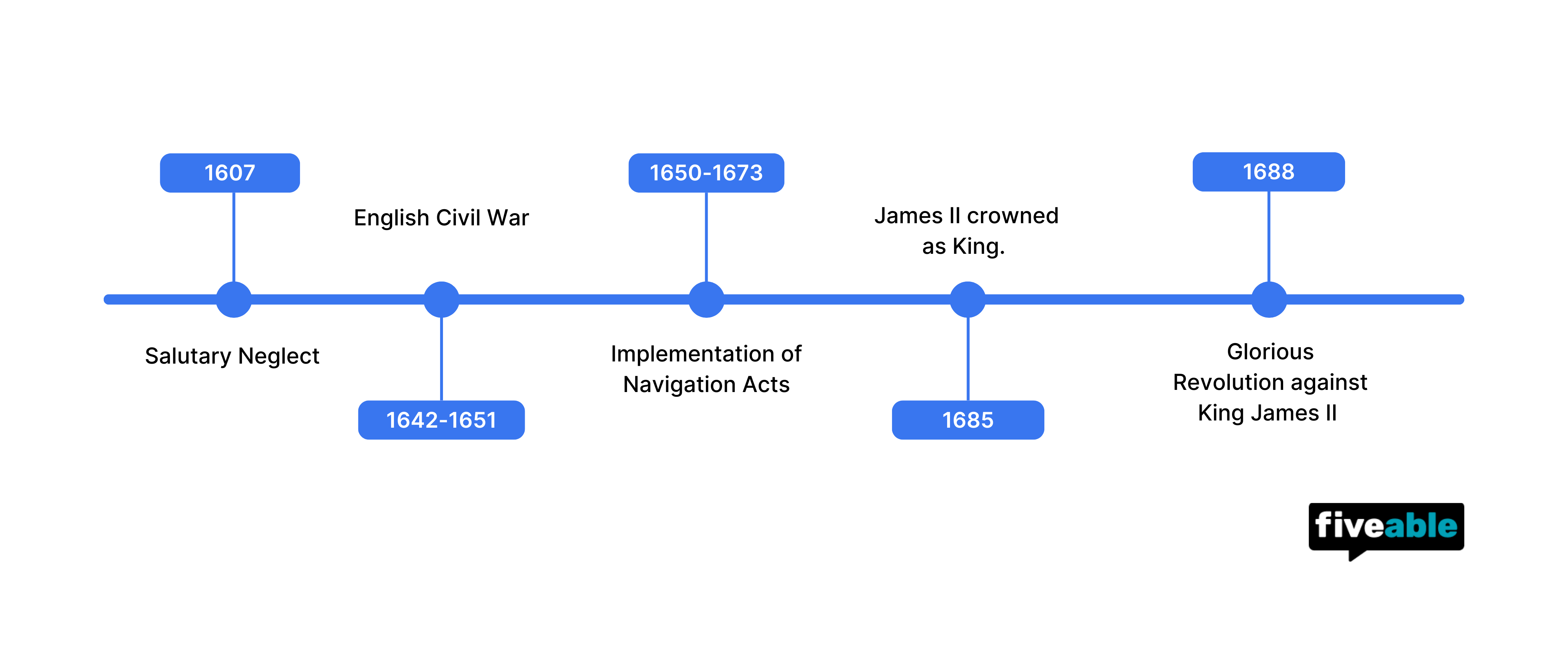
Timeline of the transatlantic trade period during the colonial era (1607-1754). Image Courtesy of Siya
Key Takeaways
- New England merchants traded rum for captive Africans, who endured the Middle Passage before survivors were exchanged for West Indian sugar; Parliament later ended the Royal African Company's monopoly when it could not meet planter demand.
- The Navigation Acts put mercantilism into practice by requiring English or colonial ships, routing most imports through England, and limiting enumerated exports to England.
- The Navigation Acts boosted New England shipbuilding and gave Chesapeake tobacco a monopoly in England, but Chesapeake farmers had to accept low prices because they could sell crops only to England.
- Colonists traded furs, food, and other goods with American Indians, creating ongoing contact and cultural exchange, especially along the western frontier.
- Salutary neglect meant England enforced trade rules loosely; distance made oversight difficult, and corrupt colonial agents helped merchants evade regulations with bribes.
- James II's Dominion of New England brought Sir Edmund Andros's taxes and limits on town meetings, but the Glorious Revolution ended the Dominion; salutary neglect and colonial resistance continued until 1763.
Triangular Trade
Triangular trade was a three-part shipping route connecting North America, Africa, and Europe, and every leg of it turned a profit for the merchants involved. A typical voyage starting in New England looked like this:
- A ship left a New England port carrying rum to West Africa, where the rum was traded for hundreds of captive Africans.
- The ship then sailed the Middle Passage, the horrific voyage across the Atlantic. Africans who survived were traded in the West Indies for sugarcane.
- The ship completed the triangle by returning to New England, where the sugar was sold to be made into rum, restarting the cycle.
Variations on the route included stops in England or Spain, but the logic was the same: each trade produced a substantial profit for the slave-trading entrepreneur.
A few details worth remembering:
- The chapter opens with Henry Louis Gates Jr.'s point that the slave trade depended on "complex business partnerships between African elites and European traders." It was a transatlantic business, not a one-sided raid.
- In the 17th century, English slave trading was monopolized by the Royal African Company (RAC). When the RAC couldn't supply enough enslaved Africans to meet planter demand, Parliament ended its monopoly in the late 17th century, and New England merchants entered the lucrative business.
- This is the economic backbone of slavery's growth in the colonies, which AMSCO develops further in Topic 2.6 on slavery in the British colonies.
Mercantilism and the Navigation Acts
Mercantilism is the economic theory that a country's wealth is determined by how much more it exports than it imports. Under this thinking, colonies existed for exactly one purpose: to enrich the parent country by supplying raw materials that fed its industries. Governments promoted sales abroad and used tariffs to discourage imports.
- Spain and France followed mercantilist policies from the start of colonization.
- England started applying them after the end of the English Civil War in 1651.
The Navigation Acts (1650-1673)
England put mercantilism into practice with a series of Navigation Acts passed between 1650 and 1673. The acts set three rules for colonial trade:
- Trade to and from the colonies could only be carried on English or colonial-built ships, operated by English or colonial crews.
- All goods imported into the colonies (except some perishables) had to pass through ports in England first.
- Specified "enumerated" goods from the colonies could be exported only to England. Tobacco was the original enumerated good, and the list expanded greatly over the years.
In plain terms: colonial trade had to flow through England, on England's terms, so England captured the profit.
Impact on the Colonies
The Navigation Acts cut both ways, and the exam loves this kind of "mixed effects" analysis.
Benefits for the colonies:
- Boosted New England shipbuilding (colonial-built ships counted as "English").
- Gave Chesapeake tobacco a monopoly in the English market.
- Provided English military protection against French and Spanish attacks.
- The triangular slave trade was largely unaffected by the increased regulations.
Costs for the colonies:
- Colonists couldn't manufacture their own goods, so they paid high prices for manufactured goods from England.
- Chesapeake farmers could sell their crops only to England, so they had to accept low prices. In the 1660s, low tobacco prices from overproduction brought hard times to Maryland and Virginia. When Virginia's House of Burgesses tried to raise tobacco prices, London merchants retaliated by raising prices on goods exported to Virginia.
Trade with American Indians
Colonists also kept trading with American Indians for furs, food, and other goods, which created ongoing contact and cultural exchange, especially along the western frontier.
- Some Indians adopted Christianity, and some colonial men married Indian women.
- Intermarriage was uncommon, and when it happened, the couple almost always lived in the Indian community rather than the settler one. Pocahontas and John Rolfe, who lived in Jamestown, were a rare exception.
- This thread continues in Topic 2.5 on interactions between American Indians and Europeans.
Salutary Neglect: Why Enforcement Failed
England's enforcement of its own trade rules was lax, a policy known as salutary neglect. Mercantilist theory called for strict enforcement; the practice was nearly the opposite. Three factors made enforcement difficult:
- Distance. The Atlantic Ocean separated London from the colonies, so exerting real authority over distant possessions was hard.
- England was distracted. Between 1642 and 1763, England was in constant turmoil: the English Civil War, a revolution that replaced the monarch, and four wars with France.
- Corruption. Britain's colonial agents were often corrupt, so colonial merchants evaded regulations easily with well-placed bribes.
AMSCO adds an interesting kicker: regulation might not have been necessary at all. England and its colonies were natural trading partners with close economic and cultural ties, and the colonies probably would have sold their abundant natural resources mostly to the English with or without rules forcing them to.
The Dominion of New England and the Glorious Revolution
When the crown did try to enforce its trade laws, it backfired. In 1684, the crown revoked the charter of Massachusetts Bay because the colony had been a center of smuggling. Whatever economic gains this brought England were offset by the damage to English-colonial relations. New Englanders especially defied the acts by smuggling goods from other countries.
James II and the Dominion
A new king, James II, took the throne in 1685, determined to increase royal control by combining colonies into larger administrative units and eliminating representative assemblies.
- In 1686, he merged New York, New Jersey, and the New England colonies into the Dominion of New England.
- Sir Edmund Andros was sent from England as governor. He made himself instantly unpopular by levying taxes, limiting town meetings, and revoking land titles.
The Glorious Revolution (1688)
James II's power grab triggered an uprising in England. The Glorious Revolution of 1688 deposed James and replaced him with William and Mary. James's fall ended the Dominion of New England, and the colonies went back to operating under separate charters.
Ongoing Trade Tensions
After the Glorious Revolution, mercantilist policies stayed on the books, but enforcement efforts were never sustained enough to be effective. Until 1763, salutary neglect and colonial resistance to regulation continued. Trade regulation wasn't the only source of friction between the colonists and England, but it would remain the fundamental problem. Hold onto that line; it sets up the imperial crisis after 1763 that drives Unit 3.
Key Terms to Know
| Term | Why it matters |
|---|---|
| Triangular trade | The three-part trade route linking New England (rum), West Africa (enslaved people), and the West Indies (sugar), with every leg producing profit. |
| Middle Passage | The horrendous Atlantic voyage that carried captive Africans to the Americas; many did not survive it. |
| Royal African Company | Held England's monopoly on the slave trade until it couldn't meet planter demand; Parliament ended the monopoly and New England merchants moved in. |
| Mercantilism | The theory that national wealth comes from exporting more than you import, which made colonies exist solely to enrich the parent country. |
| Navigation Acts | England's laws (1650-1673) requiring English or colonial ships, routing imports through English ports, and restricting enumerated goods to England. |
| Enumerated goods | Colonial products that could legally be exported only to England; tobacco was the first, and the list kept growing. |
| House of Burgesses | Virginia's assembly, which tried to raise tobacco prices in the 1660s, only to have London merchants raise prices on goods sold to Virginia. |
| Salutary neglect | England's lax enforcement of trade regulations, made possible by distance, England's domestic turmoil, and corrupt colonial agents. |
| Smuggling | The main colonial workaround to the Navigation Acts, especially in New England; it's why Massachusetts Bay lost its charter in 1684. |
| James II | The king (from 1685) who tried to tighten royal control by consolidating colonies and eliminating representative assemblies. |
| Dominion of New England | James II's 1686 merger of New York, New Jersey, and the New England colonies into one administrative unit. |
| Sir Edmund Andros | The dominion's unpopular governor, who levied taxes, limited town meetings, and revoked land titles. |
| Glorious Revolution | The 1688 uprising that deposed James II, installed William and Mary, and ended the Dominion of New England. |
| William and Mary | The monarchs who replaced James II; under them, the colonies returned to their separate charters. |
Practice and Next Steps
Pair these notes with the Topic 2.4 Transatlantic Trade course study guide for the College Board framing of the same material, and review how this topic connects to the colonial regions you covered in AMSCO 2.3. All the chapters in this unit live on the APUSH AMSCO Notes page.
To check your understanding:
- Run through guided multiple-choice practice on Period 2 to test cause-and-effect questions about trade and mercantilism.
- Try a practice FRQ with instant scoring. Salutary neglect and the Navigation Acts are classic SAQ and LEQ material.
- Look up any term that's still fuzzy in the APUSH key terms glossary.
Frequently Asked Questions
What does AMSCO Topic 2.4 Transatlantic Trade cover?
AMSCO 2.4 (p.49-53) covers the triangular trade connecting New England, West Africa, and the West Indies, mercantilism and the Navigation Acts of 1650-1673, salutary neglect, the Dominion of New England under Sir Edmund Andros, and the Glorious Revolution of 1688. It sits in APUSH Period 2 (1607-1754) and sets up the trade tensions that explode after 1763.
How did the Glorious Revolution affect the American colonies?
The Glorious Revolution of 1688 deposed James II and replaced him with William and Mary, which ended the Dominion of New England and returned the colonies to their separate charters. Mercantilist policies stayed in place afterward, but enforcement was never sustained, so salutary neglect and colonial resistance continued until 1763. You can review the full sequence in the Topic 2.4 course study guide.
See Fiveable more often in Google
Mark Fiveable as a preferred source and Google is more likely to show you our guides in Top Stories, with a "preferred" badge in AI Mode and AI Overviews.