8.1 Context: U.S. as a Global Leader

🇺🇸AP US History Unit 8 Review
8.1 Context: U.S. as a Global Leader
🇺🇸 AP US History
8.1
Context: U.S. as a Global Leader
8.2
The Cold War from 1945 to 1980
8.3
The Red Scare
8.4
Economy after 1945
8.5
Culture after 1945
8.6
Early Steps in the Civil Rights Movement (1940s and 1950s)
8.7
America as a World Power
8.8
The Vietnam War
8.9
The Great Society
8.10
The African American Civil Rights Movement (1960s)
8.11
The Expansion of the Civil Rights Movement
8.12
Youth Culture of the 1960s
8.13
The Environment and Natural Resources
8.14
Society in Transition
8.15
Continuity and Change in Period 8
Period 8 (1945-1980) makes up 10-17% of the APUSH exam and covers the United States as a global leader after World War II. Focus on how Cold War foreign policy, economic growth, migration, and civil rights movements shaped American power at home and abroad.
What to Know About Context
- The U.S. and Soviet Union competed for global influence after World War II, and U.S. containment policy led to military engagements, aid programs, and security agreements.
- The Civil Rights Movement challenged segregation and won major legal protections, while second-wave feminism fought for workplace equality, reproductive rights, and legal protections.
- Anti-war activism influenced public opinion on Vietnam, while 1960s youth counterculture rejected mainstream values and connected with other social movements.
- Post-war growth expanded the middle class, migration to Sun Belt states shifted where people lived, and pollution drew growing environmental concern.
- Great Society programs marked a peak in liberal influence, while conservatism grew and public trust in government fell after Vietnam, Watergate, and economic challenges.
- Decolonization created new nations, the U.S. sought influence in developing regions, and Soviet relations alternated between confrontation and détente.
The Cold War Context
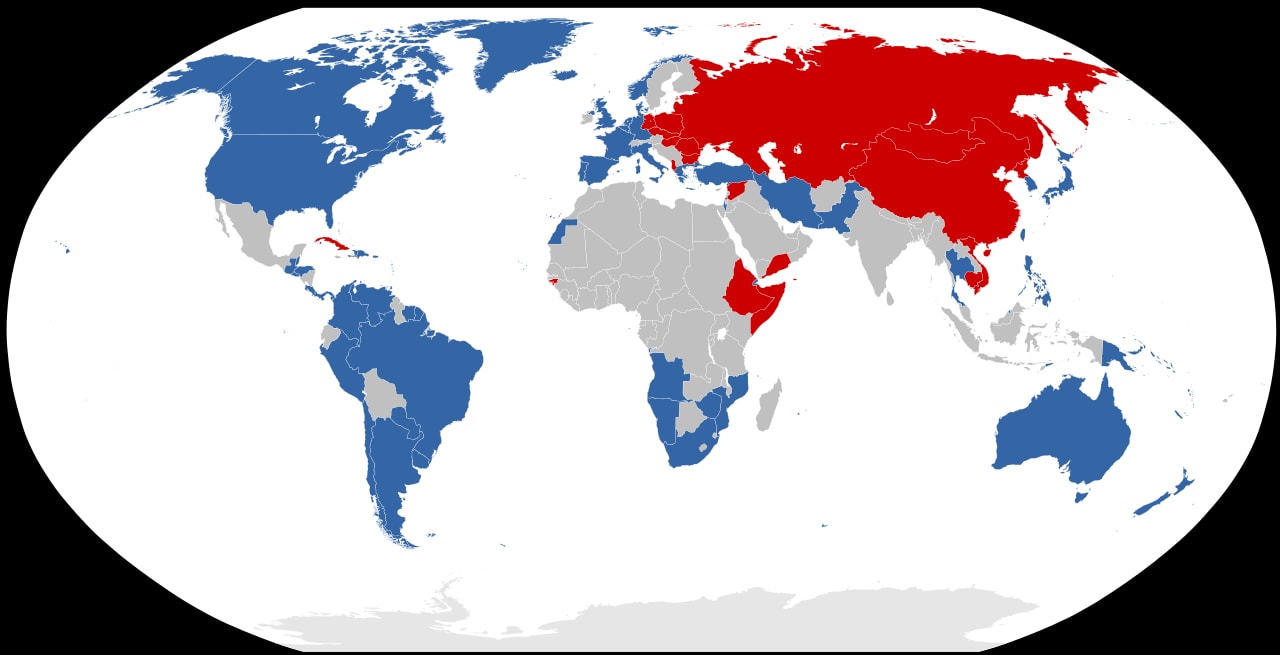
The Cold War fundamentally shaped American foreign and domestic policy during this period. Following World War II, the United States and Soviet Union emerged as competing superpowers with opposing ideologies - American democracy and capitalism versus Soviet communism. Though these nations never engaged in direct military conflict, they competed for global influence through:
- Proxy wars in Korea, Vietnam, and other regions
- Nuclear arms race and space race
- Economic and diplomatic competition for allies
- Military alliances (NATO vs. Warsaw Pact)
The United States adopted a policy of containment to prevent the spread of communism, leading to significant military engagements, international aid programs, and security agreements that defined American foreign policy for decades. U.S. leaders also aimed to build a world economy based on open, market-driven trade and an international security system, so American influence would last beyond the immediate Soviet threat.
Social Movements and Cultural Change
The post-war period witnessed dramatic social transformation as various groups advocated for equality and justice:
Civil Rights Movement
African Americans organized to challenge segregation and discrimination through legal challenges, nonviolent protests, and civil disobedience. Key developments included:
- Brown v. Board of Education (1954) declaring school segregation unconstitutional
- Rise of leaders like Martin Luther King Jr.
- Legislative victories with the Civil Rights Act (1964) and Voting Rights Act (1965), as leaders and activists used legal and political action to pursue promises first made during Reconstruction
- Progress toward racial equality still came slowly, even after these victories
- Later debates within the movement about tactics and goals
Feminist Movement
The second wave of feminism emerged to address gender inequality:
- Challenged traditional gender roles and expectations
- Fought for workplace equality, reproductive rights, and legal protections
- Expanded from primarily white, middle-class concerns to include intersectional perspectives addressing race, class, and sexuality
- Key figures included Betty Friedan, author of "The Feminine Mystique," and Audre Lorde, an important voice in intersectional feminism
Anti-War Movement
Opposition to American military interventions grew throughout this period:
- Diverse coalition including pacifists, students, civil rights activists, and others
- Utilized protests, sit-ins, and civil disobedience
- Influenced public opinion regarding Vietnam and other conflicts
- Contributed to policy changes regarding military intervention
Counterculture
Youth rejection of mainstream values gained momentum in the 1960s:
- Challenged conventional norms around gender, sexuality, and race
- Embraced alternative lifestyles, music, fashion, and art
- Connected to anti-war sentiment and other social movements
- Influenced lasting cultural changes in American society
Economic and Demographic Shifts
The period also saw significant economic and demographic changes:
Post-War Economic Boom
- Strong industrial growth and technological innovation
- Expansion of middle class and consumer culture
- Rise of service sector and multinational corporations
- Increased federal government role in economy
Population and Migration Changes
- Baby Boom generation created demographic surge
- Social and demographic changes, together with Cold War fears, transformed U.S. culture and fueled sharp moral and political debates that divided Americans
- Suburban development and white flight from urban centers
- Migration to Sun Belt states in the South and West
- Educational expansion through GI Bill and other initiatives
- New immigration patterns following 1965 immigration reforms
Environmental Concerns
- Growing awareness of pollution and environmental degradation
- Energy crises in 1970s highlighting resource dependence
- Beginning of environmental regulation and protection efforts
Political Transformation
American politics underwent significant shifts during this period:
- Liberal policies reached peak influence in mid-1960s with Great Society programs
- Conservative movement gained strength in response to social changes and perceived government overreach
- Liberalism also faced growing criticism from the left, as activists argued that liberal policies did not go far enough
- Public trust in government declined after Vietnam, Watergate, and economic challenges
- Cold War policies sparked public argument over how much power the federal government should hold, and over which methods were acceptable for pursuing foreign and domestic aims, such as fighting communism abroad and at home, while protecting civil liberties
- Religious conservatives became more politically active
Global Relationships
America's position in the world evolved as:
- Decolonization created new nations and nationalist movements
- U.S. sought to influence developing regions including Latin America, Middle East, and Asia
- Economic globalization increased international interdependence
- Periods of confrontation alternated with détente in Soviet relations
Understanding the interconnections between these domestic and international developments is essential for grasping how the United States transformed during this pivotal period in its history. These changes would significantly reshape American identity and set the stage for developments in the later 20th century and beyond.
Practice Questions for 8.1
1 of 10
Second-wave feminism of the 1960s–70s emerged most directly from which postwar American context?
A.
Admiration for Soviet gender policies inspired much of American second-wave feminism.
B.
Women's increased education and wartime work clashed with postwar domestic expectations.
C.
Warren Court rulings made gender discrimination unconstitutional, launching second-wave feminism.
D.
Exclusion of women from civil rights leadership produced nearly all second-wave feminist organizing.
Vocabulary
The following words are mentioned explicitly in the AP® course framework for this topic.Term | Definition |
|---|---|
civil liberties | Individual rights and freedoms protected by law, including freedom of speech, religion, and due process. |
civil rights | The movement and legal efforts to secure equal rights and protections for African Americans and other marginalized groups, particularly regarding ending segregation and discrimination. |
Cold War | The prolonged period of geopolitical tension between the United States and the Soviet Union and their respective allies, characterized by ideological conflict, nuclear arms race, and proxy wars, but without direct military confrontation between the superpowers. |
Communist | An ideology and political system based on collective ownership of property and centralized control of the economy, associated with the Soviet Union during the Cold War. |
conservatism | A political ideology emphasizing limited government, traditional values, and resistance to rapid social change, which resurgent in the postwar period. |
free-market global economy | An international economic system based on capitalism and open trade that the United States promoted as an alternative to communist economic models. |
international security system | Institutions and agreements established after World War II to maintain peace and collective defense, including organizations like NATO and the United Nations. |
liberalism | A political ideology emphasizing individual rights, democratic governance, and an expanded role for government in addressing social and economic problems. |
postwar | The period following World War II, from 1945 onward, characterized by American global leadership and significant domestic social and economic changes. |
Reconstruction-era promises | The unfulfilled commitments made during Reconstruction (1865-1877) to provide equality and rights to formerly enslaved African Americans. |
segregation | The forced separation of people based on race, enforced through laws and social practices, particularly in the American South. |
social justice | The pursuit of fair treatment and equal rights for all people, particularly regarding issues of identity, discrimination, and systemic inequality. |
See Fiveable more often in Google
Mark Fiveable as a preferred source and Google is more likely to show you our guides in Top Stories, with a "preferred" badge in AI Mode and AI Overviews.