AMSCO 1.3 European Exploration in the Americas Notes

🇺🇸AP US History Review
AMSCO 1.3 European Exploration in the Americas Notes
🇺🇸 AP US History
AMSCO 1.2:Native American Societies Before European Contact Notes
AMSCO 2.1 Context: European Colonization of North America Notes
AMSCO 2.2 European Colonization Notes
AMSCO 2.3 The Regions of the British Colonies Notes
AMSCO 2.4 Transatlantic Trade Notes
AMSCO 2.5 Interactions between American Indians and Europeans Notes
AMSCO 2.6 Slavery in the British Colonies Notes
AMSCO 2.7 Colonial Society and Culture Notes
AMSCO 2.8 Comparison in Period 2 (1607-1754) Notes
AMSCO 3.1 Contextualizing Period 3
AMSCO 3.2 The Seven Year's War
AMSCO 3.3 Taxation Without Representation
AMSCO 3.4 Philosophical Foundations of the American Revolution
AMSCO 3.5 The American Revolution
AMSCO 3.6 The Influence of Revolutionary Ideals
AMSCO 3.7 The Articles of Confederation
AMSCO 3.8 The Constitutional Convention and Debates Over Ratification
AMSCO 3.9 The Constitution
AMSCO 3.10 Shaping a New Republic
AMSCO 3.11 Developing an American Identity
AMSCO 3.12 Movements in the Early Republic
AMSCO 3.13 Continuity and Change in Period 3
AMSCO 4.1 Contextualizing Period 4
AMSCO 4.2 The Rise of Political Parties and the Era of Jefferson
AMSCO 4.3 Politics and Regional Interests
AMSCO 4.4 America on the World Stage
AMSCO 4.5 Market Revolution
AMSCO 4.6 Effects of the Market Revolution on Society and Culture
AMSCO 4.7 Expanding Democracy
AMSCO 4.8 Jackson and Federal Power
AMSCO 4.9 The Development of an American Culture
AMSCO 4.10 The Second Great Awakening
AMSCO 4.11 An Age of Reform
AMSCO 4.12 African Americans in the Early Republic
AMSCO 4.13 Southern Society in the Early Republic
AMSCO 4.14 Causation in Period 4
AMSCO 5.1 Contextualizing Period 5
AMSCO 5.2 The Idea of Manfiest Destiny
AMSCO 5.3 Manifest Destiny and the Mexican-American War
AMSCO 5.4 The Compromise of 1850
AMSCO 5.5 Sectional Conflict: Regional Differences
AMSCO 5.6 Failure of Compromise
AMSCO 5.7 Election of 1860 and Secession
AMSCO 5.8 Military Conflict in the Civil War
AMSCO 5.9 Government Policies During the Civil War
AMSCO 5.10 Reconstruction
AMSCO 5.11 Failure of Reconstruction
AMSCO 5.12 Comparion in Period 5
AMSCO 6.1 Contextualizing Period 6
AMSCO 6.2 Westward Expansion: Economic Development
AMSCO 6.3 Westward Expansion: Social and Cultural Development
AMSCO 6.4 The "New South"
AMSCO 6.5 Technological Innovation
AMSCO 6.6 The Rise of Industrial Capitalism
AMSCO 6.7 Labor in the Gilded Age
AMSCO 6.8 Immigration and Migration in the Gilded Age
AMSCO 6.9 Responses to Immigration in the Gilded Age
AMSCO 6.10 Development of the Middle Class
AMSCO 6.11 Reform in the Gilded Age
AMSCO 6.12 Role of Government in the Gilded Age
AMSCO 6.13 Politics in the Gilded Age
AMSCO 6.14 Continuity and Change Period 6
AMSCO 7.1 Contextualizing Period 7
AMSCO 7.2 Imperialism: Debates
AMSCO 7.3 The Spanish-American War and U.S. Foreign Policy to 1917
AMSCO 7.4 The Progressives
AMSCO 7.5 World War I: Military and Diplomacy
AMSCO 7.6 World War I: Home Front
AMSCO 7.7 1920s: Innovations in Communication and Technology
AMSCO 7.8 1920s: Cultural and Political Controversies
AMSCO 7.9 The Great Depression
AMSCO 7.10 The New Deal
AMSCO 7.11 Inerwar Foreign Policy
AMSCO 7.12 World War II Mobilization
AMSCO 7.13 World War II Military
AMSCO 7.14 World War II and Postwar Diplomacy
AMSCO 7.15 Comparison in Period 7
AMSCO 8.1 Contextualizing Period 8
AMSCO 8.2 The Cold War from 1945 to 1980
AMSCO 8.3 The Red Scare
AMSCO 8.4 Economy after 1945
AMSCO 8.5 Culture after 1945
AMSCO 8.6 Early Steps in the Civil Rights Movement, 1945-1960
AMSCO 8.7 America as a World Power
AMSCO 8.8 The Vietnam War
AMSCO 8.9 The Great Society
AMSCO 8.10 The African American Civil Rights Movement in the 1960s
AMSCO 8.11 The Civil Rights Movement Expands
AMSCO 8.12 Youth Culture of the 1960s
AMSCO 8.13 The Environment and Natural Resources from 1968 to 1980
AMSCO 8.14 Society in Transition
AMSCO 8.15 Continuity and Change in Period 8
AMSCO 9.1 Contextualizing Period 9
AMSCO 9.2 Reagan and Conservatism
AMSCO 9.3 The End of the Cold War
AMSCO 9.4 A Changing Economy
AMSCO 9.5 Migration and Immgiration in the 1990s and 2000s
AMSCO 9.6 Challenges of the 21st Century
AMSCO 9.7 Causation in Period 9
AMSCO 1.1 Contextualizing Period 1 Notes
AMSCO 1.3 European Exploration in the Americas Notes
AMSCO 1.4 Columbian Exchange, Spanish Exploration, and Conquest Notes
AMSCO 1.5 Labor, Slavery, and Caste in the Spanish Colonial System Notes
AMSCO 1.6 Cultural Interactions in the Americas Notes
AMSCO 1.7 Causation in Period 1 Notes
Overview
AMSCO Topic 1.3, "European Exploration in the Americas," explains why Europeans started crossing the Atlantic in the late 1400s after centuries of having no contact with the Americas. The chapter covers the big causes of exploration (Renaissance technology, religious conflict, trade competition, and the rise of nation-states) and then walks through how Spain, Portugal, England, and France staked their first claims in the New World. This is core Period 1 (1491-1607) material, and it answers the question the AP exam loves to ask: what motivated European exploration and conquest?
The shorthand to remember is "God, gold, and glory." Europeans explored to find new sources of wealth, to compete economically and militarily with rival kingdoms, and to spread Christianity. Everything in this chapter feeds one of those three motives.
Quick context: Vikings reached Greenland and North America around the year 1000, but those voyages had no lasting impact. Columbus's voyages, starting in 1492, are what created ongoing contact across the Atlantic. If you need the pre-contact setup first, review the AMSCO 1.1 contextualization notes.
Key Takeaways
- Improved ships, navigation tools, and maps helped Europeans cross the Atlantic, while the printing press spread news of discoveries.
- After Spain conquered Granada in 1492, Isabella and Ferdinand funded Columbus's voyage; later, Catholic and Protestant rivalry added competition to spread Christianity.
- After the Ottoman Turks blocked the land route to Asia, Portugal pursued a sea route around Africa; Columbus sailed west seeking Asia and instead connected Europe and the Americas.
- The Portuguese used enslaved West Africans on Atlantic island sugar plantations, and Europeans later copied that profitable system in American colonies.
- As nation-states emerged, monarchs sponsored voyages to gain trade revenue and strengthen their kingdoms.
- The Treaty of Tordesillas gave Portugal a claim to Brazil and Spain the rest of the Americas; England and France made later claims, but religious conflicts slowed their colonization.
Changes in Thought and Technology
The Renaissance made long ocean voyages possible. This rebirth of classical learning in the 15th and 16th centuries sparked artistic and scientific activity across Europe, and a lot of the key technology came from Europeans improving on other people's inventions:
- Gunpowder, invented by the Chinese, adopted and improved by Europeans
- Sailing compass, picked up from Arab merchants, who learned about it from the Chinese
- Major European improvements in shipbuilding and mapmaking
- The printing press, invented in the 1450s, which spread knowledge (including news of discoveries) rapidly across Europe
The takeaway for essays: exploration wasn't just bravery. It was a technology story. Without better ships, navigation tools, and maps, nobody crosses the Atlantic on purpose and comes back.
Religious Conflict as a Motive
Religion pushed exploration in two big ways: Catholic Spain's triumph at home and the Protestant Reformation splitting Europe.
Catholic Victory in Spain
In the 8th century, Muslim invaders from North Africa known as the Moors conquered most of what is now Spain. Spanish Christians spent centuries reconquering the land and building independent kingdoms. Then everything came together fast:
- 1469: Isabella, queen of Castile, married Ferdinand, king of Aragon, uniting two of the largest Christian kingdoms
- 1492: Spain conquered Granada, the last Moorish stronghold
- 1492: That same year, Isabella and Ferdinand funded Columbus's first voyage
That timing matters. A newly unified, confident, intensely Catholic Spain immediately turned its energy and religious zeal outward, toward the Atlantic.
Protestant Revolt in Northern Europe
In the early 1500s, Christians in Germany, England, France, Holland, and other northern European countries revolted against the pope's authority. This Protestant Reformation triggered religious wars that killed many millions of people in the 16th and 17th centuries.
The connection to exploration: competition. The Catholics of Spain and Portugal and the Protestants of England and Holland each wanted to spread their own version of Christianity to Africa, Asia, and the Americas. So a religious motive got layered on top of the political and economic ones.
Expanding Trade and New Routes to Asia
The economic motive came from fierce competition among European kingdoms for trade with Africa, India, and China. For centuries, merchants traveled a long, slow, expensive overland route from Venice and Constantinople to eastern China. In 1453, the Ottoman Turks seized Constantinople and blocked that land route. Europe needed a sea route to Asia, fast.
Two possible routes
- South and east: sail down the West African coast, around Africa, then east to Asia. Portugal figured out this was the shortest path. Voyages sponsored by Portugal's Prince Henry the Navigator opened up the route around South Africa's Cape of Good Hope, and in 1498 Vasco da Gama became the first European to reach India by sea.
- West across the Atlantic: Columbus's plan. He believed sailing west would be a shorter route to Asia. He was wrong about the geography, but his 1492 voyage connected Europe and the Americas permanently.
Slave trading begins
In the 15th century, the Portuguese began trading for enslaved people from West Africa and used their labor on new sugar plantations on the Madeira and Azores islands. Producing sugar with enslaved labor was so profitable that Europeans later copied the system in their American colonies. This is the origin point of a pattern you'll trace through Topic 1.5 on labor and slavery in the Spanish colonies and across the whole course.
The Rise of Nation-States
Europe's political map was reorganizing in the 15th century, and that reorganization funded exploration. Two trends were happening at once:
- Small kingdoms were uniting into larger ones (Castile + Aragon = the core of modern Spain)
- Huge multiethnic empires like the Holy Roman Empire were starting to break apart
What replaced them were nation-states: countries where most people shared a common culture and a common loyalty to a central government. Monarchs like Isabella and Ferdinand of Spain, Prince Henry the Navigator of Portugal, and the rulers of France, England, and the Netherlands depended on trade to bring in revenue and on the church to justify their right to rule. That's why monarchs, not private merchants, sponsored the big voyages. Exploration was state policy.
Dividing the Americas: Competing Claims
Spain and Portugal claimed first, the pope drew the line, and England and France challenged everyone later. Here's how the claims shook out.
Spanish and Portuguese claims
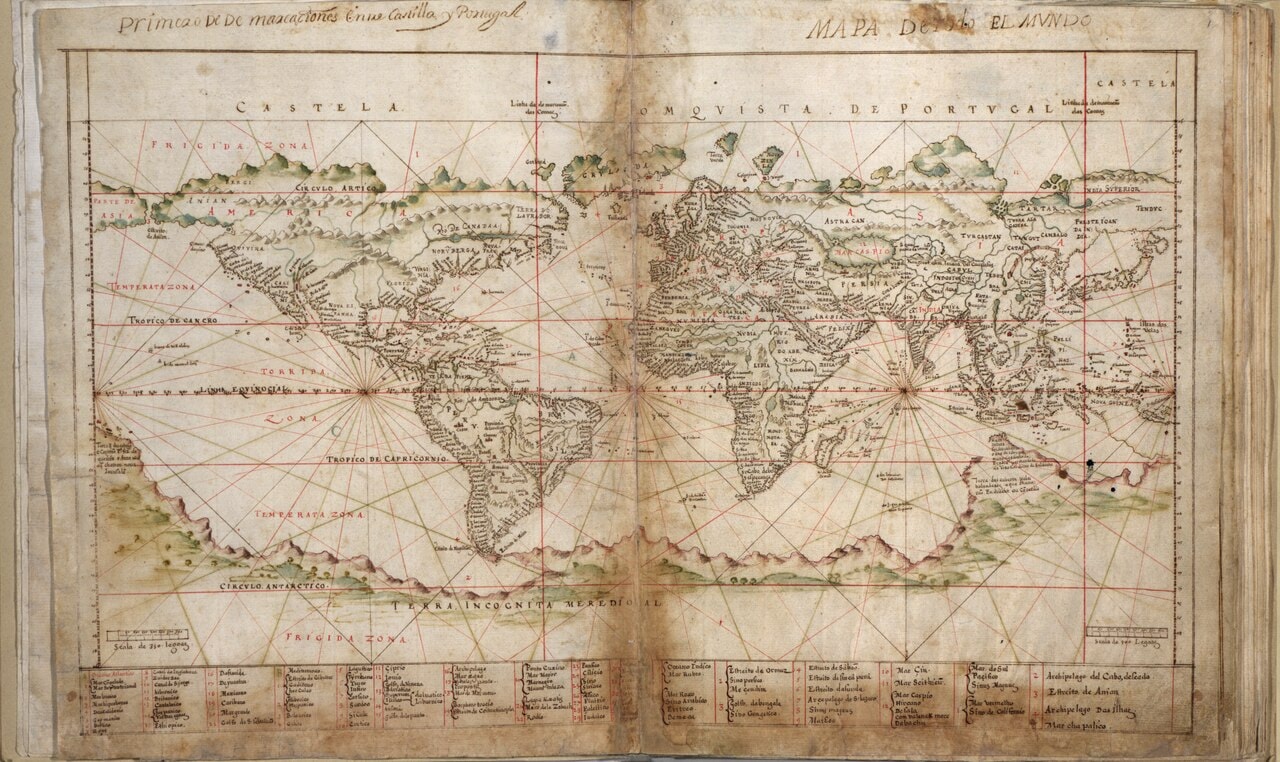
Spain and Portugal were the first European kingdoms to claim territory in the Americas, and their claims overlapped. Both being Catholic, they asked the pope to settle it:
- 1493: The pope drew a north-south line of demarcation on the world map. Spain got everything west of the line, Portugal everything east.
- 1494: The two kingdoms moved the line a few degrees west and signed the Treaty of Tordesillas. The new line passed through what is now Brazil, which (along with Portuguese exploration) established Portugal's claim to Brazil. Spain claimed the rest of the Americas.
Other European countries soon ignored this arrangement entirely.
English claims
England's earliest claims rested on John Cabot, an Italian sea captain sailing for King Henry VII, who explored the Newfoundland coast in 1497. But England didn't follow up for decades. The monarchy spent the 1500s preoccupied with the religious conflict that followed Henry VIII's break with the Catholic Church.
England re-engaged under Queen Elizabeth I in the 1570s and 1580s:
- Sir Francis Drake attacked Spanish ships, seized their gold and silver, and even raided Spanish settlements on the coast of Peru
- Sir Walter Raleigh attempted a colonial settlement at Roanoke Island off the North Carolina coast in 1587. It failed.
French claims
France's claims came from two sponsored voyages:
- Giovanni da Verrazzano (1524), an Italian navigator who explored part of North America's eastern coast (including New York harbor) while searching for a northwest passage through the Americas to Asia
- Jacques Cartier (1534-1542), who explored the St. Lawrence River extensively
Like England, France was slow to colonize. During the 1500s the French monarchy was tied up in European wars and internal religious conflict between Catholics and French Protestants called Huguenots. France only got serious about North America in the next century.
The pattern to notice: Spain and Portugal moved first and fast; England and France had claims on paper but were stalled by religious conflict at home. That head start explains why Spain built a massive American empire, which is exactly where Topic 1.4 on the Columbian Exchange and Spanish conquest picks up.
Key Terms to Know
| Term | Why it matters |
|---|---|
| Gunpowder | Chinese invention adopted by Europeans, giving them a military edge during exploration and conquest. |
| Sailing compass | Navigation tool Europeans adopted from Arab merchants (originally Chinese) that made open-ocean voyages possible. |
| Printing press | Invented in the 1450s, it spread knowledge across Europe and accelerated the Renaissance and Reformation. |
| Isabella and Ferdinand | Spanish monarchs whose 1469 marriage united Castile and Aragon; they conquered Granada and funded Columbus in 1492. |
| Christopher Columbus | His 1492 voyage west (a mistaken shortcut to Asia) created lasting contact between Europe and the Americas. |
| Prince Henry the Navigator | Portuguese prince who sponsored the voyages that opened the sea route around Africa's Cape of Good Hope. |
| Vasco da Gama | Portuguese captain who in 1498 became the first European to reach India by sea. |
| Protestant Reformation | Early 1500s revolt against the pope's authority that split Europe and made spreading Christianity a competitive motive for colonization. |
| Nation-states | Countries with a shared culture and loyalty to a central government; their monarchs funded exploration for revenue and prestige. |
| Treaty of Tordesillas | The 1494 Spain-Portugal agreement that moved the pope's line of demarcation west, giving Portugal its claim to Brazil and Spain the rest of the Americas. |
| John Cabot | Italian captain sailing for England who explored Newfoundland in 1497, the basis of England's claims. |
| Sir Francis Drake | English sea captain under Elizabeth I who raided Spanish ships and settlements in the 1570s-80s. |
| Roanoke Island | Sir Walter Raleigh's failed 1587 attempt at an English colony off the North Carolina coast. |
| Jacques Cartier | French explorer (1534-1542) whose voyages up the St. Lawrence River grounded France's claims in North America. |
| Northwest passage | The hoped-for water route through the Americas to Asia that motivated explorers like Verrazzano. |
| Huguenots | French Protestants whose conflict with Catholics kept France distracted from colonization during the 1500s. |
Practice and Next Steps
Keep these motives organized as causes: economic (blocked trade routes, competition for wealth), religious (Catholic vs. Protestant rivalry), and political (nation-states funding voyages). That cause-and-effect framing is exactly what Period 1 questions test.
- Review the Topic 1.3 European Exploration in the Americas course study guide for the College Board-aligned version of this material
- Continue to AMSCO 1.4 on the Columbian Exchange and Spanish conquest, or browse all the APUSH AMSCO notes
- Test yourself with APUSH guided practice questions
- Drill vocab in the APUSH key terms glossary
Frequently Asked Questions
What does AMSCO Topic 1.3 cover in APUSH?
AMSCO Topic 1.3 covers the causes of European exploration of the Americas in Period 1 (1491-1607): Renaissance technology like the compass and printing press, religious conflict from the Protestant Reformation, competition for Asian trade after the Ottomans seized Constantinople in 1453, and the rise of nation-states. It also covers the first Spanish, Portuguese, English, and French claims in the Americas.
What were the main motives for European exploration in APUSH?
The three motives are often summarized as God, gold, and glory: spreading Christianity (intensified by Catholic-Protestant rivalry after the Reformation), finding new sources of wealth (the Ottoman capture of Constantinople in 1453 blocked the overland route to Asia), and economic and military competition among emerging nation-states like Spain, Portugal, England, and France.
What was the Treaty of Tordesillas and why does it matter?
The Treaty of Tordesillas (1494) was an agreement between Spain and Portugal that moved the pope's 1493 line of demarcation a few degrees west. Portugal got lands east of the line, which established its claim to Brazil, and Spain claimed the rest of the Americas. It matters because it shows how religion and politics shaped early colonization, and because other European powers like England and France soon ignored it.
Why were England and France so slow to colonize the Americas compared to Spain?
Both were distracted by religious conflict at home during the 1500s. England's monarchy was preoccupied with the fallout from Henry VIII's break with the Catholic Church, and France was tied up in European wars and conflict between Catholics and Huguenots. Spain, freshly unified after conquering Granada in 1492, moved immediately. England only re-engaged under Elizabeth I in the 1570s-80s, and France followed up its claims in the next century.
How does Topic 1.3 show up on the AP US History exam?
Period 1 questions frequently ask you to explain the causes of European exploration and conquest, so know the economic, religious, and political motives and specific evidence like the 1453 fall of Constantinople, the 1492 conquest of Granada, and the Treaty of Tordesillas. Practice applying that causation framing with APUSH guided practice questions.
See Fiveable more often in Google
Mark Fiveable as a preferred source and Google is more likely to show you our guides in Top Stories, with a "preferred" badge in AI Mode and AI Overviews.