AMSCO 3.7 The Articles of Confederation

🇺🇸AP US History Review
AMSCO 3.7 The Articles of Confederation
🇺🇸 AP US History
AMSCO 1.2:Native American Societies Before European Contact Notes
AMSCO 2.1 Context: European Colonization of North America Notes
AMSCO 2.2 European Colonization Notes
AMSCO 2.3 The Regions of the British Colonies Notes
AMSCO 2.4 Transatlantic Trade Notes
AMSCO 2.5 Interactions between American Indians and Europeans Notes
AMSCO 2.6 Slavery in the British Colonies Notes
AMSCO 2.7 Colonial Society and Culture Notes
AMSCO 2.8 Comparison in Period 2 (1607-1754) Notes
AMSCO 3.1 Contextualizing Period 3
AMSCO 3.2 The Seven Year's War
AMSCO 3.3 Taxation Without Representation
AMSCO 3.4 Philosophical Foundations of the American Revolution
AMSCO 3.5 The American Revolution
AMSCO 3.6 The Influence of Revolutionary Ideals
AMSCO 3.7 The Articles of Confederation
AMSCO 3.8 The Constitutional Convention and Debates Over Ratification
AMSCO 3.9 The Constitution
AMSCO 3.10 Shaping a New Republic
AMSCO 3.11 Developing an American Identity
AMSCO 3.12 Movements in the Early Republic
AMSCO 3.13 Continuity and Change in Period 3
AMSCO 4.1 Contextualizing Period 4
AMSCO 4.2 The Rise of Political Parties and the Era of Jefferson
AMSCO 4.3 Politics and Regional Interests
AMSCO 4.4 America on the World Stage
AMSCO 4.5 Market Revolution
AMSCO 4.6 Effects of the Market Revolution on Society and Culture
AMSCO 4.7 Expanding Democracy
AMSCO 4.8 Jackson and Federal Power
AMSCO 4.9 The Development of an American Culture
AMSCO 4.10 The Second Great Awakening
AMSCO 4.11 An Age of Reform
AMSCO 4.12 African Americans in the Early Republic
AMSCO 4.13 Southern Society in the Early Republic
AMSCO 4.14 Causation in Period 4
AMSCO 5.1 Contextualizing Period 5
AMSCO 5.2 The Idea of Manfiest Destiny
AMSCO 5.3 Manifest Destiny and the Mexican-American War
AMSCO 5.4 The Compromise of 1850
AMSCO 5.5 Sectional Conflict: Regional Differences
AMSCO 5.6 Failure of Compromise
AMSCO 5.7 Election of 1860 and Secession
AMSCO 5.8 Military Conflict in the Civil War
AMSCO 5.9 Government Policies During the Civil War
AMSCO 5.10 Reconstruction
AMSCO 5.11 Failure of Reconstruction
AMSCO 5.12 Comparion in Period 5
AMSCO 6.1 Contextualizing Period 6
AMSCO 6.2 Westward Expansion: Economic Development
AMSCO 6.3 Westward Expansion: Social and Cultural Development
AMSCO 6.4 The "New South"
AMSCO 6.5 Technological Innovation
AMSCO 6.6 The Rise of Industrial Capitalism
AMSCO 6.7 Labor in the Gilded Age
AMSCO 6.8 Immigration and Migration in the Gilded Age
AMSCO 6.9 Responses to Immigration in the Gilded Age
AMSCO 6.10 Development of the Middle Class
AMSCO 6.11 Reform in the Gilded Age
AMSCO 6.12 Role of Government in the Gilded Age
AMSCO 6.13 Politics in the Gilded Age
AMSCO 6.14 Continuity and Change Period 6
AMSCO 7.1 Contextualizing Period 7
AMSCO 7.2 Imperialism: Debates
AMSCO 7.3 The Spanish-American War and U.S. Foreign Policy to 1917
AMSCO 7.4 The Progressives
AMSCO 7.5 World War I: Military and Diplomacy
AMSCO 7.6 World War I: Home Front
AMSCO 7.7 1920s: Innovations in Communication and Technology
AMSCO 7.8 1920s: Cultural and Political Controversies
AMSCO 7.9 The Great Depression
AMSCO 7.10 The New Deal
AMSCO 7.11 Inerwar Foreign Policy
AMSCO 7.12 World War II Mobilization
AMSCO 7.13 World War II Military
AMSCO 7.14 World War II and Postwar Diplomacy
AMSCO 7.15 Comparison in Period 7
AMSCO 8.1 Contextualizing Period 8
AMSCO 8.2 The Cold War from 1945 to 1980
AMSCO 8.3 The Red Scare
AMSCO 8.4 Economy after 1945
AMSCO 8.5 Culture after 1945
AMSCO 8.6 Early Steps in the Civil Rights Movement, 1945-1960
AMSCO 8.7 America as a World Power
AMSCO 8.8 The Vietnam War
AMSCO 8.9 The Great Society
AMSCO 8.10 The African American Civil Rights Movement in the 1960s
AMSCO 8.11 The Civil Rights Movement Expands
AMSCO 8.12 Youth Culture of the 1960s
AMSCO 8.13 The Environment and Natural Resources from 1968 to 1980
AMSCO 8.14 Society in Transition
AMSCO 8.15 Continuity and Change in Period 8
AMSCO 9.1 Contextualizing Period 9
AMSCO 9.2 Reagan and Conservatism
AMSCO 9.3 The End of the Cold War
AMSCO 9.4 A Changing Economy
AMSCO 9.5 Migration and Immgiration in the 1990s and 2000s
AMSCO 9.6 Challenges of the 21st Century
AMSCO 9.7 Causation in Period 9
AMSCO 1.1 Contextualizing Period 1 Notes
AMSCO 1.3 European Exploration in the Americas Notes
AMSCO 1.4 Columbian Exchange, Spanish Exploration, and Conquest Notes
AMSCO 1.5 Labor, Slavery, and Caste in the Spanish Colonial System Notes
AMSCO 1.6 Cultural Interactions in the Americas Notes
AMSCO 1.7 Causation in Period 1 Notes
Overview
AMSCO Topic 3.7, The Articles of Confederation, covers America's first national government and why it didn't last. After declaring independence, the 13 states wanted a central government too weak to become tyrannical, and that's exactly what they got. The chapter traces how new state constitutions and the Articles of Confederation organized power after the Revolution, what the Confederation Congress actually accomplished (independence, the Land Ordinance of 1785, the Northwest Ordinance of 1787), and how foreign policy failures, economic depression, interstate rivalry, and Shays's Rebellion convinced leaders the country needed something stronger. This is the setup for the Constitutional Convention in AMSCO 3.8, so know the weaknesses cold.
The chapter opens with Henry Knox's 1786 line to George Washington: "The source of the evil is the nature of the government." That's the whole argument in one sentence.
Key Takeaways
- New state constitutions protected rights and divided power, but legislatures held most authority and property requirements limited political participation.
- Western land disputes delayed ratification until 1781; under the Articles, each state had one vote in Congress, which could not tax, regulate commerce, or enforce its laws.
- The Confederation negotiated favorable terms in the Treaty of Paris, organized western land sales through the Land Ordinance, and set rules for new states while prohibiting slavery in the Northwest Territory.
- The national government could not enforce the Treaty of Paris or resolve interstate disputes, while its lack of taxing power and unpaid debts contributed to economic depression.
- The state militia broke Shays's uprising against taxes and debt, and delegates soon met in Philadelphia to replace the Articles.
New State Governments
While the Revolutionary War was still being fought, the colonies rewrote themselves as independent states, each with its own written constitution. By 1777, ten of the former colonies had new constitutions. Most were written and adopted by state legislatures, but a few states (Maryland, Pennsylvania, and North Carolina) submitted their constitutions to a popular vote for ratification.
Each constitution sparked debate between conservatives, who stressed law and order, and liberals, who wanted to protect individual rights and prevent future tyranny. Despite differences, the constitutions shared four features:
- A list of rights. Each constitution opened with a "bill" or "declaration" of basic rights, commonly including jury trials and freedom of religion. State officials could not infringe on these rights.
- Separation of powers. With a few exceptions, power was split among an elected two-house legislature, an elected governor, and a court system. The goal was preventing tyranny, especially from a too-powerful executive. Most real power sat with the legislatures.
- Voting. All White males who owned some property could vote. The property requirement (usually a small amount of land or money) rested on the assumption that property owners had a bigger stake in government than the poor.
- Office-holding. Candidates for office usually had to meet an even higher property qualification than voters.
The pattern to remember: power flowed to legislatures, and property qualifications limited who participated. That builds directly on the revolutionary ideals covered in AMSCO 3.6.
The Articles of Confederation: Structure and Powers
The Articles of Confederation created a central government with one body, a unicameral Congress, and deliberately limited power. John Dickinson drafted the original plan in Philadelphia in 1776 (while Jefferson was writing the Declaration of Independence), and Congress modified it to protect state power even further. Congress adopted the Articles in 1777 and sent them to the states.
Ratification Was Delayed Until 1781
Western land claims held everything up. States like Rhode Island and Maryland insisted that states with claims to American Indian lands west of the Alleghenies give them up so the new central government could control them. When Virginia and New York finally agreed to cede their western claims, the Articles were ratified in March 1781.
How the Government Worked
- One-house (unicameral) Congress, each state gets one vote regardless of size
- 9 of 13 votes required to pass important laws
- Unanimous vote required to amend the Articles (this made fixing problems nearly impossible)
- No executive branch, no national judiciary
- A Committee of States (one representative per state) handled minor decisions when Congress wasn't in session
What Congress Could and Couldn't Do
Congress could: wage war, make treaties, send diplomats, and borrow money.
Congress could not: regulate commerce, collect taxes, or enforce its own laws. To fund anything, Congress had to ask the states for money and hope they paid. Picture a government that can run up a tab but can't make anyone pay it. That's the Confederation.
Accomplishments Under the Articles, 1781-1789
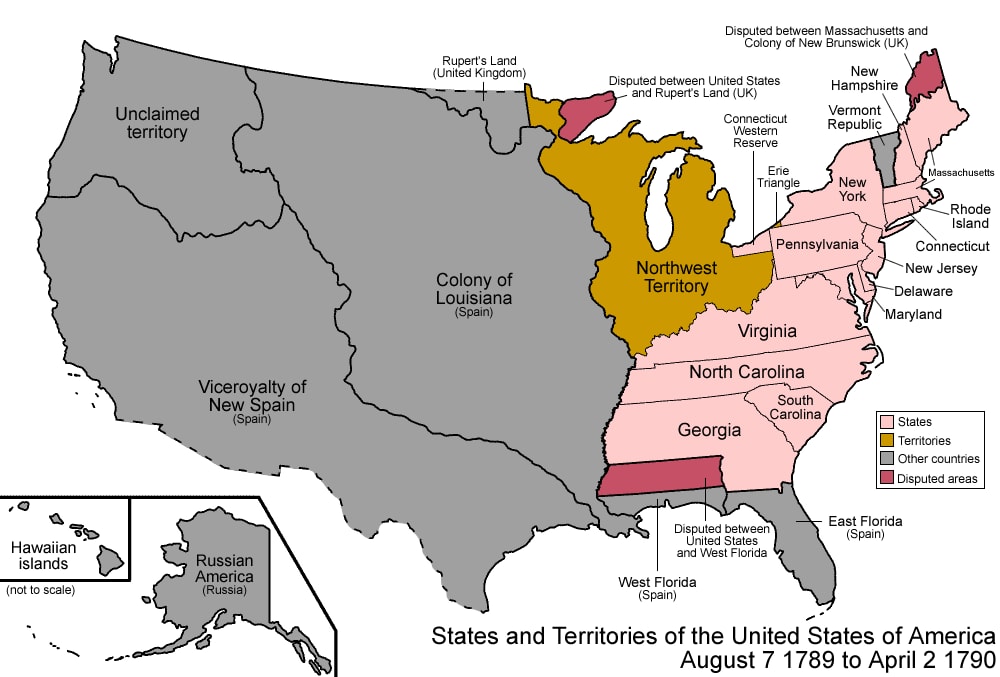
The Confederation government was weak by design, but it scored three real wins. APUSH loves asking about these because students assume "weak government = nothing happened."
- Independence. The government could claim credit for Washington's ultimate victory and for negotiating favorable terms in the Treaty of Paris (1783) ending the war with Britain.
- Land Ordinance of 1785. Congress set a policy for surveying and selling western lands, dividing them into 36 square-mile townships and reserving one square-mile section per township for public education.
- Northwest Ordinance of 1787. For the territory between the Great Lakes and the Ohio River, Congress set the rules for creating new states, granted limited self-government to the territory, and prohibited slavery in the region.
Reserving land for schools and banning slavery made the Northwest Territory attractive to both White and free Black settlers. But there was a catch in the land system: the government auctioned land by the square mile (640 acres) at $1 per acre, so the first buyers had to have at least $640 in cash. Wealthy purchasers bought big, then resold smaller parcels to less wealthy Americans.
The Northwest Ordinance is the one historians call the Confederation's greatest achievement. It promoted public education, protected private property, and kept slavery out of the territory, and its process for admitting new states outlived the Articles themselves.
Weaknesses of the Articles
The accomplishments were overshadowed by problems the government simply couldn't solve. These weaknesses are the direct cause of the Constitutional Convention, so this is the most exam-relevant part of the chapter.
Foreign Affairs
European powers had little respect for a nation that couldn't pay its debts or act in a crisis. The government couldn't enforce the Treaty of Paris: it was too weak to stop Britain from keeping military outposts on the western frontier and restricting trade, and too weak to force states to restore Loyalist property or repay debts to foreigners as the treaty required. Britain and Spain eyed the western lands, ready to take advantage of American weakness.
Economic Problems
The root problem was that Congress had no taxing power. It could only request donations from the states, so it had no dependable revenue to repay its war loans. States carried large unpaid debts too. Unpaid debts limited credit and reduced foreign trade, and many states made things worse by printing worthless paper money. The combined result was an economic depression.
Internal Conflicts
The 13 states acted like rivals, not partners. They slapped tariffs and restrictions on goods crossing state lines and fought boundary disputes with neighbors. The national government had no power to settle any of it.
Shays's Rebellion
In the summer of 1786, Captain Daniel Shays, a Massachusetts farmer and Revolutionary War veteran, led farmers in an uprising against high state taxes, imprisonment for debt, and the lack of paper money. The rebels stopped tax collection and forced debtors' courts to close. In January 1787, when Shays and his followers tried to seize weapons from the Springfield armory, the Massachusetts state militia broke the rebellion.
Notice who put it down: the state militia, not the national government, because there was no national force to send. For elites like Washington and Knox, Shays's Rebellion was the alarm bell proving the Articles couldn't keep order. Within months, delegates were meeting in Philadelphia to replace them.
Key Terms to Know
| Term | Why it matters |
|---|---|
| Articles of Confederation | America's first constitution (adopted 1777, ratified 1781), creating a deliberately weak central government with no executive, judiciary, or taxing power. |
| State constitutions | Written plans of government adopted by the states by 1777, featuring bills of rights, separation of powers, and property qualifications for voting. |
| Unicameral legislature | The one-house Congress under the Articles, where each state had one vote and 9 of 13 votes passed major laws. |
| John Dickinson | Drafted the first version of the Articles in 1776; Congress weakened it further to protect state power. |
| Ratification (1781) | Approval of the Articles, delayed until March 1781 by disputes over western land claims until Virginia and New York ceded theirs. |
| Land Ordinance of 1785 | Set up the survey and sale of western lands in 36 square-mile townships, reserving one section per township for public education. |
| Northwest Ordinance of 1787 | Created the process for admitting new states, granted limited self-government, and banned slavery in the Northwest Territory. |
| Northwest Territory | The region between the Great Lakes and the Ohio River, made attractive to White and free Black settlers by school lands and the slavery ban. |
| Treaty of Paris (1783) | The peace treaty ending the Revolutionary War; the Confederation negotiated favorable terms but was too weak to enforce its provisions. |
| Shays's Rebellion | The 1786-87 Massachusetts farmers' uprising against taxes and debt courts that exposed the government's inability to keep order. |
| Daniel Shays | Massachusetts farmer and Revolutionary War veteran who led the rebellion, broken when the state militia stopped his attempt on the Springfield armory. |
| Committee of States | One representative per state, empowered to make minor decisions when the full Congress was not in session. |
| Property qualifications | Requirements that voters (and, at higher levels, officeholders) own property, limiting political participation to White male property owners. |
| Economic depression | The post-war slump caused by no national taxing power, unpaid debts, limited credit, and worthless state paper money. |
Practice and Next Steps
Test how well the Articles material stuck with the Topic 3.7 course study guide, which frames this content the way the AP exam does. Then keep moving through the full set of AMSCO notes, starting with AMSCO 3.8 on the Constitutional Convention, where the weaknesses you just reviewed get fixed (and fought over).
For practice, run a few APUSH multiple-choice questions on Period 3, or try writing about the Articles' strengths and weaknesses with FRQ practice and instant scoring. A classic prompt asks you to evaluate the extent to which the Articles provided an effective government, and now you have evidence for both sides. The APUSH key terms glossary is there when a term needs a quick refresher.
Frequently Asked Questions
What were the main weaknesses of the Articles of Confederation?
Congress could not collect taxes, regulate commerce, or enforce its laws, and there was no executive or national court system. It had to request money from the states, amendments required a unanimous vote, and the government couldn't enforce the Treaty of Paris or stop interstate trade wars. These failures led directly to calls for a stronger central government.
What did the government actually accomplish under the Articles of Confederation?
Three big things: it won independence and negotiated favorable terms in the Treaty of Paris (1783), it passed the Land Ordinance of 1785 setting up the survey and sale of western lands with a section reserved for public education, and it passed the Northwest Ordinance of 1787, which created the process for admitting new states and banned slavery in the Northwest Territory.
Why was Shays's Rebellion so important if it failed?
Because the national government couldn't respond at all; the Massachusetts state militia had to break the rebellion in January 1787 when Shays's farmers tried to seize the Springfield armory. To leaders like Washington and Henry Knox, it proved the Articles couldn't keep order, which fueled the push for the Constitutional Convention months later.
Why did it take until 1781 to ratify the Articles of Confederation?
Disputes over western land claims. States like Maryland and Rhode Island refused to ratify until states with claims to lands west of the Alleghenies gave them up to the central government. Once Virginia and New York agreed to cede their claims, the Articles were ratified in March 1781.
How does AMSCO 3.7 show up on the APUSH exam?
Topic 3.7 asks you to explain how forms of government developed and changed during the revolutionary period: legislature-heavy state constitutions with property qualifications, a limited central government under the Articles, and the Northwest Ordinance's rules for new states. It's also classic essay material, since you can argue both the Articles' achievements and its failures. Practice applying it with APUSH FRQ practice.
See Fiveable more often in Google
Mark Fiveable as a preferred source and Google is more likely to show you our guides in Top Stories, with a "preferred" badge in AI Mode and AI Overviews.