AMSCO 5.2 The Idea of Manfiest Destiny

🇺🇸AP US History Review
AMSCO 5.2 The Idea of Manfiest Destiny
🇺🇸 AP US History
AMSCO 1.2:Native American Societies Before European Contact Notes
AMSCO 2.1 Context: European Colonization of North America Notes
AMSCO 2.2 European Colonization Notes
AMSCO 2.3 The Regions of the British Colonies Notes
AMSCO 2.4 Transatlantic Trade Notes
AMSCO 2.5 Interactions between American Indians and Europeans Notes
AMSCO 2.6 Slavery in the British Colonies Notes
AMSCO 2.7 Colonial Society and Culture Notes
AMSCO 2.8 Comparison in Period 2 (1607-1754) Notes
AMSCO 3.1 Contextualizing Period 3
AMSCO 3.2 The Seven Year's War
AMSCO 3.3 Taxation Without Representation
AMSCO 3.4 Philosophical Foundations of the American Revolution
AMSCO 3.5 The American Revolution
AMSCO 3.6 The Influence of Revolutionary Ideals
AMSCO 3.7 The Articles of Confederation
AMSCO 3.8 The Constitutional Convention and Debates Over Ratification
AMSCO 3.9 The Constitution
AMSCO 3.10 Shaping a New Republic
AMSCO 3.11 Developing an American Identity
AMSCO 3.12 Movements in the Early Republic
AMSCO 3.13 Continuity and Change in Period 3
AMSCO 4.1 Contextualizing Period 4
AMSCO 4.2 The Rise of Political Parties and the Era of Jefferson
AMSCO 4.3 Politics and Regional Interests
AMSCO 4.4 America on the World Stage
AMSCO 4.5 Market Revolution
AMSCO 4.6 Effects of the Market Revolution on Society and Culture
AMSCO 4.7 Expanding Democracy
AMSCO 4.8 Jackson and Federal Power
AMSCO 4.9 The Development of an American Culture
AMSCO 4.10 The Second Great Awakening
AMSCO 4.11 An Age of Reform
AMSCO 4.12 African Americans in the Early Republic
AMSCO 4.13 Southern Society in the Early Republic
AMSCO 4.14 Causation in Period 4
AMSCO 5.1 Contextualizing Period 5
AMSCO 5.2 The Idea of Manfiest Destiny
AMSCO 5.3 Manifest Destiny and the Mexican-American War
AMSCO 5.4 The Compromise of 1850
AMSCO 5.5 Sectional Conflict: Regional Differences
AMSCO 5.6 Failure of Compromise
AMSCO 5.7 Election of 1860 and Secession
AMSCO 5.8 Military Conflict in the Civil War
AMSCO 5.9 Government Policies During the Civil War
AMSCO 5.10 Reconstruction
AMSCO 5.11 Failure of Reconstruction
AMSCO 5.12 Comparion in Period 5
AMSCO 6.1 Contextualizing Period 6
AMSCO 6.2 Westward Expansion: Economic Development
AMSCO 6.3 Westward Expansion: Social and Cultural Development
AMSCO 6.4 The "New South"
AMSCO 6.5 Technological Innovation
AMSCO 6.6 The Rise of Industrial Capitalism
AMSCO 6.7 Labor in the Gilded Age
AMSCO 6.8 Immigration and Migration in the Gilded Age
AMSCO 6.9 Responses to Immigration in the Gilded Age
AMSCO 6.10 Development of the Middle Class
AMSCO 6.11 Reform in the Gilded Age
AMSCO 6.12 Role of Government in the Gilded Age
AMSCO 6.13 Politics in the Gilded Age
AMSCO 6.14 Continuity and Change Period 6
AMSCO 7.1 Contextualizing Period 7
AMSCO 7.2 Imperialism: Debates
AMSCO 7.3 The Spanish-American War and U.S. Foreign Policy to 1917
AMSCO 7.4 The Progressives
AMSCO 7.5 World War I: Military and Diplomacy
AMSCO 7.6 World War I: Home Front
AMSCO 7.7 1920s: Innovations in Communication and Technology
AMSCO 7.8 1920s: Cultural and Political Controversies
AMSCO 7.9 The Great Depression
AMSCO 7.10 The New Deal
AMSCO 7.11 Inerwar Foreign Policy
AMSCO 7.12 World War II Mobilization
AMSCO 7.13 World War II Military
AMSCO 7.14 World War II and Postwar Diplomacy
AMSCO 7.15 Comparison in Period 7
AMSCO 8.1 Contextualizing Period 8
AMSCO 8.2 The Cold War from 1945 to 1980
AMSCO 8.3 The Red Scare
AMSCO 8.4 Economy after 1945
AMSCO 8.5 Culture after 1945
AMSCO 8.6 Early Steps in the Civil Rights Movement, 1945-1960
AMSCO 8.7 America as a World Power
AMSCO 8.8 The Vietnam War
AMSCO 8.9 The Great Society
AMSCO 8.10 The African American Civil Rights Movement in the 1960s
AMSCO 8.11 The Civil Rights Movement Expands
AMSCO 8.12 Youth Culture of the 1960s
AMSCO 8.13 The Environment and Natural Resources from 1968 to 1980
AMSCO 8.14 Society in Transition
AMSCO 8.15 Continuity and Change in Period 8
AMSCO 9.1 Contextualizing Period 9
AMSCO 9.2 Reagan and Conservatism
AMSCO 9.3 The End of the Cold War
AMSCO 9.4 A Changing Economy
AMSCO 9.5 Migration and Immgiration in the 1990s and 2000s
AMSCO 9.6 Challenges of the 21st Century
AMSCO 9.7 Causation in Period 9
AMSCO 1.1 Contextualizing Period 1 Notes
AMSCO 1.3 European Exploration in the Americas Notes
AMSCO 1.4 Columbian Exchange, Spanish Exploration, and Conquest Notes
AMSCO 1.5 Labor, Slavery, and Caste in the Spanish Colonial System Notes
AMSCO 1.6 Cultural Interactions in the Americas Notes
AMSCO 1.7 Causation in Period 1 Notes
Overview
AMSCO Topic 5.2, "The Idea of Manifest Destiny," covers the 1840s-1850s belief that the United States had a divine mission to expand across North America, and the conflicts that came with it. Manifest Destiny pushed the country west toward the Pacific and south into Mexican territory, driving the annexation of Texas, the division of Oregon, the settlement of the West, and a surge in foreign trade. This is one of the foundational topics in APUSH Unit 5 (1844-1877), because the expansion it describes reignited the fight over slavery that led straight to the Civil War.
The phrase Manifest Destiny was popularized by writer John L. O'Sullivan in 1845. Enthusiasm for expansion hit a fever pitch, fueled by nationalism, a growing population, fast economic development, new technology, and reform ideals. But critics argued the real engine behind expansion was the desire to spread slavery into new western land, and that argument shaped everything that followed.
Key Takeaways
- Sam Houston led Texas settlers in a revolt against Mexico, but opposition to expanding slavery delayed U.S. annexation.
- The Webster-Ashburton Treaty settled the Maine border, while migration to Oregon fueled expansionist demands before James K. Polk's 1844 campaign.
- Tyler secured Texas annexation through a joint resolution, and Polk compromised with Britain by dividing Oregon at the 49th parallel.
- Settlers crossed the dry interior to reach the coast, the California gold rush drew miners, and the cost of moving made western farming mostly a middle-class movement.
- U.S. foreign commerce grew through shipping changes and trade with Asia, including the 1854 Kanagawa Treaty that opened two Japanese ports.
- Expansion continued after the Civil War when Secretary of State William Seward bought Alaska in 1867.
Conflicts Over Texas, Maine, and Oregon
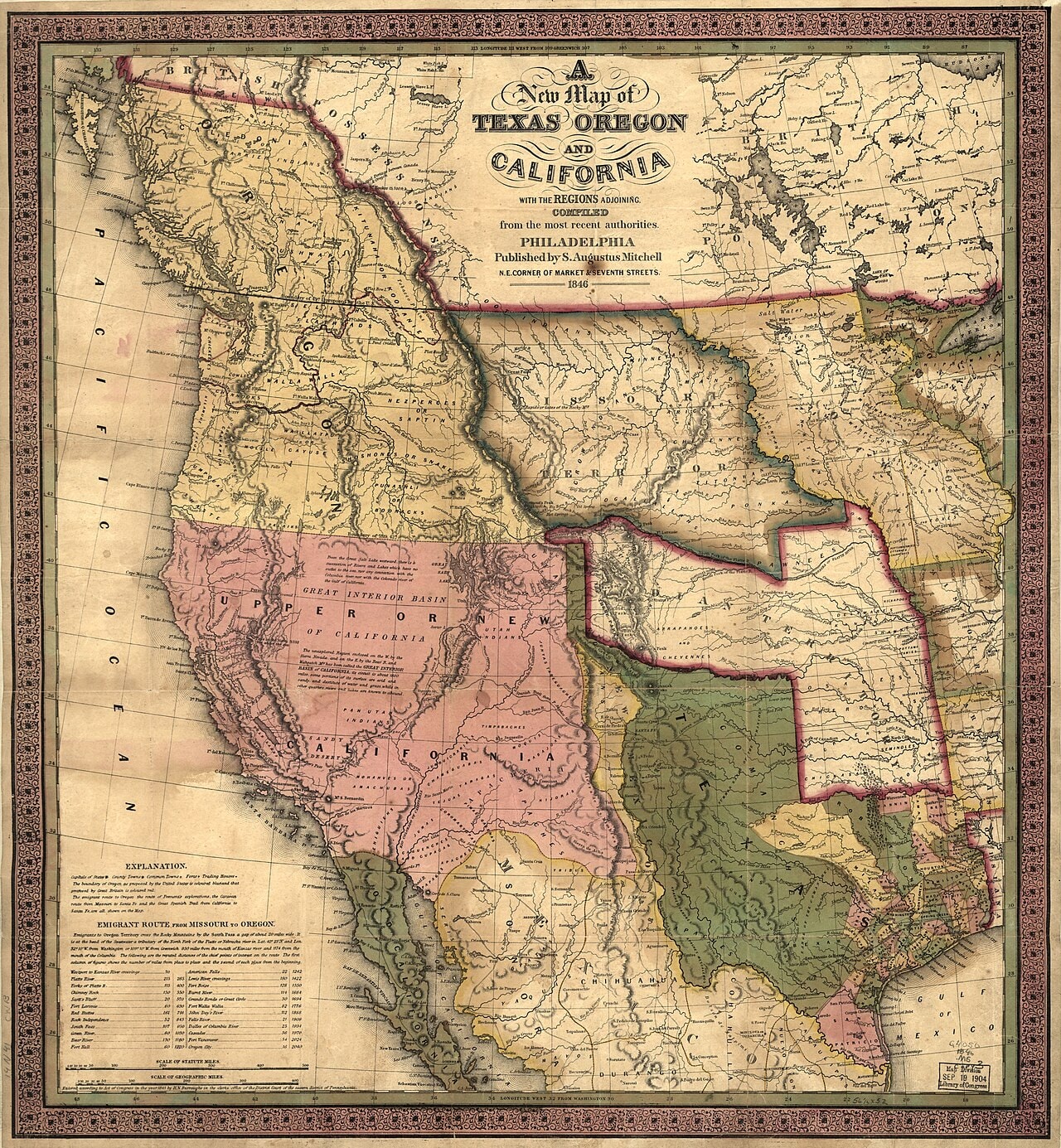
American pioneers migrating into Mexican Texas and British-claimed Oregon in the 1820s and 1830s created the border disputes that defined the 1840s.
Texas
After winning independence from Spain in 1823, Mexico wanted settlers for its sparsely populated northern province of Texas. Moses Austin got a large land grant but died first; his son Stephen Austin brought 300 families in and started a steady stream of American migration. By 1830, Americans (White farmers and enslaved Black people) outnumbered Mexicans in Texas three to one.
Friction grew fast:
- In 1829 Mexico outlawed slavery and required immigrants to convert to Roman Catholicism. Many American settlers refused.
- Mexico then closed Texas to new American immigrants. Southerners ignored the ban and poured in anyway.
Revolt and Independence
In 1834, General Antonio López de Santa Anna made himself dictator of Mexico and scrapped the federal system. When he tried to enforce Mexican law in Texas, settlers led by Sam Houston revolted and declared Texas an independent republic in March 1836. The new Texas constitution made slavery legal again.
The war moved fast:
- Santa Anna's army took Goliad and attacked the Alamo in San Antonio, killing every American defender.
- At the Battle of San Jacinto, Houston's army surprised the Mexicans and captured Santa Anna. Under threat of death, Santa Anna signed a treaty recognizing Texas independence and granting it all land north of the Rio Grande.
- The Mexican legislature in Mexico City rejected the treaty and insisted Texas was still part of Mexico.
Annexation Denied
Houston, as first president of the Republic of Texas (the Lone Star Republic), asked the U.S. to annex it as a new state. Presidents Jackson and Van Buren both stalled, mostly because Northerners opposed expanding slavery. If annexed, Texas might split into five states, which could add ten proslavery senators. The risk of war with Mexico also cooled expansionist enthusiasm. President John Tyler (1841-1845), a Southern Whig worried about British influence in Texas, pushed for annexation, but the Senate rejected his treaty in 1844.
Boundary Dispute in Maine
The fuzzy border between Maine and British Canada's New Brunswick caused a clash between rival lumber crews known as the Aroostook War, or the "battle of the maps." It was settled by the Webster-Ashburton Treaty of 1842, negotiated by Secretary of State Daniel Webster and British ambassador Lord Ashburton. The treaty split the disputed land and also fixed the Minnesota boundary, leaving the iron-rich Mesabi Range on the U.S. side.
Boundary Dispute in Oregon
Oregon Territory was a huge Pacific Coast region once claimed by Spain, Russia, Britain, and the United States. Spain dropped out in the Adams-Onís Treaty of 1819.
- Britain's claim rested on the Hudson's Bay Company's fur trade. By 1846, fewer than 1,000 British settlers lived north of the Columbia River.
- The U.S. claim rested on three things: Robert Gray's 1792 exploration of the Columbia River, the Lewis and Clark expedition of 1805, and John Jacob Astor's fur post at Astoria in 1811.
Protestant missionaries and farmers settled the Willamette Valley in the 1840s. Their success sparked "Oregon fever," sending 5,000 Americans 2,000 miles over the Oregon Trail. By the 1844 election, many believed taking all of Oregon and annexing Texas was the nation's Manifest Destiny, and expansionists eyed Mexican California next.
The Election of 1844
The 1844 election turned annexation and slavery into a national fight that split the Democratic Party.
- The Northern Democrats opposed immediate annexation and backed former president Martin Van Buren.
- Proslavery, pro-annexation Southerners backed John C. Calhoun.
- The deadlocked convention turned to a dark horse (lesser-known candidate): James K. Polk of Tennessee, a Jackson protege fully committed to Manifest Destiny.
Polk wanted to annex Texas, acquire California, and "reoccupy" Oregon all the way north to the Russian Alaska border at latitude 54°40'. His slogan, "Fifty-Four Forty or Fight!", fired up Westerners and Southerners.
Whig nominee Henry Clay flip-flopped on Texas annexation, which pushed antislavery New York voters to the Liberty Party. Losing New York's electoral votes cost Clay the close election, and Polk won. Democrats read the result as a mandate to add Texas.
Annexing Texas and Dividing Oregon
Outgoing president Tyler used Polk's win to push Texas annexation through Congress with a joint resolution instead of a treaty. A joint resolution needs only a simple majority in both houses, while a treaty needs a two-thirds Senate vote. That move added Texas but left Polk to deal with Mexico's anger.
On Oregon, Polk backed off his fighting words. Instead of demanding 54°40', he signed a deal with Britain to split the territory at the 49th parallel (the same line used for the Louisiana Territory in 1818). The U.S. gave Britain Vancouver Island and Columbia River navigation rights. Some Northerners called it a sellout to the South because it killed the chance for free states in British Columbia. But with war against Mexico already breaking out, Senate critics did not want to fight Britain too, so they ratified the compromise in 1846.
Settlement of the Western Territories
After acquiring Oregon peacefully and California violently, American migration west surged. The dry stretch between the Mississippi Valley and the Pacific was called the Great American Desert, so settlers rushed across it to reach the coast. That is why California and Oregon were settled decades before the Great Plains.
Fur Traders' Frontier
Mountain men were the first non-native people in the Far West. In the 1820s they held yearly rendezvous in the Rockies to trade for animal skins with American Indians. James Beckwourth, Jim Bridger, Kit Carson, and Jedediah Smith mapped trails and conditions for later settlers.
Overland Trails
Hundreds of thousands of pioneers followed the overland trails (the Oregon, California, Santa Fe, and Mormon trails) by 1860.
- Most departed from St. Joseph or Independence, Missouri, or Council Bluffs, Iowa.
- Wagon trains crawled about 15 miles a day and took months to cross.
- The deadly final test was getting through the Sierra and Cascade passes before the first heavy snow.
- The biggest dangers were not American Indian attacks but disease and depression.
Mining Frontier
The 1848 discovery of gold in California kicked off the gold rush and a series of mining booms. Gold and silver rush strikes hit Colorado, Nevada, and the Black Hills of the Dakotas. California's population jumped from 14,000 in 1848 to 380,000 by 1860. The mining frontier drew miners from around the world; by the 1860s, nearly one-third of western miners were Chinese.
Farming Frontier
Most families moved west to farm. Congress's Preemption Acts of the 1830s and 1840s let squatters settle public land and buy it cheaply later, and the government sold parcels as small as 40 acres. But moving west was not for the poor. When a laborer earned about $1.00 a day, the overland trip cost $200 to $300, making the farming frontier mostly a middle-class movement. Isolated pioneers built schools, churches, and clubs modeled on the ones back East.
Urban Frontier
Railroads, mineral wealth, and farming spawned instant western cities. San Francisco and Denver exploded from gold and silver rushes, and Salt Lake City grew by resupplying overland travelers.
Foreign Commerce
Growth in manufactured goods, western grain, and southern cotton drove a boom in exports and imports in the mid-1800s. Several developments expanded U.S. foreign commerce:
- Shipping firms set regular departure schedules instead of waiting for full ships.
- Demand for whale oil to light middle-class homes created a whaling boom from 1830 to 1860, led by New England.
- The American clipper ship cut the New York-to-San Francisco trip around the Horn from six months to as little as 89 days.
- Steamships replaced clipper ships in the mid-1850s with more storage, lower costs, and reliable schedules.
- The U.S. expanded trade to Asia. New England merchants traded with China for tea, silk, and porcelain, and Commodore Matthew C. Perry pressured Japan to sign the Kanagawa Treaty in 1854, opening two ports and leading to a trade agreement.
Expansion After the Civil War
Manifest Destiny survived the Civil War, even though union, slavery, war, and Reconstruction dominated from 1855 to 1870. In 1867, Secretary of State William Seward bought Alaska while the country was still recovering from the war, showing the expansionist drive never fully stopped.
Key Terms to Know
| Term | Why it matters |
|---|---|
| Manifest Destiny | The belief the U.S. had a divine mission to expand across North America; the engine behind 1840s expansion. |
| Stephen Austin | Brought 300 families to Texas, starting the American migration that led to revolt. |
| Antonio López de Santa Anna | Mexican dictator whose crackdown sparked the Texas Revolution; captured at San Jacinto. |
| Sam Houston | Led the Texas revolt and became first president of the Republic of Texas. |
| Alamo | San Antonio mission where Santa Anna's army killed every American defender, a rallying cry for Texans. |
| Texas | Independent republic from 1836 whose annexation reopened the slavery fight. |
| John Tyler | Pushed Texas annexation through Congress with a joint resolution, avoiding a Senate treaty vote. |
| Webster-Ashburton Treaty | 1842 deal settling the Maine-Canada border and the Minnesota boundary with the Mesabi Range. |
| Oregon Territory | Pacific region contested by the U.S. and Britain, split at the 49th parallel in 1846. |
| "Fifty-Four Forty or Fight!" | Polk's 1844 slogan demanding all of Oregon up to latitude 54°40'. |
| James K. Polk | Dark-horse Democrat elected in 1844 on a Manifest Destiny platform. |
| Great American Desert | Name for the dry interior West that settlers rushed across to reach the coast. |
| Mountain men | Fur trappers like Jim Bridger and Kit Carson who first mapped the Far West. |
| Overland trails | The Oregon, California, Santa Fe, and Mormon trails that carried pioneers west. |
| Gold rush | The 1848 California strike that exploded the state's population and started the mining frontier. |
| Matthew C. Perry | Naval commodore who forced Japan to open trade in 1854. |
| Kanagawa Treaty | 1854 agreement opening two Japanese ports to U.S. ships, ending centuries of isolation. |
Practice and Next Steps
Review the matching 5.2 Manifest Destiny course topic study guide for the College Board framing, then keep moving through Unit 5 with the AMSCO notes hub. The next topic, AMSCO 5.3 Manifest Destiny and the Mexican-American War, picks up exactly where annexation leaves off, and AMSCO 5.4 The Compromise of 1850 shows how new western land reignited the slavery debate.
Build your skills with these resources:
- Guided MCQ practice to test the cause-and-effect details of expansion.
- FRQ practice with instant scoring to write about the causes and effects of westward expansion.
- The APUSH key terms glossary to lock in vocabulary fast.
Frequently Asked Questions
What is Manifest Destiny in APUSH 5.2?
Manifest Destiny was the popular 1840s belief that the United States had a divine mission to expand its power and civilization across North America to the Pacific. The phrase was popularized by writer John L. O'Sullivan in 1845, and it drove the annexation of Texas, the division of Oregon, and westward settlement. Critics argued its real purpose was spreading slavery into new land.
Why did the United States delay annexing Texas after 1836?
Texas declared independence in 1836, but Presidents Jackson and Van Buren stalled annexation mainly because Northerners opposed expanding slavery. Annexed Texas could split into five states, adding up to ten proslavery senators, and the risk of war with Mexico added more hesitation. Texas was finally annexed in 1845 through a joint resolution of Congress under President John Tyler.
What did 'Fifty-Four Forty or Fight!' actually result in?
Despite the slogan, Polk did not fight for all of Oregon up to latitude 54°40'. He compromised with Britain and split the territory at the 49th parallel in 1846, also giving Britain Vancouver Island and Columbia River navigation rights. With war against Mexico already starting, the Senate ratified the deal rather than fight Britain too.
How does AMSCO 5.2 connect to the AP US History exam?
Topic 5.2 supports the exam's focus on explaining the causes and effects of westward expansion from 1844 to 1877. Expect questions linking Manifest Destiny to the reignited slavery debate, the 1844 election, and conflict with Mexico. You can practice these with APUSH FRQ practice.
What role did foreign trade play in Manifest Destiny?
Expansion was not only about land; it also pushed U.S. trade outward, especially toward Asia. New England merchants traded with China for tea, silk, and porcelain, and Commodore Matthew C. Perry pressured Japan to sign the Kanagawa Treaty in 1854, opening two ports after centuries of isolation. Clipper ships and then steamships made this growing commerce faster and cheaper.
Was the trip west on the overland trails as dangerous as movies show?
Not in the way most people think. While pioneers feared American Indian attacks, the most common and serious dangers on the overland trails were disease and depression from harsh daily conditions. The trip also cost $200 to $300 at a time when a laborer earned about $1.00 a day, so westward migration was largely a middle-class movement.
See Fiveable more often in Google
Mark Fiveable as a preferred source and Google is more likely to show you our guides in Top Stories, with a "preferred" badge in AI Mode and AI Overviews.