AMSCO 3.3 Taxation Without Representation

🇺🇸AP US History Review
AMSCO 3.3 Taxation Without Representation
🇺🇸 AP US History
AMSCO 1.2:Native American Societies Before European Contact Notes
AMSCO 2.1 Context: European Colonization of North America Notes
AMSCO 2.2 European Colonization Notes
AMSCO 2.3 The Regions of the British Colonies Notes
AMSCO 2.4 Transatlantic Trade Notes
AMSCO 2.5 Interactions between American Indians and Europeans Notes
AMSCO 2.6 Slavery in the British Colonies Notes
AMSCO 2.7 Colonial Society and Culture Notes
AMSCO 2.8 Comparison in Period 2 (1607-1754) Notes
AMSCO 3.1 Contextualizing Period 3
AMSCO 3.2 The Seven Year's War
AMSCO 3.3 Taxation Without Representation
AMSCO 3.4 Philosophical Foundations of the American Revolution
AMSCO 3.5 The American Revolution
AMSCO 3.6 The Influence of Revolutionary Ideals
AMSCO 3.7 The Articles of Confederation
AMSCO 3.8 The Constitutional Convention and Debates Over Ratification
AMSCO 3.9 The Constitution
AMSCO 3.10 Shaping a New Republic
AMSCO 3.11 Developing an American Identity
AMSCO 3.12 Movements in the Early Republic
AMSCO 3.13 Continuity and Change in Period 3
AMSCO 4.1 Contextualizing Period 4
AMSCO 4.2 The Rise of Political Parties and the Era of Jefferson
AMSCO 4.3 Politics and Regional Interests
AMSCO 4.4 America on the World Stage
AMSCO 4.5 Market Revolution
AMSCO 4.6 Effects of the Market Revolution on Society and Culture
AMSCO 4.7 Expanding Democracy
AMSCO 4.8 Jackson and Federal Power
AMSCO 4.9 The Development of an American Culture
AMSCO 4.10 The Second Great Awakening
AMSCO 4.11 An Age of Reform
AMSCO 4.12 African Americans in the Early Republic
AMSCO 4.13 Southern Society in the Early Republic
AMSCO 4.14 Causation in Period 4
AMSCO 5.1 Contextualizing Period 5
AMSCO 5.2 The Idea of Manfiest Destiny
AMSCO 5.3 Manifest Destiny and the Mexican-American War
AMSCO 5.4 The Compromise of 1850
AMSCO 5.5 Sectional Conflict: Regional Differences
AMSCO 5.6 Failure of Compromise
AMSCO 5.7 Election of 1860 and Secession
AMSCO 5.8 Military Conflict in the Civil War
AMSCO 5.9 Government Policies During the Civil War
AMSCO 5.10 Reconstruction
AMSCO 5.11 Failure of Reconstruction
AMSCO 5.12 Comparion in Period 5
AMSCO 6.1 Contextualizing Period 6
AMSCO 6.2 Westward Expansion: Economic Development
AMSCO 6.3 Westward Expansion: Social and Cultural Development
AMSCO 6.4 The "New South"
AMSCO 6.5 Technological Innovation
AMSCO 6.6 The Rise of Industrial Capitalism
AMSCO 6.7 Labor in the Gilded Age
AMSCO 6.8 Immigration and Migration in the Gilded Age
AMSCO 6.9 Responses to Immigration in the Gilded Age
AMSCO 6.10 Development of the Middle Class
AMSCO 6.11 Reform in the Gilded Age
AMSCO 6.12 Role of Government in the Gilded Age
AMSCO 6.13 Politics in the Gilded Age
AMSCO 6.14 Continuity and Change Period 6
AMSCO 7.1 Contextualizing Period 7
AMSCO 7.2 Imperialism: Debates
AMSCO 7.3 The Spanish-American War and U.S. Foreign Policy to 1917
AMSCO 7.4 The Progressives
AMSCO 7.5 World War I: Military and Diplomacy
AMSCO 7.6 World War I: Home Front
AMSCO 7.7 1920s: Innovations in Communication and Technology
AMSCO 7.8 1920s: Cultural and Political Controversies
AMSCO 7.9 The Great Depression
AMSCO 7.10 The New Deal
AMSCO 7.11 Inerwar Foreign Policy
AMSCO 7.12 World War II Mobilization
AMSCO 7.13 World War II Military
AMSCO 7.14 World War II and Postwar Diplomacy
AMSCO 7.15 Comparison in Period 7
AMSCO 8.1 Contextualizing Period 8
AMSCO 8.2 The Cold War from 1945 to 1980
AMSCO 8.3 The Red Scare
AMSCO 8.4 Economy after 1945
AMSCO 8.5 Culture after 1945
AMSCO 8.6 Early Steps in the Civil Rights Movement, 1945-1960
AMSCO 8.7 America as a World Power
AMSCO 8.8 The Vietnam War
AMSCO 8.9 The Great Society
AMSCO 8.10 The African American Civil Rights Movement in the 1960s
AMSCO 8.11 The Civil Rights Movement Expands
AMSCO 8.12 Youth Culture of the 1960s
AMSCO 8.13 The Environment and Natural Resources from 1968 to 1980
AMSCO 8.14 Society in Transition
AMSCO 8.15 Continuity and Change in Period 8
AMSCO 9.1 Contextualizing Period 9
AMSCO 9.2 Reagan and Conservatism
AMSCO 9.3 The End of the Cold War
AMSCO 9.4 A Changing Economy
AMSCO 9.5 Migration and Immgiration in the 1990s and 2000s
AMSCO 9.6 Challenges of the 21st Century
AMSCO 9.7 Causation in Period 9
AMSCO 1.1 Contextualizing Period 1 Notes
AMSCO 1.3 European Exploration in the Americas Notes
AMSCO 1.4 Columbian Exchange, Spanish Exploration, and Conquest Notes
AMSCO 1.5 Labor, Slavery, and Caste in the Spanish Colonial System Notes
AMSCO 1.6 Cultural Interactions in the Americas Notes
AMSCO 1.7 Causation in Period 1 Notes
Overview
AMSCO Topic 3.3, Taxation Without Representation, covers the decade of escalating conflict between Britain and the colonies from the Proclamation of 1763 to the Intolerable Acts of 1774. After the Seven Years' War, Britain started taxing the colonies aggressively to pay for its empire, and colonists pushed back with boycotts, pamphlets, and eventually destroyed tea. This chapter sits at the heart of Period 3 (1754-1800) because it explains exactly how British colonial policies led to the Revolutionary War.
The core argument to remember: colonists weren't just mad about money. They were defending a principle. Without elected representatives in Parliament, they had no way to consent to taxes, and "no taxation without representation" became the rallying cry that united colonies from Massachusetts to Georgia.
This chapter follows AMSCO 3.2 on the Seven Years' War, which explains why Britain was so desperate for revenue in the first place.
Key Takeaways
- Colonists rejected Britain's claim of virtual representation because they could not elect members of Parliament or consent to its taxes.
- The Stamp Act's direct tax sparked coordinated resistance, including the Stamp Act Congress; after Parliament repealed it, the Declaratory Act still claimed Parliament could tax the colonies.
- The Townshend duties made crown officials less dependent on colonial assemblies; Parliament later kept only the tea tax, while Samuel Adams used the Boston Massacre to stir anti-British feeling.
- Committees of Correspondence built a resistance network, and colonists rejected cheap Tea Act tea because buying it would accept Parliament's tax authority; Bostonians then dumped 342 chests into the harbor.
- Britain answered the Boston Tea Party with the Coercive Acts, which colonists grouped with the Quebec Act as the Intolerable Acts; the crackdown strengthened the independence movement.
The Representation Debate: Why Colonists Got Angry
The fight came down to one question: who has the right to tax the colonies? Colonists argued they could not elect representatives to Parliament, so they had no way to consent to (or oppose) British laws. The British answered with the theory of virtual representation, the idea that every member of Parliament represented the interests of the entire empire, not just the district that elected them.
Colonists rejected that argument. They drew on two sources:
- Long-established British traditions of representative government, local self-rule, and individual rights
- Newer Enlightenment ideas about natural rights
John Adams captured the mood in 1765: the people "have become more attentive to their liberties... and more determined to defend them." From the British view, the new taxes were a fair way to make the colonies pay for their own protection. From the colonial view, each new act looked like part of a plot to destroy their liberties.
Grenville's Acts and the Stamp Act Crisis, 1764-1766
Prime Minister George Grenville pushed three measures through Parliament that lit the fuse:
- Sugar Act (1764): Placed duties on foreign sugar and luxuries to raise revenue and regulate trade. A companion law cracked down on smuggling, and accused smugglers were tried in admiralty courts by crown-appointed judges with no juries.
- Quartering Act (1765): Required colonists to provide food and housing for British soldiers stationed in the colonies.
- Stamp Act (1765): Required revenue stamps on most printed paper, including legal documents, newspapers, pamphlets, and advertisements. This was the first direct tax on the colonies, paid by ordinary people who used the goods rather than by merchants on imports. That distinction is why it caused an explosion.
How the Colonies Fought Back
The Stamp Act produced the first coordinated intercolonial resistance:
- Patrick Henry stood in the Virginia House of Burgesses and demanded the king's government recognize the right not to be taxed without representation.
- James Otis of Massachusetts called for cooperative action, and representatives from nine colonies met in New York in 1765 as the Stamp Act Congress. They resolved that only their own elected representatives could legally approve taxes.
- The Sons and Daughters of Liberty, a secret society, intimidated tax agents, destroyed revenue stamps, and tarred and feathered revenue officials.
- Boycotts of British goods proved the most effective weapon. Colonial women made homespun cloth instead of buying British imports. London merchants, facing a sharp drop in trade, pressured Parliament to repeal the act.
Repeal and the Declaratory Act
Parliament repealed the Stamp Act in 1766, and colonists celebrated. But few noticed the face-saving Declaratory Act (1766) passed alongside it, which asserted Parliament's right to tax and legislate for the colonies "in all cases whatsoever." That one phrase guaranteed the conflict would return.
The Townshend Acts and the Boston Massacre, 1767-1770
Britain still needed money, so Chancellor of the Exchequer Charles Townshend tried again. The Townshend Acts (1767) placed duties on colonial imports of tea, glass, and paper. Three details made them dangerous:
- Revenue would pay crown officials' salaries, making them independent of colonial assemblies (which had previously controlled officials by paying them).
- Officials could search private homes for smuggled goods using a writ of assistance, a general license to search anywhere, instead of a specific judge's warrant.
- A related act suspended New York's assembly for defying the Quartering Act.
Most colonists accepted the duties at first because they were indirect taxes paid by merchants, not consumers. But leaders soon drew a sharper line. John Dickinson, in Letters From a Farmer in Pennsylvania (1767-1768), argued Parliament could regulate colonial commerce, but taxation required the approval of assemblies with colonial representatives. In 1768, James Otis and Samuel Adams wrote the Massachusetts Circular Letter, urging every colonial legislature to petition for repeal. British officials ordered it retracted, threatened to dissolve the Massachusetts legislature, and sent more troops to Boston. Colonists responded with renewed boycotts and increased smuggling.
Repeal Under Lord North
New prime minister Lord Frederick North convinced Parliament to repeal the Townshend Acts in 1770 because they hurt trade and raised disappointingly little revenue. Parliament kept one small tax on tea as a symbol of its right to tax the colonies. The repeal ended the boycotts and opened a three-year stretch of relative calm and economic prosperity.
The Boston Massacre (March 1770)
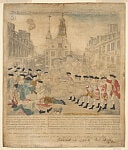
Bostonians resented the British troops quartered in their city. On a snowy day in March 1770, a crowd harassed guards near the customs house, and the guards fired into the crowd, killing five. Among the dead was Crispus Attucks, a dockworker of mixed African and American Indian heritage who later became a symbol for the antislavery movement. At trial, the soldiers were defended by John Adams; they were acquitted of murder, though two were convicted of manslaughter. Samuel Adams branded the incident a "massacre" and used it to inflame anti-British feeling. Notice the contrast between the two Adams cousins, one defending the rule of law, the other building a propaganda movement.
Renewed Conflict: Committees, the Gaspee, and the Tea Party
Even during the quiet years of 1770-1772, Samuel Adams kept resistance alive. In 1772 he organized Committees of Correspondence in Boston and other Massachusetts towns to exchange letters about suspicious British activities. In 1773 the Virginia House of Burgesses took it further by organizing intercolonial committees, creating a communication network for resistance.
The Gaspee Incident (1772)
The Gaspee, a British customs ship that had caught several smugglers, ran aground off Rhode Island. Colonists disguised as American Indians ordered the crew ashore and burned the ship. Britain set up a commission to bring the guilty to Britain for trial, which colonists saw as another threat to their right to local justice.
The Boston Tea Party (December 1773)
Parliament passed the Tea Act (1773) to bail out the struggling British East India Company. The act made the company's tea cheaper than smuggled Dutch tea, even with the tax included. That was the trap: buying the cheap tea would effectively recognize Parliament's right to tax the colonies, so many Americans refused.
When a tea shipment arrived in Boston harbor, a group of Bostonians, mostly artisans and laborers, disguised themselves as American Indians, boarded the ships, and dumped 342 chests of tea into the harbor. Colonial reaction was mixed. Many applauded the Boston Tea Party as a defense of liberty; others thought destroying private property went too far.
The Intolerable Acts, 1774
Britain retaliated with the Coercive Acts (1774), four punitive laws aimed at Massachusetts, plus the separate Quebec Act. Colonists lumped them together as the "Intolerable Acts."
The four Coercive Acts:
- Port Act: Closed Boston harbor to trade until the destroyed tea was paid for.
- Massachusetts Government Act: Reduced the power of the Massachusetts legislature and increased the royal governor's power.
- Administration of Justice Act: Allowed royal officials accused of crimes to be tried in Great Britain instead of the colonies.
- Quartering Act (expanded): Allowed British troops to be quartered in private homes, in all colonies.
The Quebec Act (1774) organized Canadian lands won from France. It established Roman Catholicism as Quebec's official religion, set up a government without a representative assembly, and extended Quebec's boundary to the Ohio River. Colonists hated it for three reasons: it took away western lands claimed by New York, Pennsylvania, Virginia, Massachusetts, and Connecticut; it suggested Britain might strip representative government from the colonies too; and predominantly Protestant Americans resented official recognition of the Catholic Church.
Taking Sides
The crackdown forced colonists to choose. Wealthy merchants in New York and Philadelphia and southern planters often supported Britain. Opponents from Virginia to Massachusetts criticized Britain harshly and backed their words with hostile action, especially in Boston and New England. As more people protested publicly and donated money, the independence movement gained strength. The ideas fueling that movement are the focus of AMSCO 3.4 on the philosophical foundations of the Revolution.
Key Terms to Know
| Term | Why it matters |
|---|---|
| Sugar Act (1764) | Taxed foreign sugar and luxuries; tried accused smugglers in jury-less admiralty courts. |
| Quartering Act (1765) | Forced colonists to house and feed British soldiers, later expanded to private homes in 1774. |
| Stamp Act (1765) | The first direct tax on the colonies, on printed paper, triggering the first united colonial protest. |
| Stamp Act Congress | Nine colonies met in New York in 1765 and resolved that only elected colonial representatives could approve taxes. |
| Sons and Daughters of Liberty | Secret society that intimidated tax agents and destroyed revenue stamps. |
| Declaratory Act (1766) | Passed with the Stamp Act repeal; claimed Parliament could legislate for the colonies "in all cases whatsoever." |
| Townshend Acts (1767) | Duties on tea, glass, and paper that paid crown officials' salaries, cutting them loose from colonial assemblies. |
| Writ of assistance | A general search license letting officials hunt for smuggled goods anywhere, without a specific warrant. |
| John Dickinson | Wrote Letters From a Farmer in Pennsylvania, arguing Parliament could regulate trade but not tax without colonial consent. |
| Samuel Adams | Boston radical who co-wrote the Massachusetts Circular Letter, publicized the "massacre," and launched the Committees of Correspondence. |
| Massachusetts Circular Letter | 1768 letter by Otis and Adams urging colonies to petition Parliament to repeal the Townshend Acts. |
| Committees of Correspondence | Letter-writing networks (Boston 1772, intercolonial 1773) that spread news of British threats and unified resistance. |
| Tea Act (1773) | Made East India Company tea cheaper than smuggled tea; buying it would concede Parliament's right to tax. |
| Boston Tea Party | Bostonians dumped 342 chests of tea into the harbor in December 1773, provoking British retaliation. |
| Coercive Acts (1774) | Four punitive laws (Port, Massachusetts Government, Administration of Justice, expanded Quartering) targeting Boston. |
| Quebec Act (1774) | Extended Quebec to the Ohio River with no assembly and an official Catholic church, alarming the 13 colonies. |
| Intolerable Acts | The colonists' label for the Coercive Acts plus the Quebec Act, which pushed many toward independence. |
| Lord Frederick North | Prime minister who repealed the Townshend Acts in 1770 but kept the tea tax as a symbol of Parliament's authority. |
Practice and Next Steps
Pair these notes with the Fiveable Topic 3.3 Taxation Without Representation study guide for the course-aligned version of this material, and browse the full set of APUSH AMSCO notes to keep moving through Unit 3.
To check yourself:
- Run through guided practice questions on Period 3 to test whether you can sequence the acts and colonial responses in order.
- Try a practice FRQ with instant scoring. A causation prompt on what led to the Revolution is a classic, and this chapter is your evidence bank.
- Look up any term you're shaky on in the APUSH key terms glossary.
Frequently Asked Questions
What does AMSCO Topic 3.3 Taxation Without Representation cover?
AMSCO 3.3 covers the British acts and colonial protests from the Proclamation of 1763 through the Intolerable Acts of 1774. That includes the Sugar Act, Stamp Act, Townshend Acts, Boston Massacre, Boston Tea Party, and Coercive Acts, plus the colonial argument that Parliament could not tax them without elected representation. You can pair these notes with the Topic 3.3 course study guide.
Why was the Stamp Act of 1765 such a big deal compared to earlier taxes?
The Stamp Act was the first direct tax on the colonies, paid by ordinary people on printed paper like newspapers and legal documents, rather than by merchants on imports. That hit nearly everyone and made the lack of representation impossible to ignore. It triggered the Stamp Act Congress, the Sons and Daughters of Liberty, and boycotts that forced Parliament to repeal it in 1766.
What is virtual representation and why did colonists reject it?
Virtual representation was the British theory that every member of Parliament represented the interests of the whole empire, not just the district that elected them, so colonists were already 'represented.' Colonists rejected it because they could not actually elect anyone to Parliament, meaning they had no real way to consent to or oppose taxes. They insisted only their own elected colonial assemblies could approve taxation.
What were the Intolerable Acts and what did each one do?
The Intolerable Acts was the colonists' name for the four Coercive Acts of 1774 plus the Quebec Act. The Port Act closed Boston harbor until the tea was paid for, the Massachusetts Government Act weakened the colonial legislature, the Administration of Justice Act let accused royal officials be tried in Britain, and an expanded Quartering Act allowed troops in private homes. The Quebec Act extended Quebec to the Ohio River and set up a government with no representative assembly.
How does Topic 3.3 show up on the APUSH exam?
Topic 3.3 supports one of Unit 3's central tasks: explaining how British colonial policies led to the Revolutionary War. Causation questions about the Revolution love this material, so know the sequence (Sugar Act, Stamp Act, Townshend Acts, Tea Act, Coercive Acts) and how colonial resistance escalated from petitions and boycotts to destroying property. You can test the chronology with guided practice questions.
See Fiveable more often in Google
Mark Fiveable as a preferred source and Google is more likely to show you our guides in Top Stories, with a "preferred" badge in AI Mode and AI Overviews.