AMSCO 2.1 Context: European Colonization of North America Notes

🇺🇸AP US History Review
AMSCO 2.1 Context: European Colonization of North America Notes
🇺🇸 AP US History
AMSCO 1.2:Native American Societies Before European Contact Notes
AMSCO 2.1 Context: European Colonization of North America Notes
AMSCO 2.2 European Colonization Notes
AMSCO 2.3 The Regions of the British Colonies Notes
AMSCO 2.4 Transatlantic Trade Notes
AMSCO 2.5 Interactions between American Indians and Europeans Notes
AMSCO 2.6 Slavery in the British Colonies Notes
AMSCO 2.7 Colonial Society and Culture Notes
AMSCO 2.8 Comparison in Period 2 (1607-1754) Notes
AMSCO 3.1 Contextualizing Period 3
AMSCO 3.2 The Seven Year's War
AMSCO 3.3 Taxation Without Representation
AMSCO 3.4 Philosophical Foundations of the American Revolution
AMSCO 3.5 The American Revolution
AMSCO 3.6 The Influence of Revolutionary Ideals
AMSCO 3.7 The Articles of Confederation
AMSCO 3.8 The Constitutional Convention and Debates Over Ratification
AMSCO 3.9 The Constitution
AMSCO 3.10 Shaping a New Republic
AMSCO 3.11 Developing an American Identity
AMSCO 3.12 Movements in the Early Republic
AMSCO 3.13 Continuity and Change in Period 3
AMSCO 4.1 Contextualizing Period 4
AMSCO 4.2 The Rise of Political Parties and the Era of Jefferson
AMSCO 4.3 Politics and Regional Interests
AMSCO 4.4 America on the World Stage
AMSCO 4.5 Market Revolution
AMSCO 4.6 Effects of the Market Revolution on Society and Culture
AMSCO 4.7 Expanding Democracy
AMSCO 4.8 Jackson and Federal Power
AMSCO 4.9 The Development of an American Culture
AMSCO 4.10 The Second Great Awakening
AMSCO 4.11 An Age of Reform
AMSCO 4.12 African Americans in the Early Republic
AMSCO 4.13 Southern Society in the Early Republic
AMSCO 4.14 Causation in Period 4
AMSCO 5.1 Contextualizing Period 5
AMSCO 5.2 The Idea of Manfiest Destiny
AMSCO 5.3 Manifest Destiny and the Mexican-American War
AMSCO 5.4 The Compromise of 1850
AMSCO 5.5 Sectional Conflict: Regional Differences
AMSCO 5.6 Failure of Compromise
AMSCO 5.7 Election of 1860 and Secession
AMSCO 5.8 Military Conflict in the Civil War
AMSCO 5.9 Government Policies During the Civil War
AMSCO 5.10 Reconstruction
AMSCO 5.11 Failure of Reconstruction
AMSCO 5.12 Comparion in Period 5
AMSCO 6.1 Contextualizing Period 6
AMSCO 6.2 Westward Expansion: Economic Development
AMSCO 6.3 Westward Expansion: Social and Cultural Development
AMSCO 6.4 The "New South"
AMSCO 6.5 Technological Innovation
AMSCO 6.6 The Rise of Industrial Capitalism
AMSCO 6.7 Labor in the Gilded Age
AMSCO 6.8 Immigration and Migration in the Gilded Age
AMSCO 6.9 Responses to Immigration in the Gilded Age
AMSCO 6.10 Development of the Middle Class
AMSCO 6.11 Reform in the Gilded Age
AMSCO 6.12 Role of Government in the Gilded Age
AMSCO 6.13 Politics in the Gilded Age
AMSCO 6.14 Continuity and Change Period 6
AMSCO 7.1 Contextualizing Period 7
AMSCO 7.2 Imperialism: Debates
AMSCO 7.3 The Spanish-American War and U.S. Foreign Policy to 1917
AMSCO 7.4 The Progressives
AMSCO 7.5 World War I: Military and Diplomacy
AMSCO 7.6 World War I: Home Front
AMSCO 7.7 1920s: Innovations in Communication and Technology
AMSCO 7.8 1920s: Cultural and Political Controversies
AMSCO 7.9 The Great Depression
AMSCO 7.10 The New Deal
AMSCO 7.11 Inerwar Foreign Policy
AMSCO 7.12 World War II Mobilization
AMSCO 7.13 World War II Military
AMSCO 7.14 World War II and Postwar Diplomacy
AMSCO 7.15 Comparison in Period 7
AMSCO 8.1 Contextualizing Period 8
AMSCO 8.2 The Cold War from 1945 to 1980
AMSCO 8.3 The Red Scare
AMSCO 8.4 Economy after 1945
AMSCO 8.5 Culture after 1945
AMSCO 8.6 Early Steps in the Civil Rights Movement, 1945-1960
AMSCO 8.7 America as a World Power
AMSCO 8.8 The Vietnam War
AMSCO 8.9 The Great Society
AMSCO 8.10 The African American Civil Rights Movement in the 1960s
AMSCO 8.11 The Civil Rights Movement Expands
AMSCO 8.12 Youth Culture of the 1960s
AMSCO 8.13 The Environment and Natural Resources from 1968 to 1980
AMSCO 8.14 Society in Transition
AMSCO 8.15 Continuity and Change in Period 8
AMSCO 9.1 Contextualizing Period 9
AMSCO 9.2 Reagan and Conservatism
AMSCO 9.3 The End of the Cold War
AMSCO 9.4 A Changing Economy
AMSCO 9.5 Migration and Immgiration in the 1990s and 2000s
AMSCO 9.6 Challenges of the 21st Century
AMSCO 9.7 Causation in Period 9
AMSCO 1.1 Contextualizing Period 1 Notes
AMSCO 1.3 European Exploration in the Americas Notes
AMSCO 1.4 Columbian Exchange, Spanish Exploration, and Conquest Notes
AMSCO 1.5 Labor, Slavery, and Caste in the Spanish Colonial System Notes
AMSCO 1.6 Cultural Interactions in the Americas Notes
AMSCO 1.7 Causation in Period 1 Notes
Overview
AMSCO Topic 2.1, Contextualizing Period 2 (AMSCO pages 32-33), sets the stage for everything in APUSH Unit 2: the colonization of North America from 1607 to 1754. The chapter explains how European exploration (dominated by Spain in Period 1) gave way to expanding colonization by the Spanish, French, Dutch, and British, with the British eventually controlling the Atlantic coast from Canada to the Caribbean and founding 13 colonies. Three big threads run through the chapter: how early settlements grew into distinct colonial societies, how trade tied the colonies to Britain and to Native Americans, and how the search for labor led colonists from enslaving Native Americans, to indentured servitude, to importing enslaved Africans.
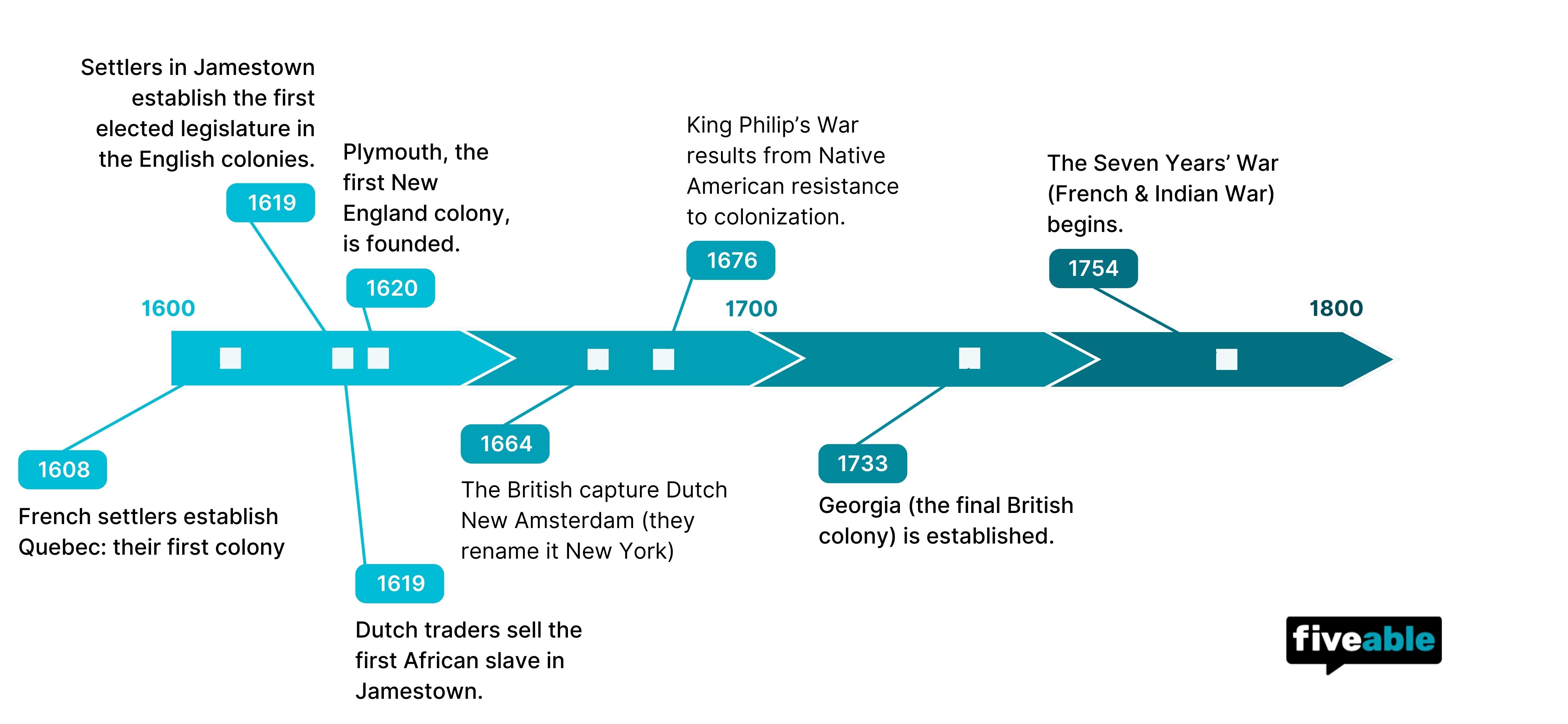
Timeline of key events in the colonial period. Image courtesy of Sitara Hariharan.
Key Takeaways
- After 1607, Spanish, French, Dutch, and British colonization expanded in North America; Jamestown and Plymouth became starting points for the 13 British colonies.
- British colonies developed different economies: Northern colonies leaned toward trade and industry, while Southern colonies relied on plantation agriculture.
- Trade shaped early contact with Native Americans, but competition over land brought conflict, and European diseases devastated Native populations.
- Colonists first tried enslaving Native Americans, then used indentured servants, but large landowners' labor needs led the British to import enslaved Africans.
- Trade tied the colonies to Britain, but resistance to British control over commerce grew by the mid-1700s as a shared colonial identity slowly emerged.
The Big Picture: From Exploration to Colonization (1607-1754)
Period 2 marks the shift from exploring the Americas to settling them permanently. The years 1491-1607 were dominated by Spanish exploration. After 1607, the Spanish, French, Dutch, and British all established colonies in North America, and the British came to dominate the region.
What changed over the period:
- The colonies started out struggling just to survive. Jamestown's early years were brutal.
- Over time, they became a society of permanent farms, plantations, towns, and cities.
- European settlers brought different cultures, economic plans, and ideas about government to North America. Despite those differences, all of them sought to dominate the native inhabitants.
The period runs from the first permanent English settlement in 1607 to the eve of a decisive war for control of the continent (the French and Indian War). By the 1750s, the 13 British colonies were using trade and war to dominate both Native Americans and rival European colonists.
Early Settlements
The Spanish and Portuguese arrived first, settling mainly in Central and South America, with the Spanish slowly migrating north into North America. The French, Dutch, and British then settled along the Atlantic coast and gradually pushed westward, each developing different colonial systems and different relationships with Native Americans.
Jamestown, Plymouth, and the 13 Colonies
Jamestown and Plymouth were the first two successful British colonies on the Atlantic coast. They were the starting points for what became 13 colonies stretching as far south as Georgia.
- Each colony developed its own economic and cultural system depending on environmental conditions and settlement patterns. Northern colonies leaned toward trade and industry; Southern colonies relied on plantation agriculture.
- Transatlantic trade mattered for most of them. Tobacco, timber, and rice were the big export products.
- Trade, religion, and a shared language created strong bonds between the colonies and Great Britain. But by the mid-1700s, trade became a point of conflict as colonists resisted British control over their commerce. That tension foreshadows the road to independence in Unit 3.
The AMSCO 2.3 notes on the regions of the British colonies break down these regional differences in detail.
Trade with Native Americans
Trade was also the mainstay of early contact between Europeans and Native Americans.
- Colonists wanted a dependable food supply. Native Americans were drawn to European iron tools and guns. The fur trade became a major exchange point.
- Despite this exchange, Europeans generally treated Native Americans as inferiors to be used or pushed aside. The European idea of private land ownership also clashed with Native American communal land use.
- European diseases like smallpox caused massive casualties among Native populations, which made it easier for Europeans to keep expanding.
Trade created competition for resources, too. The British and French fought a series of wars for control of land, and Native American nations such as the Iroquois and the Huron allied with European powers (or with each other) to advance their own interests. More on this dynamic in the AMSCO 2.5 notes on interactions between American Indians and Europeans.
Sources of Labor
As Europeans seized land from Native Americans, they needed workers to make that land profitable, especially for labor-intensive cash crops grown for export. The chapter traces a three-step progression that you should be able to explain on the exam.
- Enslaving Native Americans. This was tried first and failed. Native Americans knew the land and could escape too easily.
- Indentured servants. These were individuals who agreed to work for a master for a set number of years (often seven) in exchange for transportation from Europe to the Americas. Indentured servitude became common in the colonies, but it never supplied enough labor for large landowners.
- Enslaved Africans. The British, following the example of the Spanish and others, began importing enslaved laborers from Africa as a permanent labor force. Agricultural economies built on enslaved labor grew throughout the colonies, especially where cash-crop plantations dominated.
This shift from indentured servitude to African slavery is one of the most-tested cause-and-effect chains in Unit 2. The AMSCO 2.6 notes on slavery in the British colonies cover where it goes next.
Why This Context Matters for Unit 2
Topic 2.1 is a setup chapter, so the payoff is knowing the themes you'll see developed in Topics 2.2 through 2.8:
- Different colonizers, different goals. Spanish, French, Dutch, and British colonizers had different economic and imperial goals involving land and labor, which shaped their colonies and their relationships with native populations.
- Regional variation. The British colonies along the Atlantic coast developed regional differences based on environment, economy, culture, and demographics.
- Competition breeds conflict. Rivalry over resources between European powers and Native Americans encouraged trade and industry but also led to recurring warfare.
- Bonds and resistance. Transatlantic commercial, religious, and political exchanges tied colonists more closely to Britain and to one another, while also planting the seeds of resistance to British control.
- A shared colonial identity slowly emerged. Ties to England stayed strong, but the groundwork for later calls for independence was being laid.
Key Terms to Know
| Term | Why it matters |
|---|---|
| Period 2 (1607-1754) | The APUSH period covering British colonization, from Jamestown's founding to the eve of the French and Indian War. |
| Jamestown | The first permanent English settlement in North America (1607) and one of the two starting points for the 13 colonies. |
| Plymouth | The second successful British Atlantic colony, founded by settlers with religious motives. |
| 13 colonies | The British colonies along the Atlantic coast, stretching as far south as Georgia, each with its own economy and culture. |
| Transatlantic trade | The commerce in tobacco, timber, and rice that tied the colonies to Britain and later became a source of conflict. |
| Indentured servants | Workers who exchanged a set term of labor (often seven years) for passage from Europe to the Americas. |
| Atlantic slave trade | The system of importing enslaved Africans that the British adopted when indentured servitude proved insufficient. |
| Cash crops | Export crops like tobacco and rice that drove the demand for labor in the colonies. |
| Plantation agriculture | The labor-intensive farming system that dominated Southern colonial economies. |
| Iroquois | A Native American confederacy that allied strategically with European powers to advance its own interests. |
| Huron | A Native American nation that, like the Iroquois, formed alliances with Europeans or other nations during colonial conflicts. |
| Fur trade | A major point of exchange between Native Americans and European colonists. |
| Smallpox | A European disease that devastated Native American populations and eased colonial expansion. |
| Spanish, French, Dutch, and British colonizers | The four European powers whose differing goals for land and labor shaped distinct colonial societies. |
Practice and Next Steps
Reinforce Topic 2.1 with the 2.1 Context: European Colonization course study guide, then move on to the AMSCO 2.2 European Colonization notes to compare the Spanish, French, Dutch, and British colonial models in depth. You can find the full set of chapter summaries on the APUSH AMSCO notes page.
To check your understanding, try guided multiple-choice practice on Unit 2 content, or look up any term that's still fuzzy in the APUSH key terms glossary. When you're ready to write, the FRQ practice tool with instant scoring is a good way to practice contextualization, the exact skill this chapter builds.
Frequently Asked Questions
What is AMSCO Topic 2.1 about in APUSH?
AMSCO Topic 2.1, Contextualizing Period 2 (pages 32-33), sets up Unit 2 by explaining the shift from European exploration to colonization of North America between 1607 and 1754. It covers the Spanish, French, Dutch, and British colonial powers, the founding of Jamestown and Plymouth, transatlantic trade, and the search for labor that led to African slavery.
What years does APUSH Period 2 cover?
Period 2 runs from 1607, the founding of Jamestown as the first permanent English settlement in North America, to 1754, the eve of the French and Indian War. During this stretch, struggling early settlements grew into a society of permanent farms, plantations, towns, and cities.
Why did the colonies switch from indentured servants to enslaved Africans?
Enslaving Native Americans failed because they knew the land and escaped easily, and indentured servants (who worked a set term, often seven years, for passage to America) never supplied enough labor for large landowners. So the British, following the Spanish example, began importing enslaved Africans as a permanent labor force. The AMSCO 2.6 notes trace how slavery developed from there.
Did trade make the colonies closer to Britain or push them apart?
Both, and that tension is the point of this chapter. Trade in tobacco, timber, and rice, plus shared religion and language, created strong bonds between the colonies and Great Britain. But by the mid-1700s, colonists increasingly resisted British control over their trade, laying groundwork for later calls for independence.
How does Topic 2.1 show up on the APUSH exam?
Topic 2.1 is a contextualization topic, so it's most useful for the context point on DBQs and LEQs about colonial America and for multiple-choice questions on causes of colonization and the shift to enslaved labor. Practice explaining the big-picture setup with guided practice questions on Unit 2.
See Fiveable more often in Google
Mark Fiveable as a preferred source and Google is more likely to show you our guides in Top Stories, with a "preferred" badge in AI Mode and AI Overviews.