AMSCO 8.2 The Cold War from 1945 to 1980

🇺🇸AP US History Review
AMSCO 8.2 The Cold War from 1945 to 1980
🇺🇸 AP US History
AMSCO 1.2:Native American Societies Before European Contact Notes
AMSCO 2.1 Context: European Colonization of North America Notes
AMSCO 2.2 European Colonization Notes
AMSCO 2.3 The Regions of the British Colonies Notes
AMSCO 2.4 Transatlantic Trade Notes
AMSCO 2.5 Interactions between American Indians and Europeans Notes
AMSCO 2.6 Slavery in the British Colonies Notes
AMSCO 2.7 Colonial Society and Culture Notes
AMSCO 2.8 Comparison in Period 2 (1607-1754) Notes
AMSCO 3.1 Contextualizing Period 3
AMSCO 3.2 The Seven Year's War
AMSCO 3.3 Taxation Without Representation
AMSCO 3.4 Philosophical Foundations of the American Revolution
AMSCO 3.5 The American Revolution
AMSCO 3.6 The Influence of Revolutionary Ideals
AMSCO 3.7 The Articles of Confederation
AMSCO 3.8 The Constitutional Convention and Debates Over Ratification
AMSCO 3.9 The Constitution
AMSCO 3.10 Shaping a New Republic
AMSCO 3.11 Developing an American Identity
AMSCO 3.12 Movements in the Early Republic
AMSCO 3.13 Continuity and Change in Period 3
AMSCO 4.1 Contextualizing Period 4
AMSCO 4.2 The Rise of Political Parties and the Era of Jefferson
AMSCO 4.3 Politics and Regional Interests
AMSCO 4.4 America on the World Stage
AMSCO 4.5 Market Revolution
AMSCO 4.6 Effects of the Market Revolution on Society and Culture
AMSCO 4.7 Expanding Democracy
AMSCO 4.8 Jackson and Federal Power
AMSCO 4.9 The Development of an American Culture
AMSCO 4.10 The Second Great Awakening
AMSCO 4.11 An Age of Reform
AMSCO 4.12 African Americans in the Early Republic
AMSCO 4.13 Southern Society in the Early Republic
AMSCO 4.14 Causation in Period 4
AMSCO 5.1 Contextualizing Period 5
AMSCO 5.2 The Idea of Manfiest Destiny
AMSCO 5.3 Manifest Destiny and the Mexican-American War
AMSCO 5.4 The Compromise of 1850
AMSCO 5.5 Sectional Conflict: Regional Differences
AMSCO 5.6 Failure of Compromise
AMSCO 5.7 Election of 1860 and Secession
AMSCO 5.8 Military Conflict in the Civil War
AMSCO 5.9 Government Policies During the Civil War
AMSCO 5.10 Reconstruction
AMSCO 5.11 Failure of Reconstruction
AMSCO 5.12 Comparion in Period 5
AMSCO 6.1 Contextualizing Period 6
AMSCO 6.2 Westward Expansion: Economic Development
AMSCO 6.3 Westward Expansion: Social and Cultural Development
AMSCO 6.4 The "New South"
AMSCO 6.5 Technological Innovation
AMSCO 6.6 The Rise of Industrial Capitalism
AMSCO 6.7 Labor in the Gilded Age
AMSCO 6.8 Immigration and Migration in the Gilded Age
AMSCO 6.9 Responses to Immigration in the Gilded Age
AMSCO 6.10 Development of the Middle Class
AMSCO 6.11 Reform in the Gilded Age
AMSCO 6.12 Role of Government in the Gilded Age
AMSCO 6.13 Politics in the Gilded Age
AMSCO 6.14 Continuity and Change Period 6
AMSCO 7.1 Contextualizing Period 7
AMSCO 7.2 Imperialism: Debates
AMSCO 7.3 The Spanish-American War and U.S. Foreign Policy to 1917
AMSCO 7.4 The Progressives
AMSCO 7.5 World War I: Military and Diplomacy
AMSCO 7.6 World War I: Home Front
AMSCO 7.7 1920s: Innovations in Communication and Technology
AMSCO 7.8 1920s: Cultural and Political Controversies
AMSCO 7.9 The Great Depression
AMSCO 7.10 The New Deal
AMSCO 7.11 Inerwar Foreign Policy
AMSCO 7.12 World War II Mobilization
AMSCO 7.13 World War II Military
AMSCO 7.14 World War II and Postwar Diplomacy
AMSCO 7.15 Comparison in Period 7
AMSCO 8.1 Contextualizing Period 8
AMSCO 8.2 The Cold War from 1945 to 1980
AMSCO 8.3 The Red Scare
AMSCO 8.4 Economy after 1945
AMSCO 8.5 Culture after 1945
AMSCO 8.6 Early Steps in the Civil Rights Movement, 1945-1960
AMSCO 8.7 America as a World Power
AMSCO 8.8 The Vietnam War
AMSCO 8.9 The Great Society
AMSCO 8.10 The African American Civil Rights Movement in the 1960s
AMSCO 8.11 The Civil Rights Movement Expands
AMSCO 8.12 Youth Culture of the 1960s
AMSCO 8.13 The Environment and Natural Resources from 1968 to 1980
AMSCO 8.14 Society in Transition
AMSCO 8.15 Continuity and Change in Period 8
AMSCO 9.1 Contextualizing Period 9
AMSCO 9.2 Reagan and Conservatism
AMSCO 9.3 The End of the Cold War
AMSCO 9.4 A Changing Economy
AMSCO 9.5 Migration and Immgiration in the 1990s and 2000s
AMSCO 9.6 Challenges of the 21st Century
AMSCO 9.7 Causation in Period 9
AMSCO 1.1 Contextualizing Period 1 Notes
AMSCO 1.3 European Exploration in the Americas Notes
AMSCO 1.4 Columbian Exchange, Spanish Exploration, and Conquest Notes
AMSCO 1.5 Labor, Slavery, and Caste in the Spanish Colonial System Notes
AMSCO 1.6 Cultural Interactions in the Americas Notes
AMSCO 1.7 Causation in Period 1 Notes
Overview
AMSCO Topic 8.2, "The Cold War from 1945 to 1980," covers the long rivalry between the United States and the Soviet Union, from the breakdown of the wartime alliance through containment, Korea, Eisenhower's brinkmanship, the Cuban missile crisis, and the slide toward détente. It's the backbone chapter of Period 8 (1945-1980): almost every other topic in the unit, from the Red Scare to Vietnam, grows out of the conflict described here. The big skill the exam wants is tracing continuity and change in Cold War policy across these 35 years.
The one-sentence version: the U.S. tried to limit Communist military power and ideological influence through collective security (NATO), international aid (the Marshall Plan), and economic institutions, while the conflict swung between confrontation and coexistence.
Key Takeaways
- Long-standing U.S.-Soviet distrust deepened as Moscow backed Communist governments in Eastern Europe and the two sides disagreed over Germany's future.
- Containment in Europe used the Marshall Plan to rebuild Western Europe, the Berlin airlift to supply blockaded Berlin, and NATO as a permanent European alliance.
- China's Communist victory fueled U.S. fears of a wider conspiracy, while the Korean War tested containment and ended in a stalemate near the 38th parallel.
- Eisenhower and Dulles pursued brinkmanship and nuclear-based massive retaliation, but the U.S. did not intervene in Hungary's 1956 revolt.
- Kennedy shifted to flexible response, the Cuban missile crisis brought the superpowers near nuclear war, and Nixon later pursued détente with the Soviet Union and China.
Origins of the Cold War
The Cold War grew out of decades of U.S.-Soviet distrust that the World War II alliance only paused, never fixed. The two superpowers competed through diplomacy and proxy conflicts among allies, rarely fighting each other directly, but several crises brought the world close to nuclear war.
Why the wartime alliance fell apart
- Americans had viewed the Soviets as a threat since the 1917 Bolshevik Revolution (think the Red Scare of 1919). The U.S. didn't even recognize the USSR until 1933.
- Stalin resented that the British and Americans waited until 1944 to open a second front in France. By some estimates, half of all WWII deaths were Soviets.
- Tensions over Central and Eastern Europe were already visible at Yalta and Potsdam in 1945. Truman, unlike FDR, was quickly suspicious of Stalin.
Early flashpoints, 1945-1946
- The United Nations (founded fall 1945) gave the five major wartime allies permanent seats and veto power on the Security Council. The Soviets rejected the Baruch Plan to regulate nuclear energy and eliminate atomic weapons, which Americans read as proof of hostile intent.
- The Soviets also refused to join the World Bank (created at Bretton Woods, 1944), viewing it as an instrument of capitalism.
- From 1946 to 1948, Communist dictators loyal to Moscow took power in Poland, Romania, Bulgaria, Albania, Hungary, and Czechoslovakia. The Soviets called these satellite states a buffer against another invasion from the West; the U.S. and Britain saw a violation of self-determination.
- Germany's "temporary" occupation zones hardened. The Soviets wanted a weak Germany and heavy reparations; the U.S. and Britain wanted German economic recovery.
- In March 1946 at Fulton, Missouri, Winston Churchill declared that "an iron curtain has descended across the continent," the metaphor used for the rest of the Cold War for the East-West divide in Europe.
Containment in Europe
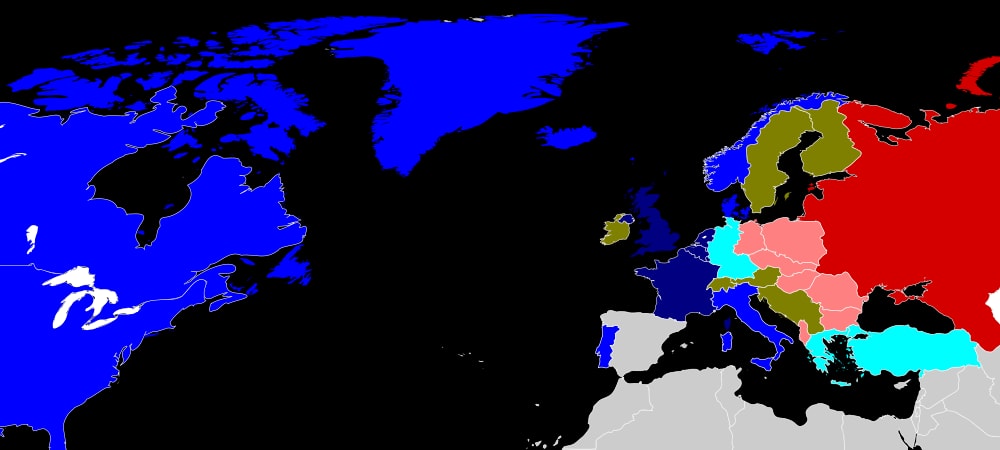
In early 1947, Truman adopted containment, a policy designed to prevent Soviet expansion without starting a war. It was shaped by George Marshall, Dean Acheson, and Soviet expert George F. Kennan, who argued that "long-term, patient but firm and vigilant containment" would eventually force the Soviets to back off. The lesson of Munich (appeasing Hitler in 1938 failed) convinced U.S. leaders that Communist aggression had to be challenged everywhere.
The Truman Doctrine and Marshall Plan
- Truman Doctrine (March 1947): $400 million in economic and military aid to Greece (facing a Communist-led uprising) and Turkey (facing Soviet demands on the Dardanelles). It framed the Cold War as "free people" versus "totalitarian" regimes.
- Marshall Plan (1948): about $12 billion in U.S. aid to rebuild Western Europe over four years. It worked. Western Europe achieved self-sustaining growth by the 1950s, the Communist political threat in France and Italy faded, and U.S. exports boomed. The Soviets refused the aid, deepening the East-West rift.
Berlin, NATO, and the national security state
- Berlin airlift (1948-1949): when the Soviets blockaded land access to Berlin, Truman flew in supplies for 11 months instead of using force. Stalin backed down in May 1949. The crisis produced two Germanys: West Germany (U.S. ally) and East Germany (Soviet satellite).
- NATO (1949): the U.S. broke its tradition (dating to Washington's farewell address) of avoiding permanent European alliances. Twelve nations formed a mutual-defense pact; Eisenhower was its first Supreme Commander. The Soviets answered with the Warsaw Pact in 1955.
- National Security Act (1947): created the Department of Defense, the National Security Council (NSC), and the CIA.
- Arms race: the U.S. nuclear monopoly lasted only 1945-1949. After the Soviets tested an atomic bomb, Truman approved the hydrogen bomb (added to the U.S. arsenal in 1952). The secret report NSC-68 (1950) called for quadrupling defense spending to 20 percent of GNP and building alliances worldwide.
Cold War in Asia
Containment worked in Europe but not in Asia, where new nations emerging from colonialism resisted U.S. influence. Ironically, the Asian country most tightly tied to U.S. defense became Japan, the former enemy.
Japan, the Philippines, and China
- Under General Douglas MacArthur, occupied Japan adopted a 1947 constitution creating a parliamentary democracy and renouncing war. Treaties in 1951 ended the occupation but kept U.S. bases there; Japan prospered as an ally.
- The Philippines became independent on July 4, 1946, but the U.S. kept key naval and air bases.
- China "fell" to communism in 1949. Mao Zedong's Communists, appealing to landless peasants, defeated Chiang Kai-shek's corruption-plagued Nationalists, who fled to Taiwan. The U.S. refused to recognize the People's Republic of China until 1979. Republicans blamed Democrats for the "loss of China," and the 1950 Sino-Soviet pact fed fears of a worldwide Communist conspiracy.
The Korean War
- After WWII, Korea was split at the 38th parallel: Communist Kim Il Sung in the North, conservative nationalist Syngman Rhee in the South.
- North Korea invaded the South on June 25, 1950. Truman, applying containment, got UN authorization (the Soviets were boycotting the Security Council) and sent U.S. troops under MacArthur. Congress never declared war; it was officially a "police action."
- MacArthur's amphibious landing at Inchon reversed the war, but when UN forces neared the Chinese border, masses of Chinese troops poured in and drove them back.
- Truman vs. MacArthur: when MacArthur publicly demanded expanding the war into China ("There is no substitute for victory"), Truman fired him for insubordination in April 1951. This is a classic civilian-control-of-the-military example for FRQs.
- The war stalemated near the 38th parallel. Containment worked (no world war, aggression stopped), but Republicans branded Democrats "soft on communism" and won the presidency in 1952 with Eisenhower.
Eisenhower, Dulles, and the "New Look"
Eisenhower (1953-1961) and Secretary of State John Foster Dulles pushed a more aggressive-sounding strategy than Truman's containment. Dulles talked of "liberating captive nations" and pushing Communist powers to the brink of war, betting they'd back down before American nuclear superiority. That hard line became known as brinkmanship.
- Massive retaliation meant relying on nuclear weapons and air power instead of expensive conventional forces ("more bang for the buck"). The U.S. developed the hydrogen bomb in 1953; the Soviets matched it within about a year.
- A Korean armistice in 1953 ended the fighting near the 38th parallel without a peace treaty.
- Eisenhower also floated cooperative proposals, including "atoms for peace" and an open-skies policy, producing a brief thaw called the spirit of Geneva.
- Soviet leader Nikita Khrushchev talked of peaceful coexistence, but the limits of "liberation" showed in 1956 when the U.S. did not intervene in the Hungarian revolt against Soviet control.
- Sputnik (1957), the first satellite, shocked Americans and spurred the creation of NASA in 1958.
- The U-2 incident (1960), when the Soviets shot down an American spy plane, wrecked a planned summit.
- In Cuba, Fidel Castro came to power in 1959 and aligned with the Soviets.
- In his farewell address, Eisenhower warned against the growing power of the military-industrial complex.
Kennedy to Détente
Cold War policy after 1960 swung from the most dangerous confrontation of the era to negotiated coexistence. Kennedy replaced massive retaliation with a flexible-response policy, building up conventional forces so every crisis didn't have to be nuclear.
- The Bay of Pigs invasion (1961), a failed CIA-backed attempt to topple Castro, embarrassed Kennedy.
- The Berlin Wall went up in 1961, sealing off East Berlin and becoming the Cold War's most visible symbol.
- The Cuban missile crisis (1962) over Soviet missiles in Cuba brought the superpowers to the edge of nuclear war before Khrushchev withdrew the missiles.
- The scare produced arms-control steps: the Nuclear Test Ban Treaty (1963) and later the Non-Proliferation Treaty.
- Under Nixon, Henry Kissinger engineered détente, a deliberate easing of tensions with both the Soviet Union and China. The Strategic Arms Limitation Talks (SALT) capped antiballistic missiles (ABMs) and slowed the arms race.
For the exam, that arc is the answer to the continuity/change question: containment stayed constant from Truman through Nixon, but the methods shifted from economic aid and alliances, to nuclear brinkmanship, to flexible response, to détente. The follow-through into the 1970s-80s is in AMSCO 8.7 America as a World Power.
Key Terms to Know
| Term | Why it matters |
|---|---|
| Containment policy | Kennan's strategy of blocking Soviet expansion without war; it guided U.S. foreign policy for decades. |
| Truman Doctrine | 1947 pledge of $400 million to Greece and Turkey, committing the U.S. to aid "free people" against totalitarianism. |
| Marshall Plan | $12 billion in U.S. aid that rebuilt Western Europe and ended the Communist political threat there. |
| Iron Curtain | Churchill's 1946 metaphor for the division between Western democracies and Soviet-controlled Eastern Europe. |
| Satellites | Eastern European nations (Poland, Hungary, etc.) controlled by Moscow as a buffer zone after 1946-1948. |
| Berlin airlift | Truman's 11-month airborne supply of blockaded West Berlin (1948-1949) that forced Stalin to back down. |
| NATO | The 1949 military alliance that broke the U.S. tradition of avoiding permanent European alliances. |
| Warsaw Pact | The Soviets' 1955 answer to NATO, a defense alliance of Communist Eastern Europe. |
| NSC-68 | Secret 1950 report calling for quadrupling defense spending to fight the Cold War globally. |
| Korean War | The first major military test of containment (1950-1953), fought as a UN "police action" and ending in stalemate at the 38th parallel. |
| Douglas MacArthur | UN commander in Korea, fired by Truman in 1951 for publicly pushing to expand the war into China. |
| Mao Zedong | Communist leader who won China's civil war in 1949, fueling "loss of China" attacks on Democrats. |
| Brinkmanship | Dulles's strategy of pushing Communist powers to the edge of war, counting on U.S. nuclear superiority. |
| Massive retaliation | Eisenhower-era reliance on nuclear weapons over conventional forces ("more bang for the buck"). |
| Sputnik | The 1957 Soviet satellite that shocked the U.S. and led to NASA's creation in 1958. |
| Cuban missile crisis | The 1962 standoff over Soviet missiles in Cuba, the closest the Cold War came to nuclear war. |
| Flexible-response policy | Kennedy's shift back toward conventional forces so crises wouldn't automatically go nuclear. |
| Détente | The Nixon-Kissinger easing of tensions with the USSR and China, including the SALT agreements. |
Practice and Next Steps
Pair these chapter notes with the matching course-topic guide, 8.2 The Cold War from 1945 to 1980, which frames the same material the way the exam tests it. For the bigger Period 8 picture, start with AMSCO 8.1 Contextualizing Period 8, then see how Cold War fear played out at home in AMSCO 8.3 The Red Scare. You can browse every chapter on the APUSH AMSCO notes page.
To check yourself, drill stimulus-based multiple choice with APUSH guided practice, quiz the vocab in the key terms glossary, and try a Cold War prompt in FRQ practice with instant scoring.
Frequently Asked Questions
What does AMSCO Chapter 8.2 cover in APUSH?
AMSCO 8.2 covers the Cold War from 1945 to 1980: the breakdown of the U.S.-Soviet wartime alliance, Truman's containment policy (Truman Doctrine, Marshall Plan, Berlin airlift, NATO), the Korean War, Eisenhower's brinkmanship, the Cuban missile crisis, and détente under Nixon. It pairs with the course-topic guide 8.2 The Cold War from 1945 to 1980.
What was the containment policy and who created it?
Containment was the U.S. strategy, adopted by Truman in 1947, of blocking Soviet expansion without starting a war. It was shaped by George Marshall, Dean Acheson, and George F. Kennan, who argued that patient, firm resistance to Russian expansion would eventually force the Soviets to back off. It guided U.S. foreign policy for decades, from the Truman Doctrine through Korea and Vietnam.
What's the difference between the Truman Doctrine and the Marshall Plan?
The Truman Doctrine (March 1947) was $400 million in military and economic aid specifically for Greece and Turkey, plus a broad pledge to support 'free people' against totalitarian regimes. The Marshall Plan (1948) was a much bigger program, about $12 billion in economic aid to rebuild all of Western Europe. Same goal (containing communism), different tools: the doctrine was a policy statement with targeted aid, the plan was mass economic reconstruction.
Did the US and Soviet Union ever fight each other directly in the Cold War?
No. The superpowers competed through diplomacy and through armed conflicts among their allies (like Korea, where U.S. troops fought North Koreans and Chinese, not Soviets), but they never went to war with each other directly. Several crises came close, though, especially the Berlin blockade in 1948-49 and the Cuban missile crisis in 1962, which is why it's called a 'cold' war.
How does the Cold War show up on the APUSH exam?
Topic 8.2 asks you to explain continuities and changes in Cold War policies from 1945 to 1980. The continuity is containment; the changes are the methods, from Truman's economic aid and alliances, to Eisenhower's brinkmanship and massive retaliation, to Kennedy's flexible response, to Nixon's détente. That arc makes a strong LEQ or DBQ thesis, and you can practice it with FRQ practice and instant scoring.
See Fiveable more often in Google
Mark Fiveable as a preferred source and Google is more likely to show you our guides in Top Stories, with a "preferred" badge in AI Mode and AI Overviews.