AMSCO 7.5 World War I: Military and Diplomacy

🇺🇸AP US History Review
AMSCO 7.5 World War I: Military and Diplomacy
🇺🇸 AP US History
AMSCO 1.2:Native American Societies Before European Contact Notes
AMSCO 2.1 Context: European Colonization of North America Notes
AMSCO 2.2 European Colonization Notes
AMSCO 2.3 The Regions of the British Colonies Notes
AMSCO 2.4 Transatlantic Trade Notes
AMSCO 2.5 Interactions between American Indians and Europeans Notes
AMSCO 2.6 Slavery in the British Colonies Notes
AMSCO 2.7 Colonial Society and Culture Notes
AMSCO 2.8 Comparison in Period 2 (1607-1754) Notes
AMSCO 3.1 Contextualizing Period 3
AMSCO 3.2 The Seven Year's War
AMSCO 3.3 Taxation Without Representation
AMSCO 3.4 Philosophical Foundations of the American Revolution
AMSCO 3.5 The American Revolution
AMSCO 3.6 The Influence of Revolutionary Ideals
AMSCO 3.7 The Articles of Confederation
AMSCO 3.8 The Constitutional Convention and Debates Over Ratification
AMSCO 3.9 The Constitution
AMSCO 3.10 Shaping a New Republic
AMSCO 3.11 Developing an American Identity
AMSCO 3.12 Movements in the Early Republic
AMSCO 3.13 Continuity and Change in Period 3
AMSCO 4.1 Contextualizing Period 4
AMSCO 4.2 The Rise of Political Parties and the Era of Jefferson
AMSCO 4.3 Politics and Regional Interests
AMSCO 4.4 America on the World Stage
AMSCO 4.5 Market Revolution
AMSCO 4.6 Effects of the Market Revolution on Society and Culture
AMSCO 4.7 Expanding Democracy
AMSCO 4.8 Jackson and Federal Power
AMSCO 4.9 The Development of an American Culture
AMSCO 4.10 The Second Great Awakening
AMSCO 4.11 An Age of Reform
AMSCO 4.12 African Americans in the Early Republic
AMSCO 4.13 Southern Society in the Early Republic
AMSCO 4.14 Causation in Period 4
AMSCO 5.1 Contextualizing Period 5
AMSCO 5.2 The Idea of Manfiest Destiny
AMSCO 5.3 Manifest Destiny and the Mexican-American War
AMSCO 5.4 The Compromise of 1850
AMSCO 5.5 Sectional Conflict: Regional Differences
AMSCO 5.6 Failure of Compromise
AMSCO 5.7 Election of 1860 and Secession
AMSCO 5.8 Military Conflict in the Civil War
AMSCO 5.9 Government Policies During the Civil War
AMSCO 5.10 Reconstruction
AMSCO 5.11 Failure of Reconstruction
AMSCO 5.12 Comparion in Period 5
AMSCO 6.1 Contextualizing Period 6
AMSCO 6.2 Westward Expansion: Economic Development
AMSCO 6.3 Westward Expansion: Social and Cultural Development
AMSCO 6.4 The "New South"
AMSCO 6.5 Technological Innovation
AMSCO 6.6 The Rise of Industrial Capitalism
AMSCO 6.7 Labor in the Gilded Age
AMSCO 6.8 Immigration and Migration in the Gilded Age
AMSCO 6.9 Responses to Immigration in the Gilded Age
AMSCO 6.10 Development of the Middle Class
AMSCO 6.11 Reform in the Gilded Age
AMSCO 6.12 Role of Government in the Gilded Age
AMSCO 6.13 Politics in the Gilded Age
AMSCO 6.14 Continuity and Change Period 6
AMSCO 7.1 Contextualizing Period 7
AMSCO 7.2 Imperialism: Debates
AMSCO 7.3 The Spanish-American War and U.S. Foreign Policy to 1917
AMSCO 7.4 The Progressives
AMSCO 7.5 World War I: Military and Diplomacy
AMSCO 7.6 World War I: Home Front
AMSCO 7.7 1920s: Innovations in Communication and Technology
AMSCO 7.8 1920s: Cultural and Political Controversies
AMSCO 7.9 The Great Depression
AMSCO 7.10 The New Deal
AMSCO 7.11 Inerwar Foreign Policy
AMSCO 7.12 World War II Mobilization
AMSCO 7.13 World War II Military
AMSCO 7.14 World War II and Postwar Diplomacy
AMSCO 7.15 Comparison in Period 7
AMSCO 8.1 Contextualizing Period 8
AMSCO 8.2 The Cold War from 1945 to 1980
AMSCO 8.3 The Red Scare
AMSCO 8.4 Economy after 1945
AMSCO 8.5 Culture after 1945
AMSCO 8.6 Early Steps in the Civil Rights Movement, 1945-1960
AMSCO 8.7 America as a World Power
AMSCO 8.8 The Vietnam War
AMSCO 8.9 The Great Society
AMSCO 8.10 The African American Civil Rights Movement in the 1960s
AMSCO 8.11 The Civil Rights Movement Expands
AMSCO 8.12 Youth Culture of the 1960s
AMSCO 8.13 The Environment and Natural Resources from 1968 to 1980
AMSCO 8.14 Society in Transition
AMSCO 8.15 Continuity and Change in Period 8
AMSCO 9.1 Contextualizing Period 9
AMSCO 9.2 Reagan and Conservatism
AMSCO 9.3 The End of the Cold War
AMSCO 9.4 A Changing Economy
AMSCO 9.5 Migration and Immgiration in the 1990s and 2000s
AMSCO 9.6 Challenges of the 21st Century
AMSCO 9.7 Causation in Period 9
AMSCO 1.1 Contextualizing Period 1 Notes
AMSCO 1.3 European Exploration in the Americas Notes
AMSCO 1.4 Columbian Exchange, Spanish Exploration, and Conquest Notes
AMSCO 1.5 Labor, Slavery, and Caste in the Spanish Colonial System Notes
AMSCO 1.6 Cultural Interactions in the Americas Notes
AMSCO 1.7 Causation in Period 1 Notes
Overview
AMSCO Topic 7.5, World War I: Military and Diplomacy, covers how the United States went from declaring neutrality in 1914 to declaring war on Germany in April 1917, what American troops actually did in Europe, and why the Senate rejected the Treaty of Versailles. The big arc to remember: the U.S. moved through four roles in just five years (1914-1919), from contented neutral, to a country waging "a war for peace," to victorious world power, to alienated isolationist nation. For the AP exam, this is the core of Period 7's foreign policy story, and the key takeaway is that entering World War I broke the noninvolvement tradition going back to Washington and Jefferson, but rejecting the League of Nations swung the pendulum right back.
Key Takeaways
- Wilson declared neutrality, but British and German interference with shipping made it hard for the U.S. to stay out of the war.
- Allied orders strengthened the U.S. economy, while Wilson shifted toward military preparedness and narrowly won reelection on the slogan "He kept us out of war."
- Germany's renewed unrestricted submarine warfare triggered U.S. entry in April 1917; the Zimmermann Telegram and Russian Revolution also pushed Wilson toward war.
- U.S. convoys kept Britain and France from being starved out, while Pershing's American Expeditionary Force helped stop Germany's last offensive.
- Wilson's Fourteen Points called for self-determination and a League of Nations, but he compromised on most of his points at Versailles to secure the League.
- Lodge's Reservationists demanded changes to the League covenant, but Wilson rejected the compromise; the Senate defeated the treaty twice, and the U.S. never joined the League.
Neutrality and the Slide Toward War
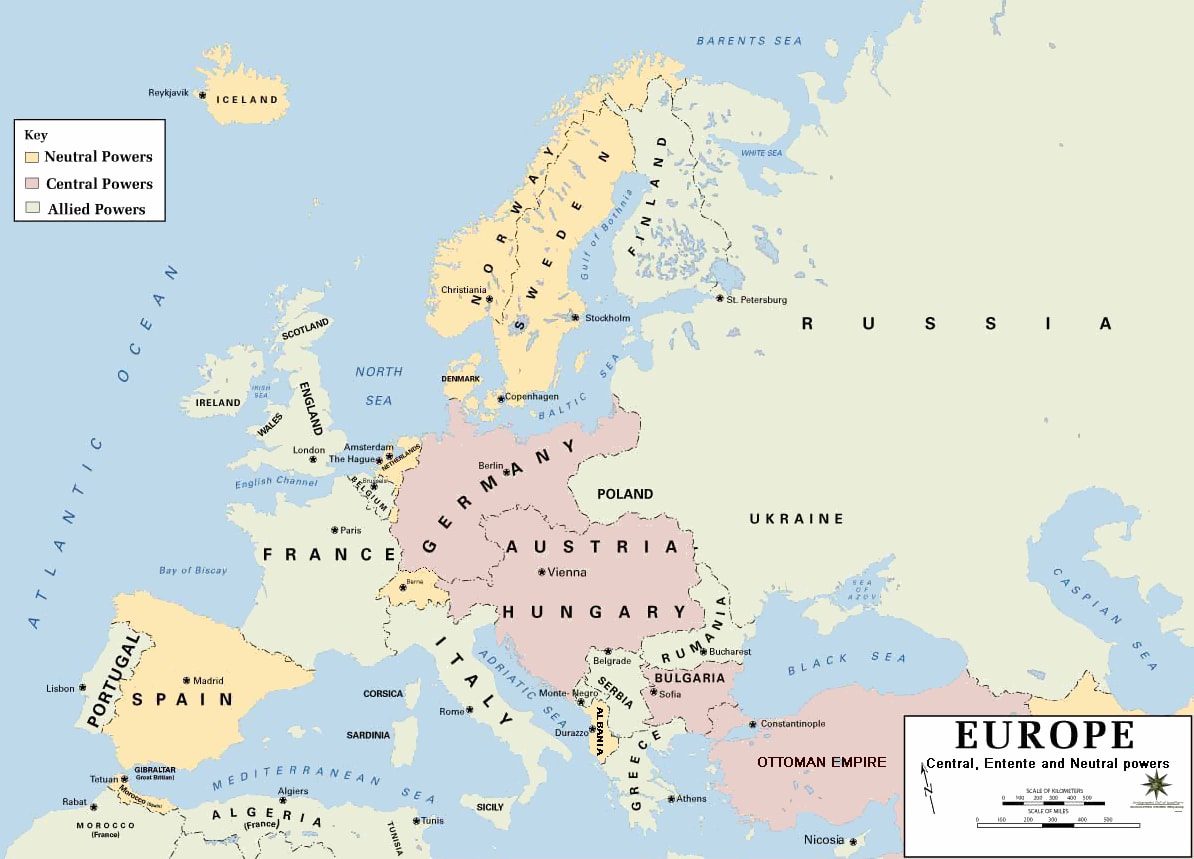
Wilson's first response to the European war was a declaration of U.S. neutrality, and he asked Americans not to take sides. That proved nearly impossible to do while also protecting U.S. trading rights.
The war itself started fast. A Serbian nationalist assassinated Archduke Francis Ferdinand, heir to the Austro-Hungarian throne, and within a week Austria-Hungary and Germany were at war with Russia, France, and Great Britain. The assassination was the spark, but AMSCO lists four underlying causes: nationalism, imperialism, militarism, and a web of public and secret alliances.
Know the two sides:
- Allied powers: Great Britain, France, and Russia (Italy joined in 1915)
- Central powers: Germany, Austria-Hungary, and the Ottoman Empire
Freedom of the Seas and Submarine Warfare
Both sides interfered with neutral shipping, just like in the War of 1812. Britain, with the stronger navy, blockaded Germany first, mining the North Sea and seizing ships (including U.S. ships). Wilson protested this as a violation of freedom of the seas. Germany's answer was the submarine. In February 1915, Germany declared its own blockade and warned that ships entering the "war zone" around the British Isles could be sunk on sight.
The Lusitania, Arabic, and Sussex
This sequence of sinkings is classic multiple-choice material:
- Lusitania (May 7, 1915): German torpedoes sank this British passenger liner, killing 128 Americans. Wilson warned Germany it would be held to "strict accountability." Secretary of State William Jennings Bryan thought the message was too warlike and resigned.
- Arabic (August 1915): Two more Americans died. Germany pledged not to sink unarmed passenger ships without warning.
- Sussex (March 1916): A torpedo injured American passengers on this unarmed merchant ship. Wilson threatened to cut diplomatic relations, a step toward war. Germany responded with the Sussex pledge, promising not to sink merchant or passenger ships without due warning. Germany kept the pledge for the rest of 1916.
Why the U.S. Leaned Toward the Allies
Officially neutral, the U.S. was economically tied to Britain and France almost from the start. The U.S. had been in a recession in early 1914, and Allied war orders pulled the economy out of it. By 1915, U.S. businesses had never been more prosperous.
The numbers tell the story: between 1914 and 1917, U.S. trade with the Allies quadrupled while trade with Germany dwindled to almost nothing. The British blockade made trade with Germany nearly impossible, and Wilson tolerated the British blockade while protesting Germany's submarine blockade. When the Allies ran out of cash, the U.S. government allowed American bankers (especially J. Pierpont Morgan's bank) to extend up to $3 billion in credit to Britain and France.
Public Opinion and Propaganda
Most Americans sympathized with the Allies. Newspapers in August 1914 portrayed German armies marching ruthlessly through Belgium, with Kaiser Wilhelm as a mean-spirited autocrat. Britain controlled the transatlantic cables, so British war propaganda fed American papers a steady diet of German atrocity stories.
Ethnic loyalties complicated things. First- and second-generation citizens made up more than 30 percent of the population in 1914, and they strongly supported staying out. German Americans identified with their homeland, and many Irish Americans backed the Central powers because they hated British rule of Ireland. But most native-born Americans favored Britain and France, partly because of their democratic governments and the long U.S. friendship with France.
The Preparedness Debate
Eastern Republicans, including Theodore Roosevelt, pushed for "preparedness" (greater defense spending) after the Lusitania crisis, arguing the U.S. military was hopelessly unready for a major war. Wilson initially opposed preparedness, then reversed course in late 1915. Congress passed the National Defense Act in June 1916, expanding the regular army to nearly 175,000, and a month later approved building more than 50 warships in one year.
Opposition came mostly from the Midwest and West: Populists, Progressives, and Socialists. Leading antiwar voices included Bryan, Jane Addams, and Jeannette Rankin, the first woman elected to Congress.
The Election of 1916
Wilson won reelection narrowly over Republican Charles Evans Hughes on the slogan "He kept us out of war." Roosevelt declined the Progressive Party's nomination and rejoined the Republicans, effectively killing the Progressive Party. Democratic strength in the South and West beat Republican power in the East.
Decision for War (April 1917)
The trigger for U.S. entry was Germany's decision in early January 1917 to resume unrestricted submarine warfare. Germany knew this risked bringing in the United States but gambled it could starve the Allies into defeat before Americans could mobilize. Wilson broke off diplomatic relations with Germany within days of being notified on January 31.
Three events in March 1917 pushed Wilson over the edge:
- Zimmermann Telegram: British intelligence intercepted a telegram from German foreign minister Arthur Zimmermann offering Mexico an alliance, with Germany pledging to help Mexico recover Texas, New Mexico, and Arizona. Mexico never considered it, but the news on March 1 enraged the American public.
- Russian Revolution: On March 15, revolutionaries overthrew the czar and proclaimed a republic. This removed Wilson's discomfort about fighting alongside an autocracy and let him frame the war as a fight for democracy (his moral diplomacy at work).
- Renewed submarine attacks: German U-boats sank five unarmed U.S. merchant ships in early March.
On April 2, 1917, Wilson asked Congress for a declaration of war, condemning German submarine policy as "warfare against mankind" and declaring "The world must be made safe for democracy." Congress voted overwhelmingly for war on April 6, with a few pacifists, including Robert La Follette and Jeannette Rankin, voting no. Earlier, in January 1917, Wilson had told the Senate he hoped for "peace without victory," language that stayed central to his peace aims.
Fighting the War
By the time U.S. troops shipped over in late 1917, millions of European soldiers had died in three years of trench warfare made deadlier by heavy artillery, machine guns, poison gas, tanks, and airplanes. The Bolshevik (Communist) revolution took Russia out of the war, freeing Germany to throw everything at the Western Front in France.
Naval Operations
Unrestricted submarine warfare was working: 900,000 tons of shipping were lost in April 1917 alone. The U.S. responded with a record shipbuilding program and a convoy system of armed escorts for merchant ships. By the end of 1917, convoys ensured Britain and France would not be starved out.
The American Expeditionary Force
General John J. Pershing commanded the American Expeditionary Force (AEF). The first U.S. troops plugged gaps in French and British lines; by summer 1918, with Americans arriving by the hundreds of thousands, the AEF took independent responsibility for its own segment of the Western Front. Know the sequence:
- Château-Thierry (June 1918): Americans stopped the last German offensive on the Marne River, then counterattacked at Belleau Wood.
- Meuse-Argonne offensive (August-October 1918): The Allied drive that pushed the exhausted German army back toward Germany. U.S. troops fought at St. Mihiel on the southern sector.
- November 11, 1918: Germany signed an armistice, agreeing to surrender its arms, give up much of its navy, and evacuate occupied territory.
U.S. combat deaths totaled nearly 49,000, with total U.S. fatalities at 112,432 once disease (including a flu epidemic in training camps) is counted. Total war deaths were around 20 million, most of them civilians. For the AP framing: the AEF played a relatively limited combat role, but U.S. entry tipped the balance toward the Allies.
Making the Peace: The Fourteen Points and Versailles
In January 1918, Wilson presented Congress his Fourteen Points, war aims designed to address the causes of the war and prevent another one. Some dealt with territory (return Alsace-Lorraine to France, evacuate Belgium, Romania, and Serbia). The broad principles matter more for the exam:
- Freedom of the seas
- No more secret treaties
- Reduction of armaments
- Impartial adjustment of colonial claims
- Self-determination for nationalities
- Removal of trade barriers
- A "general association of nations" to guarantee political independence and territorial integrity, soon named the League of Nations, the point Wilson valued most
The Treaty of Versailles
The peace conference opened at the Palace of Versailles in January 1919. Wilson attended personally, the first U.S. president ever to travel abroad for a diplomatic conference, but Republicans criticized him for bringing several Democrats and only one Republican whose advice was never sought. The Big Four (Wilson, David Lloyd George of Britain, Georges Clemenceau of France, and Vittorio Orlando of Italy) met almost daily. The others wanted revenge and compensation, not "peace without victory," and Wilson compromised on most of his Fourteen Points to save the League.
The treaty's terms:
- Punish Germany: disarmed, stripped of colonies, forced to admit war guilt, French occupation of the Rhineland for 15 years, and huge reparations to Britain and France.
- Self-determination: independence for Estonia, Latvia, Lithuania, Finland, and Poland; new nations Czechoslovakia and Yugoslavia created.
- The League of Nations: signers joined, and Article X of its covenant called on each member to protect the independence and territorial integrity of other nations.
The Battle for Ratification
The Senate never ratified the Treaty of Versailles, and the U.S. never joined the League of Nations. This is the consequence the AP exam cares about most.
Wilson needed two-thirds of the Senate, but he had hurt himself politically. His October 1918 appeal to elect Democrats backfired; Republicans won both houses in the midterms, and Senator Henry Cabot Lodge led the opposition. Critics argued League membership, especially Article X, could undermine U.S. sovereignty and invite European interference in the Western Hemisphere, violating the Monroe Doctrine.
Treaty opponents split into two camps:
- Irreconcilables: would never accept U.S. membership in the League, period.
- Reservationists: the larger group, led by Lodge, would accept the League if reservations were added to the covenant.
Wilson refused to accept Lodge's reservations and took his case to the people on a western speaking tour. He collapsed after a speech in Colorado on September 25, 1919, and days later suffered a massive stroke he never fully recovered from. The Senate defeated the treaty without reservations; when it came up with reservations, Wilson told his allies to reject the compromise, and they joined the Irreconcilables in defeating it again. The U.S. made a separate peace with Germany after Wilson left office in 1921 but never joined the League.
Key Terms to Know
| Term | Why it matters |
|---|---|
| Neutrality | Wilson's initial policy of noninvolvement, in the tradition of Washington and Jefferson, that proved impossible to sustain. |
| Allied powers | Britain, France, and Russia (later Italy), the side the U.S. eventually joined. |
| Central powers | Germany, Austria-Hungary, and the Ottoman Empire. |
| Lusitania | British passenger liner sunk in May 1915, killing 128 Americans and turning U.S. opinion against Germany. |
| Sussex pledge | Germany's 1916 promise not to sink merchant or passenger ships without warning; its violation in 1917 led to war. |
| Preparedness | The push for greater defense spending led by eastern Republicans like Theodore Roosevelt before U.S. entry. |
| Election of 1916 | Wilson narrowly beat Charles Evans Hughes on the slogan "He kept us out of war." |
| Zimmermann Telegram | Germany's secret offer to help Mexico recover Texas, New Mexico, and Arizona, which outraged Americans in March 1917. |
| Russian Revolution | The March 1917 overthrow of the czar that let Wilson cast the war as a fight for democracy. |
| American Expeditionary Force | U.S. forces in Europe under General John J. Pershing; limited combat role but tipped the balance to the Allies. |
| November 11, 1918 | The armistice date; Germany surrendered its arms and evacuated occupied territory. |
| Fourteen Points | Wilson's war aims, including self-determination, freedom of the seas, and a League of Nations. |
| Big Four | Wilson, Lloyd George (Britain), Clemenceau (France), and Orlando (Italy) at the Versailles peace conference. |
| Treaty of Versailles | The 1919 peace treaty that punished Germany, redrew borders, and created the League of Nations. |
| Article X | The League covenant clause requiring members to protect other nations' independence; the main target of Senate objections. |
| Henry Cabot Lodge | Republican senator who led the Reservationists against the treaty. |
| Irreconcilables vs. Reservationists | The two Senate factions opposing the treaty: one rejected the League outright, the other demanded reservations. |
| Rejection of the treaty | The Senate defeated the treaty twice; the U.S. never ratified Versailles or joined the League. |
Practice and Next Steps
Pair these notes with the Topic 7.5 World War I: Military and Diplomacy study guide for the course-aligned version of this material, then move on to AMSCO 7.6 on the World War I home front to see how the war reshaped American society. The treaty fight sets up AMSCO 7.11 on interwar foreign policy, where isolationism takes over.
To check your understanding, run through APUSH guided practice questions on Period 7, or try a timed essay with FRQ practice and instant scoring. The full set of AMSCO Unit 7 notes is there when you need the rest of the period.
Frequently Asked Questions
Why did the US enter World War I in 1917?
The main cause was Germany's resumption of unrestricted submarine warfare in January 1917, which Germany announced on January 31. Three March 1917 events sealed the decision: the Zimmermann Telegram offering Mexico an alliance to recover Texas, New Mexico, and Arizona; the Russian Revolution removing the czar so the war could be framed as a fight for democracy; and German U-boats sinking five unarmed U.S. merchant ships. Congress declared war on April 6, 1917.
What was the difference between the Irreconcilables and the Reservationists?
Both were Senate factions opposed to the Treaty of Versailles, but the Irreconcilables refused U.S. membership in the League of Nations no matter how the covenant was worded, while the larger Reservationist group, led by Henry Cabot Lodge, would accept the League if reservations were added. Wilson refused Lodge's reservations and told his allies to reject the compromise, so the treaty failed twice and the U.S. never joined the League.
What was the Sussex pledge?
After a German torpedo struck the unarmed merchant ship Sussex in March 1916 and injured American passengers, Wilson threatened to cut diplomatic relations with Germany. Germany backed down and promised not to sink merchant or passenger ships without due warning, a promise called the Sussex pledge. Germany kept it through 1916, then broke it by resuming unrestricted submarine warfare in January 1917, which pushed the U.S. toward war.
How does AMSCO 7.5 show up on the APUSH exam?
Topic 7.5 asks you to explain the causes and consequences of U.S. involvement in World War I, so expect questions on the shift from neutrality to war, the AEF's limited but decisive role in tipping the balance toward the Allies, and the Senate's rejection of the Treaty of Versailles and League of Nations. The neutrality-to-war-to-isolation arc also makes a strong contextualization or continuity-and-change thread for essays. Try guided practice questions to test yourself on Period 7.
Did Wilson get his Fourteen Points into the Treaty of Versailles?
Mostly no. The other Big Four leaders (Lloyd George, Clemenceau, and Orlando) wanted revenge and compensation from Germany, so Wilson compromised on most of his Fourteen Points. He insisted on keeping the one he valued most, the League of Nations, and it was included in the treaty. The irony is that the U.S. Senate then rejected the treaty, so the United States never joined the League Wilson fought for.
See Fiveable more often in Google
Mark Fiveable as a preferred source and Google is more likely to show you our guides in Top Stories, with a "preferred" badge in AI Mode and AI Overviews.