AMSCO 2.3 The Regions of the British Colonies Notes

🇺🇸AP US History Review
AMSCO 2.3 The Regions of the British Colonies Notes
🇺🇸 AP US History
AMSCO 1.2:Native American Societies Before European Contact Notes
AMSCO 2.1 Context: European Colonization of North America Notes
AMSCO 2.2 European Colonization Notes
AMSCO 2.3 The Regions of the British Colonies Notes
AMSCO 2.4 Transatlantic Trade Notes
AMSCO 2.5 Interactions between American Indians and Europeans Notes
AMSCO 2.6 Slavery in the British Colonies Notes
AMSCO 2.7 Colonial Society and Culture Notes
AMSCO 2.8 Comparison in Period 2 (1607-1754) Notes
AMSCO 3.1 Contextualizing Period 3
AMSCO 3.2 The Seven Year's War
AMSCO 3.3 Taxation Without Representation
AMSCO 3.4 Philosophical Foundations of the American Revolution
AMSCO 3.5 The American Revolution
AMSCO 3.6 The Influence of Revolutionary Ideals
AMSCO 3.7 The Articles of Confederation
AMSCO 3.8 The Constitutional Convention and Debates Over Ratification
AMSCO 3.9 The Constitution
AMSCO 3.10 Shaping a New Republic
AMSCO 3.11 Developing an American Identity
AMSCO 3.12 Movements in the Early Republic
AMSCO 3.13 Continuity and Change in Period 3
AMSCO 4.1 Contextualizing Period 4
AMSCO 4.2 The Rise of Political Parties and the Era of Jefferson
AMSCO 4.3 Politics and Regional Interests
AMSCO 4.4 America on the World Stage
AMSCO 4.5 Market Revolution
AMSCO 4.6 Effects of the Market Revolution on Society and Culture
AMSCO 4.7 Expanding Democracy
AMSCO 4.8 Jackson and Federal Power
AMSCO 4.9 The Development of an American Culture
AMSCO 4.10 The Second Great Awakening
AMSCO 4.11 An Age of Reform
AMSCO 4.12 African Americans in the Early Republic
AMSCO 4.13 Southern Society in the Early Republic
AMSCO 4.14 Causation in Period 4
AMSCO 5.1 Contextualizing Period 5
AMSCO 5.2 The Idea of Manfiest Destiny
AMSCO 5.3 Manifest Destiny and the Mexican-American War
AMSCO 5.4 The Compromise of 1850
AMSCO 5.5 Sectional Conflict: Regional Differences
AMSCO 5.6 Failure of Compromise
AMSCO 5.7 Election of 1860 and Secession
AMSCO 5.8 Military Conflict in the Civil War
AMSCO 5.9 Government Policies During the Civil War
AMSCO 5.10 Reconstruction
AMSCO 5.11 Failure of Reconstruction
AMSCO 5.12 Comparion in Period 5
AMSCO 6.1 Contextualizing Period 6
AMSCO 6.2 Westward Expansion: Economic Development
AMSCO 6.3 Westward Expansion: Social and Cultural Development
AMSCO 6.4 The "New South"
AMSCO 6.5 Technological Innovation
AMSCO 6.6 The Rise of Industrial Capitalism
AMSCO 6.7 Labor in the Gilded Age
AMSCO 6.8 Immigration and Migration in the Gilded Age
AMSCO 6.9 Responses to Immigration in the Gilded Age
AMSCO 6.10 Development of the Middle Class
AMSCO 6.11 Reform in the Gilded Age
AMSCO 6.12 Role of Government in the Gilded Age
AMSCO 6.13 Politics in the Gilded Age
AMSCO 6.14 Continuity and Change Period 6
AMSCO 7.1 Contextualizing Period 7
AMSCO 7.2 Imperialism: Debates
AMSCO 7.3 The Spanish-American War and U.S. Foreign Policy to 1917
AMSCO 7.4 The Progressives
AMSCO 7.5 World War I: Military and Diplomacy
AMSCO 7.6 World War I: Home Front
AMSCO 7.7 1920s: Innovations in Communication and Technology
AMSCO 7.8 1920s: Cultural and Political Controversies
AMSCO 7.9 The Great Depression
AMSCO 7.10 The New Deal
AMSCO 7.11 Inerwar Foreign Policy
AMSCO 7.12 World War II Mobilization
AMSCO 7.13 World War II Military
AMSCO 7.14 World War II and Postwar Diplomacy
AMSCO 7.15 Comparison in Period 7
AMSCO 8.1 Contextualizing Period 8
AMSCO 8.2 The Cold War from 1945 to 1980
AMSCO 8.3 The Red Scare
AMSCO 8.4 Economy after 1945
AMSCO 8.5 Culture after 1945
AMSCO 8.6 Early Steps in the Civil Rights Movement, 1945-1960
AMSCO 8.7 America as a World Power
AMSCO 8.8 The Vietnam War
AMSCO 8.9 The Great Society
AMSCO 8.10 The African American Civil Rights Movement in the 1960s
AMSCO 8.11 The Civil Rights Movement Expands
AMSCO 8.12 Youth Culture of the 1960s
AMSCO 8.13 The Environment and Natural Resources from 1968 to 1980
AMSCO 8.14 Society in Transition
AMSCO 8.15 Continuity and Change in Period 8
AMSCO 9.1 Contextualizing Period 9
AMSCO 9.2 Reagan and Conservatism
AMSCO 9.3 The End of the Cold War
AMSCO 9.4 A Changing Economy
AMSCO 9.5 Migration and Immgiration in the 1990s and 2000s
AMSCO 9.6 Challenges of the 21st Century
AMSCO 9.7 Causation in Period 9
AMSCO 1.1 Contextualizing Period 1 Notes
AMSCO 1.3 European Exploration in the Americas Notes
AMSCO 1.4 Columbian Exchange, Spanish Exploration, and Conquest Notes
AMSCO 1.5 Labor, Slavery, and Caste in the Spanish Colonial System Notes
AMSCO 1.6 Cultural Interactions in the Americas Notes
AMSCO 1.7 Causation in Period 1 Notes
Overview
AMSCO Topic 2.3, The Regions of British Colonies (AMSCO p. 38-48), covers how 13 distinct English colonies developed along the Atlantic coast between Jamestown in 1607 and Georgia in 1733, and why geography, religion, and settler backgrounds pushed New England, the Middle Colonies, and the Southern colonies in such different directions. It also explains the three types of colonial charters and the early self-governing institutions, like the House of Burgesses and the Mayflower Compact, that made the colonies unusually democratic for their era. This is the backbone chapter of Period 2 (1607-1754), and it builds directly on the European motives covered in AMSCO 2.2.
Every colony operated under a charter from the monarch, and three types developed:
- Corporate colonies were run by joint-stock companies (Jamestown in its early years).
- Royal colonies were under the direct authority of the king's government (Virginia after 1624).
- Proprietary colonies were owned by individuals granted charters by the king (Maryland, Pennsylvania).
Unlike the French and Spanish colonists, the English brought a tradition of representative government, electing representatives who spoke for property owners on questions like taxes. That habit of self-rule matters enormously later in the course.
Key Takeaways
- Tobacco gave struggling Jamestown a profitable crop, while Separatists founded Plymouth and religious conflict brought Puritans to Massachusetts Bay.
- Maryland's Act of Toleration granted religious freedom to Christians, banished Puritan dissenters founded Rhode Island settlements, and Connecticut settlers wrote the Fundamental Orders.
- South Carolina developed rice plantations worked by enslaved Africans, while North Carolina had smaller tobacco farms and less reliance on slavery.
- In the Middle Colonies, opposition to taxation without representation helped win New York an assembly, while William Penn's laws provided Pennsylvania with an assembly and freedom of worship.
- Georgia was founded as a buffer against Spanish Florida and a fresh start for English debtors; after becoming a royal colony, it adopted South Carolina's plantation system.
- The House of Burgesses and Mayflower Compact established early forms of self-government, but colonial political rights excluded many people.
Early English Settlements: Jamestown, Plymouth, and Massachusetts Bay
The earliest English colonies were founded for very different reasons, hundreds of miles apart. Virginia was about profit. New England was about religion.
Jamestown (1607)
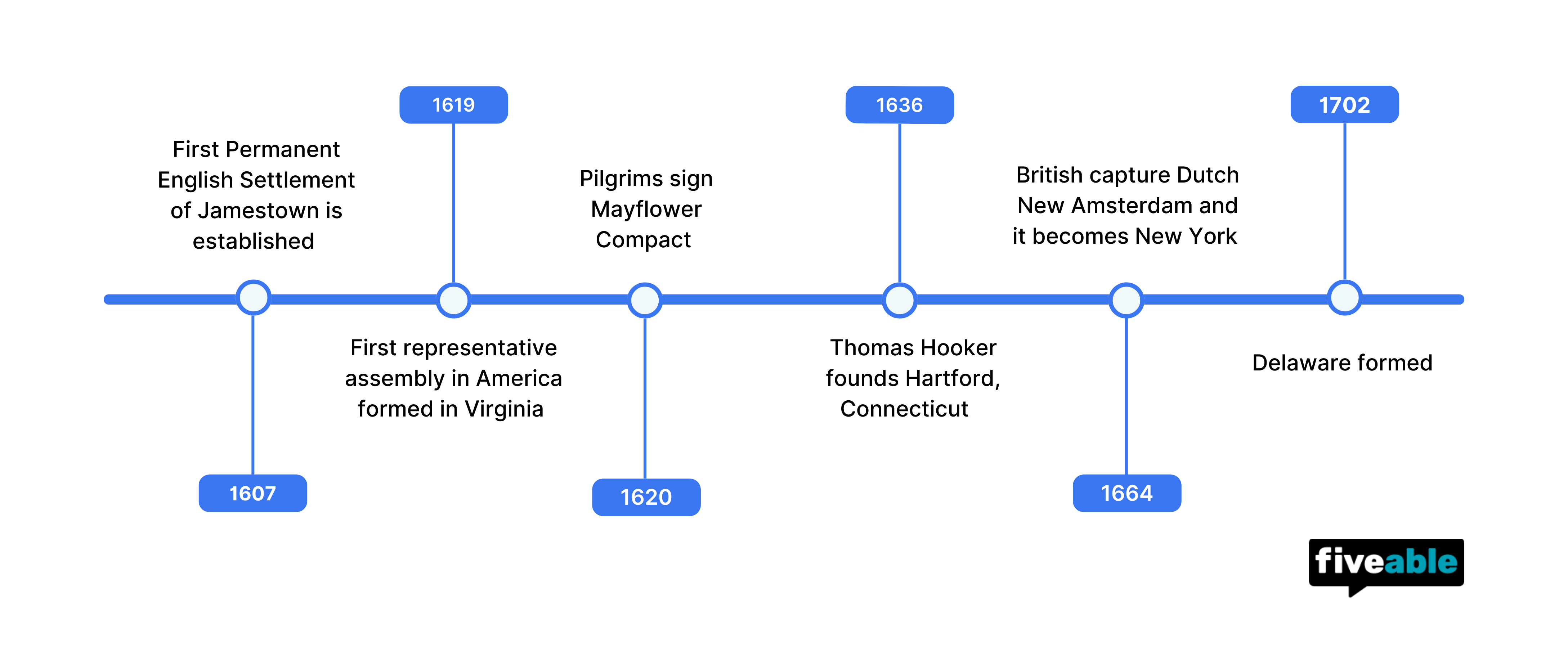
- King James I chartered the Virginia Company, a joint-stock company, which founded the first permanent English colony in America at Jamestown in 1607.
- Early problems were mostly self-inflicted. The swampy location along the James River caused fatal outbreaks of dysentery and malaria, and many settlers were gentlemen or gold hunters who refused to farm. When conflict with American Indians cut off trade, settlers starved.
- Captain John Smith's leadership got the colony through its first five years. John Rolfe and his wife Pocahontas developed a strain of tobacco that sold well in Europe, finally giving Virginia a profitable crop.
- The headright system offered 50 acres to any settler, or to anyone who paid for a settler's passage. In practice it mostly enriched landowners who sponsored indentured servants. Planters relied on White laborers for decades, then shifted toward enslaved Africans by the end of the 17th century (more on that in AMSCO 2.6).
- By 1624, despite tobacco, the colony was near collapse. Over 5,000 people had settled there, but disease and conflict had cut the population to 1,300, and the Virginia Company was nearly bankrupt. James I revoked the charter and made Virginia England's first royal colony.
Plymouth (1620)
- The Separatists were radical dissenters from the Anglican Church who wanted a church completely independent of royal control. Their travels (first to Holland, then to America) earned them the name Pilgrims.
- In 1620 about 100 passengers sailed on the Mayflower. Fewer than half were Separatists; the rest came for economic reasons. Instead of landing in Virginia as planned, they settled at Plymouth, 600 miles north.
- Half the settlers died the first winter. Local American Indians helped survivors adapt, leading to the 1621 thanksgiving feast. Under Captain Miles Standish and Governor William Bradford, Plymouth grew slowly on fish, furs, and lumber.
Massachusetts Bay Colony (1630)
- The Puritans were moderate dissenters who believed the Church of England could be reformed, or "purified," rather than abandoned. Persecution intensified under King Charles I after 1625.
- A group of Puritans secured a royal charter for the Massachusetts Bay Company in 1629. In 1630, a thousand Puritans led by John Winthrop founded Boston.
- Religious and political conflict in England drove roughly 15,000 settlers to Massachusetts Bay in the 1630s, a movement called the Great Migration.
- Unlike Virginia's plantations, New England developed small towns and family farms with a mixed economy of commerce and agriculture. That contrast between regions is exactly what the AP exam loves to test.
Maryland and Religious Toleration
Maryland, created in 1632 when Charles I split off part of Virginia, was the first proprietary colony. The king granted it to George Calvert (Lord Baltimore), a Catholic noble.
- After George Calvert died, his son Cecil Calvert carried out the plan starting in 1634: make Maryland a haven for Catholics facing persecution in Protestant Britain.
- Wealthy Catholic plantation owners were quickly outnumbered by Protestant farmers, who held a majority in the assembly.
- In 1649 Calvert persuaded the assembly to pass the Act of Toleration, the first colonial statute granting religious freedom to all Christians. The catch: it called for the death of anyone who denied the divinity of Jesus.
- In the late 1600s, Protestants angered by a Catholic proprietor ignited a civil war. They won, repealed the Act of Toleration, and stripped Catholics of the right to vote. By the 18th century, Maryland's economy and society looked much like Virginia's, just with more diversity among Protestant sects.
Development of New England: Rhode Island, Connecticut, New Hampshire
Puritan leaders did not extend religious freedom to people who disagreed with them. They banished dissidents, and those dissidents founded new colonies.
Rhode Island
- Roger Williams, a respected Puritan minister who arrived in Boston in 1631, taught that an individual's conscience was beyond the control of any civil or church authority. Banished, he founded Providence in 1636 and started one of the first Baptist churches in America.
- Providence let Catholics, Quakers, and Jews worship freely, and it was unique in recognizing American Indians' land rights and paying for the use of their land.
- Anne Hutchinson believed in antinomianism, the idea that people who receive salvation through faith alone are not bound by traditional moral laws. Banished from Massachusetts Bay, she and her followers founded Portsmouth in 1638. She later moved to Long Island and was killed in an American Indian uprising.
- In 1644, Williams received a charter from Parliament joining Providence and Portsmouth into Rhode Island, which became a refuge for diverse beliefs.
Connecticut
- Reverend Thomas Hooker led Boston Puritans into the Connecticut River Valley and founded Hartford in 1636.
- Hartford settlers wrote the Fundamental Orders of Connecticut (1639), the first written constitution in American history. It set up a representative government with a legislature elected by popular vote and a governor chosen by that legislature.
- John Davenport founded New Haven in 1637; it merged with Hartford in 1665 to form Connecticut, whose royal charter allowed limited self-government, including electing the governor.
New Hampshire and the Halfway Covenant
- New Hampshire was the last New England colony. In 1679, King Charles II separated it from Massachusetts Bay and made it a royal colony with an appointed governor, hoping to increase royal control.
- Full Puritan church membership required a conversion experience, which fewer native-born colonists were having. The halfway covenant let people become partial members without one. Over time, strict Puritan practices weakened across New England to keep church membership up.
Restoration Colonies: The Carolinas and the Middle Colonies
The Restoration colonies were founded after the monarchy was restored under Charles II in 1660, following republican rule under Oliver Cromwell.
The Carolinas
- In 1663, Charles II rewarded eight nobles who helped him gain the throne with the land between Virginia and Spanish Florida. In 1729 the grant became two royal colonies, North and South Carolina.
- South Carolina: Colonists from England and Barbados founded Charleston in 1670. The economy began with fur trading and food exports to the West Indies, then shifted to large rice-growing plantations worked by enslaved Africans, resembling the West Indies in economy and culture.
- North Carolina: Few good harbors and poor transportation meant few large plantations and less reliance on slavery. Small, self-sufficient tobacco farms run by migrants from Virginia and New England gave it a reputation for democratic views and autonomy from British control.
The Middle Colonies
New York, New Jersey, Pennsylvania, and Delaware had fertile land, good harbors where cities grew, religious tolerance, and a diverse mix of European immigrants.
- New York: In 1664, Charles II granted his brother the Duke of York (future James II) the land between Connecticut and Delaware Bay. James's forces easily took New Amsterdam from Dutch governor Peter Stuyvesant. Dutch settlers kept their language and freedom of worship, but James imposed taxes without a representative assembly. Taxation without representation met strong opposition, and in 1683 James yielded, allowing broad civil and political rights including an assembly.
- New Jersey: James split off the land between the Hudson River and Delaware Bay in 1664 for Lord John Berkeley and Sir George Carteret, which became East and West New Jersey in 1674. Both offered generous land, religious freedom, and an assembly, and both were eventually sold to Quakers. Constant ownership changes and messy property lines led the crown to combine them into one royal colony, New Jersey, in 1702.
- Pennsylvania, the "Holy Experiment": The royal family gave the land to William Penn to pay a debt; his son William Penn the younger, a Quaker, inherited it. Quakers believed religious authority lived within each person, not in the Bible or any outside source, so they supported equality of men and women and rejected violence. Penn's Frame of Government (1682-1683) guaranteed a representative assembly elected by landowners, and his Charter of Liberties (1701) guaranteed freedom of worship for all and unrestricted immigration. Penn personally supervised the founding of Philadelphia (with a grid street plan other cities later copied), advertised across Europe to attract settlers, and tried to treat American Indians fairly when buying land.
- Delaware: In 1702, Penn granted Pennsylvania's lower three counties their own assembly. Delaware effectively became a separate colony, though it shared Pennsylvania's governor until the American Revolution.
Georgia, the Last Mainland Colony
Georgia, chartered in 1732, was the thirteenth and final British colony and the only one to receive direct financial support from the government. Britain had two goals:
- Create a defensive buffer protecting South Carolina plantations from Spanish Florida.
- Provide a fresh start for English debtors crowding the prisons.
James Oglethorpe led the philanthropists who founded Savannah in 1733 and served as first governor. His strict rules included bans on rum and slavery, but the colony failed to prosper, partly because of the constant Spanish threat. In 1752 the trustees gave up, Georgia became a royal colony, the bans were dropped, and it adopted South Carolina's plantation system. In 1776 it was the smallest of the 13 colonies that rebelled.
Early Political Institutions and the Limits of Colonial Democracy
Self-rule began early because Britain struggled to control the colonies. The Atlantic made communication slow, and Britain was distracted by domestic upheavals and wars with France.
- House of Burgesses (1619): Virginia's colonists organized the first representative assembly in America, dominated by elite planters. The Virginia Company had promised settlers the same rights as residents of England.
- Mayflower Compact (1620): Aboard the Mayflower, the Pilgrims pledged to make decisions by the will of the majority. It was an early form of self-government and a rudimentary written constitution.
- Town meetings: New England communities debated local decisions and elected members to colonial legislatures. In Massachusetts Bay, all freemen (male members of the Puritan Church) could elect the governor and assembly. Voting rights were broad for the era.
- The limits: Females and landless males had few rights, indentured servants had practically none, and enslaved people had none. Many governors ruled with autocratic powers, answering only to the king or financial backers. Democratic ideas grew alongside antidemocratic practices like slavery and widespread mistreatment of American Indians.
Key Terms to Know
| Term | Why it matters |
|---|---|
| Corporate colonies | Colonies run by joint-stock companies, like early Jamestown. |
| Royal colonies | Colonies under the direct authority of the king's government, like Virginia after 1624. |
| Proprietary colonies | Colonies owned by individuals granted charters by the king, like Maryland and Pennsylvania. |
| Headright | 50 acres of land for any settler or anyone paying a settler's passage; it mostly helped big landowners sponsor indentured servants. |
| Indentured servants | Laborers who worked for a set term in exchange for passage; the Chesapeake's main labor force before enslaved Africans. |
| Separatists (Pilgrims) | Radical dissenters who wanted a church fully independent of royal control; founded Plymouth in 1620. |
| Puritans | Moderate dissenters who wanted to reform the Church of England; founded Massachusetts Bay in 1630. |
| Great Migration | The movement of about 15,000 settlers to Massachusetts Bay in the 1630s, driven by religious and political conflict in England. |
| Act of Toleration (1649) | Maryland's statute, the first colonial law granting religious freedom to all Christians; later repealed by Protestants. |
| Antinomianism | Anne Hutchinson's belief that salvation through faith alone freed individuals from traditional moral laws. |
| Fundamental Orders of Connecticut (1639) | The first written constitution in American history, with a popularly elected legislature. |
| Halfway covenant | Partial church membership for those without a conversion experience, a sign of weakening Puritan strictness. |
| Restoration | The return of the monarchy under Charles II in 1660; the Carolinas, New York, New Jersey, and Pennsylvania date from this era. |
| Quakers | The Religious Society of Friends, who located religious authority in each person and rejected violence; they shaped Pennsylvania. |
| Frame of Government (1682-1683) | Penn's plan guaranteeing a representative assembly elected by landowners. |
| Charter of Liberties (1701) | Pennsylvania's written constitution guaranteeing freedom of worship for all and unrestricted immigration. |
| House of Burgesses (1619) | The first representative assembly in America, organized in Virginia and dominated by elite planters. |
| Mayflower Compact (1620) | The Pilgrims' pledge to govern by majority will, an early form of self-government. |
Practice and Next Steps
Pair these notes with Fiveable's Topic 2.3 The Regions of the British Colonies study guide for the course-aligned version of this material, then continue to AMSCO 2.4 Transatlantic Trade to see how these regional economies plugged into the Atlantic world. The full chapter list lives on the AMSCO Notes page.
To check your recall, run regional-comparison questions in APUSH guided practice. Comparing New England, Middle, and Southern colonies is a classic SAQ and LEQ setup, so try a Period 2 prompt with FRQ practice and instant scoring once the regions feel solid.
Frequently Asked Questions
What are the three types of British colonies in APUSH?
Corporate colonies were run by joint-stock companies (like early Jamestown), royal colonies were under the direct authority of the king's government (like Virginia after 1624), and proprietary colonies were owned by individuals granted charters by the king (like Maryland and Pennsylvania). Every colony received its authority through a charter from the monarch that defined its relationship with the crown.
How were the New England, Middle, and Southern colonies different?
New England developed small towns with family farms and a mixed economy of commerce and agriculture, shaped by Puritan settlers. The Middle Colonies (New York, New Jersey, Pennsylvania, Delaware) had fertile land, good harbors, religious tolerance, and the most diverse European population. The Southern colonies used long growing seasons to build plantation economies exporting tobacco and rice, increasingly worked by enslaved Africans. These regional contrasts come straight from geography, climate, and settler backgrounds.
What was the difference between the Pilgrims and the Puritans?
Pilgrims were Separatists, radical dissenters who wanted a church completely independent of royal control; they founded Plymouth in 1620. Puritans were more moderate dissenters who believed the Church of England could be reformed from within; led by John Winthrop, they founded the Massachusetts Bay Colony in 1630. Both dissented from the Anglican Church, but Separatists wanted out entirely while Puritans wanted to 'purify' it.
Why was Georgia founded as the last British colony?
Georgia, chartered in 1732, was founded for two reasons: to create a defensive buffer protecting South Carolina's plantations from Spanish Florida, and to give English debtors imprisoned for debt a fresh start. James Oglethorpe founded Savannah in 1733 and banned rum and slavery, but the colony failed to prosper. By 1752 it became a royal colony, dropped the bans, and adopted South Carolina's plantation system.
How does Topic 2.3 show up on the APUSH exam?
Regional comparison is the big one. Expect SAQ and LEQ prompts asking you to compare the economies, labor systems, and societies of New England, the Middle Colonies, and the Southern colonies, plus questions on early self-government like the House of Burgesses, Mayflower Compact, and town meetings. You can practice these comparisons with Fiveable's FRQ practice tool.
See Fiveable more often in Google
Mark Fiveable as a preferred source and Google is more likely to show you our guides in Top Stories, with a "preferred" badge in AI Mode and AI Overviews.