AMSCO 2.5 Interactions between American Indians and Europeans Notes

🇺🇸AP US History Review
AMSCO 2.5 Interactions between American Indians and Europeans Notes
🇺🇸 AP US History
AMSCO 1.2:Native American Societies Before European Contact Notes
AMSCO 2.1 Context: European Colonization of North America Notes
AMSCO 2.2 European Colonization Notes
AMSCO 2.3 The Regions of the British Colonies Notes
AMSCO 2.4 Transatlantic Trade Notes
AMSCO 2.5 Interactions between American Indians and Europeans Notes
AMSCO 2.6 Slavery in the British Colonies Notes
AMSCO 2.7 Colonial Society and Culture Notes
AMSCO 2.8 Comparison in Period 2 (1607-1754) Notes
AMSCO 3.1 Contextualizing Period 3
AMSCO 3.2 The Seven Year's War
AMSCO 3.3 Taxation Without Representation
AMSCO 3.4 Philosophical Foundations of the American Revolution
AMSCO 3.5 The American Revolution
AMSCO 3.6 The Influence of Revolutionary Ideals
AMSCO 3.7 The Articles of Confederation
AMSCO 3.8 The Constitutional Convention and Debates Over Ratification
AMSCO 3.9 The Constitution
AMSCO 3.10 Shaping a New Republic
AMSCO 3.11 Developing an American Identity
AMSCO 3.12 Movements in the Early Republic
AMSCO 3.13 Continuity and Change in Period 3
AMSCO 4.1 Contextualizing Period 4
AMSCO 4.2 The Rise of Political Parties and the Era of Jefferson
AMSCO 4.3 Politics and Regional Interests
AMSCO 4.4 America on the World Stage
AMSCO 4.5 Market Revolution
AMSCO 4.6 Effects of the Market Revolution on Society and Culture
AMSCO 4.7 Expanding Democracy
AMSCO 4.8 Jackson and Federal Power
AMSCO 4.9 The Development of an American Culture
AMSCO 4.10 The Second Great Awakening
AMSCO 4.11 An Age of Reform
AMSCO 4.12 African Americans in the Early Republic
AMSCO 4.13 Southern Society in the Early Republic
AMSCO 4.14 Causation in Period 4
AMSCO 5.1 Contextualizing Period 5
AMSCO 5.2 The Idea of Manfiest Destiny
AMSCO 5.3 Manifest Destiny and the Mexican-American War
AMSCO 5.4 The Compromise of 1850
AMSCO 5.5 Sectional Conflict: Regional Differences
AMSCO 5.6 Failure of Compromise
AMSCO 5.7 Election of 1860 and Secession
AMSCO 5.8 Military Conflict in the Civil War
AMSCO 5.9 Government Policies During the Civil War
AMSCO 5.10 Reconstruction
AMSCO 5.11 Failure of Reconstruction
AMSCO 5.12 Comparion in Period 5
AMSCO 6.1 Contextualizing Period 6
AMSCO 6.2 Westward Expansion: Economic Development
AMSCO 6.3 Westward Expansion: Social and Cultural Development
AMSCO 6.4 The "New South"
AMSCO 6.5 Technological Innovation
AMSCO 6.6 The Rise of Industrial Capitalism
AMSCO 6.7 Labor in the Gilded Age
AMSCO 6.8 Immigration and Migration in the Gilded Age
AMSCO 6.9 Responses to Immigration in the Gilded Age
AMSCO 6.10 Development of the Middle Class
AMSCO 6.11 Reform in the Gilded Age
AMSCO 6.12 Role of Government in the Gilded Age
AMSCO 6.13 Politics in the Gilded Age
AMSCO 6.14 Continuity and Change Period 6
AMSCO 7.1 Contextualizing Period 7
AMSCO 7.2 Imperialism: Debates
AMSCO 7.3 The Spanish-American War and U.S. Foreign Policy to 1917
AMSCO 7.4 The Progressives
AMSCO 7.5 World War I: Military and Diplomacy
AMSCO 7.6 World War I: Home Front
AMSCO 7.7 1920s: Innovations in Communication and Technology
AMSCO 7.8 1920s: Cultural and Political Controversies
AMSCO 7.9 The Great Depression
AMSCO 7.10 The New Deal
AMSCO 7.11 Inerwar Foreign Policy
AMSCO 7.12 World War II Mobilization
AMSCO 7.13 World War II Military
AMSCO 7.14 World War II and Postwar Diplomacy
AMSCO 7.15 Comparison in Period 7
AMSCO 8.1 Contextualizing Period 8
AMSCO 8.2 The Cold War from 1945 to 1980
AMSCO 8.3 The Red Scare
AMSCO 8.4 Economy after 1945
AMSCO 8.5 Culture after 1945
AMSCO 8.6 Early Steps in the Civil Rights Movement, 1945-1960
AMSCO 8.7 America as a World Power
AMSCO 8.8 The Vietnam War
AMSCO 8.9 The Great Society
AMSCO 8.10 The African American Civil Rights Movement in the 1960s
AMSCO 8.11 The Civil Rights Movement Expands
AMSCO 8.12 Youth Culture of the 1960s
AMSCO 8.13 The Environment and Natural Resources from 1968 to 1980
AMSCO 8.14 Society in Transition
AMSCO 8.15 Continuity and Change in Period 8
AMSCO 9.1 Contextualizing Period 9
AMSCO 9.2 Reagan and Conservatism
AMSCO 9.3 The End of the Cold War
AMSCO 9.4 A Changing Economy
AMSCO 9.5 Migration and Immgiration in the 1990s and 2000s
AMSCO 9.6 Challenges of the 21st Century
AMSCO 9.7 Causation in Period 9
AMSCO 1.1 Contextualizing Period 1 Notes
AMSCO 1.3 European Exploration in the Americas Notes
AMSCO 1.4 Columbian Exchange, Spanish Exploration, and Conquest Notes
AMSCO 1.5 Labor, Slavery, and Caste in the Spanish Colonial System Notes
AMSCO 1.6 Cultural Interactions in the Americas Notes
AMSCO 1.7 Causation in Period 1 Notes
Overview
AMSCO Topic 2.5, Interactions Between American Indians and Europeans (AMSCO p. 54-58), covers the cycle of conflict and accommodation between Native Americans and the French, Dutch, British, and Spanish during Period 2 (1607-1754). The chapter centers on three flashpoints: Metacom's War in New England, Bacon's Rebellion in Virginia, and the Pueblo Revolt against Spanish rule in the Southwest. The big takeaway is that European powers saw each other as rivals, viewed American Indians as inferior people who could be forced into labor or pushed off their land, and yet also treated tribes as potential military allies. Native Americans, in turn, made their own strategic choices about resistance and alliance.
Key Takeaways
- Native groups resisted Europeans and made strategic alliances, sometimes joining one European group against another or against a rival tribe.
- The New England Confederation united four colonies for mutual protection and set a precedent for colonial cooperation.
- English land encroachment led Metacom to unite many southern New England tribes, but colonial forces and Native allies killed him and ended most Native resistance in the region.
- Bacon's Rebellion grew from frontier farmers' anger at Berkeley's failure to protect them and from class tensions; rebels burned Jamestown before the uprising collapsed.
- Forced labor and conversion sparked the Pueblo Revolt, which expelled the Spanish until 1692; afterward, Spain ruled less harshly and accommodated aspects of Pueblo culture.
The Big Pattern: Alliance, Rivalry, and Resistance
Relationships between Europeans and American Indians weren't one simple story of conquest. They fostered both accommodation and conflict, and they shifted over time based on politics and territory.
- Europeans armed and allied with American Indian groups to gain an edge over other European rivals.
- Native Americans who survived the devastation of European diseases actively defended themselves and their cultures. They were not passive victims.
- Tribes sometimes joined together to resist Europeans, and other times allied with one European group against another, or against a traditional tribal rival.
- Example from the chapter: in 1626 in southern New York, the Mahican Indians persuaded Dutch settlers to join an attack on the Mohawk Indians.
Keep this pattern in mind for the exam: alliances were strategic on both sides, and Native nations frequently sought European partners against other Native groups. This continues themes set up in AMSCO 2.1 on European colonization of North America.
Conflict in New England
In the 1640s, the New England colonies faced constant threat of attack from American Indians, the Dutch, and the French. With England consumed by its own civil war, colonists expected little help from home, so they organized themselves.
The New England Confederation (1643-1684)
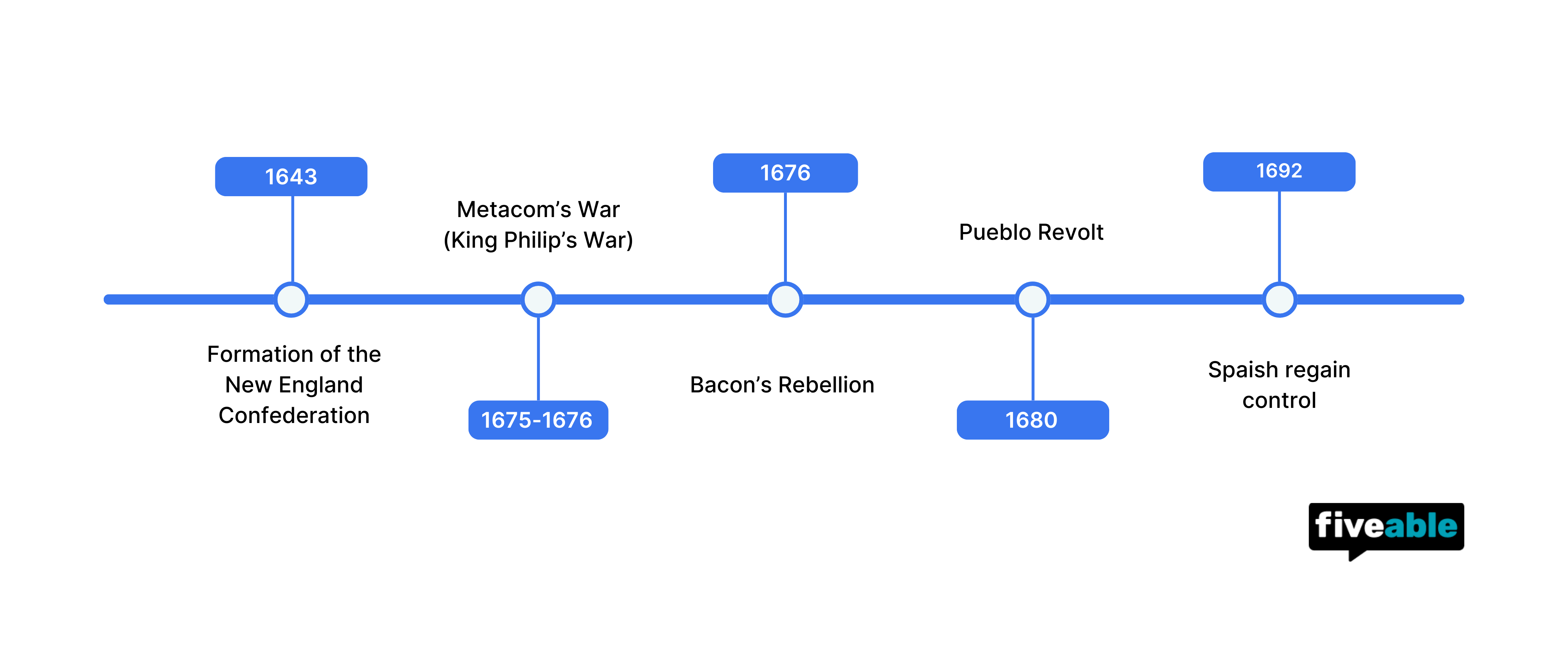
In 1643, four colonies (Plymouth, Massachusetts Bay, Connecticut, and New Haven) formed a military alliance called the New England Confederation for mutual protection.
- Directed by a board of two representatives from each colony.
- Had limited powers: boundary disputes, the return of runaway servants, and dealings with American Indians.
- Ended in 1684 when colonial rivalries and renewed control by the English monarch shut it down.
Why it matters: even though it lasted only about four decades, the confederation was the first experiment in colonial cooperation. It set the precedent for colonies taking unified action for a common purpose. That idea comes back in a big way before the Revolution.
Metacom's War (King Philip's War), 1675-1676
English settlers kept encroaching on American Indian lands. In response, Metacom, a chief of the Wampanoag whom colonists called King Philip, united many tribes in southern New England to push back.
- Not all tribes joined Metacom. The Mohegans and Pequots sided with the colonists because of their long-standing rivalry with the Wampanoag. This is the alliance pattern in action.
- The war was brutal: several villages burned to the ground, hundreds killed, thousands injured.
- The New England Confederation helped the colonists coordinate and win.
- Colonial forces and their Indian allies eventually prevailed, killing Metacom and ending most American Indian resistance in New England.
Exam framing: Metacom's War is the textbook example of British conflicts with American Indians over land, resources, and political boundaries escalating into military confrontation.
Conflict in Virginia: Bacon's Rebellion
Sir William Berkeley, the royal governor of Virginia (1641-1652 and again 1660-1677), governed with dictatorial powers on behalf of the large planters. Small farmers on Virginia's western frontier resented him because he failed to protect them from Indian attacks.
What happened (1676)
Nathaniel Bacon, an impoverished gentleman farmer, channeled the western farmers' grievances into a rebellion against Berkeley's government.
- Bacon and his followers resented the control a few large planters held over the Chesapeake.
- In 1676, Bacon raised a volunteer army and conducted raids and massacres against American Indian villages on the frontier, including some tribes that had friendly relationships with the colonial government.
- Berkeley's government in Jamestown accused Bacon of rebelling against royal authority.
- Bacon's army defeated the governor's forces and burned the Jamestown settlement.
- Bacon then died of dysentery, the rebel army collapsed, and Berkeley suppressed the rest of the insurrection, executing 23 rebels.
Why it matters long after 1676
Bacon's Rebellion (sometimes called the Chesapeake Revolution) was short-lived but exposed three lasting tensions in Virginia and most of the colonies:
- Sharp class differences between the wealthy and landless or poor farmers
- Conflict on the frontiers between settlers and American Indians
- Colonial resistance to royal control
These problems persisted into the next century, even after the Chesapeake became more stable and prosperous. Bonus connection: many historians link the aftermath of Bacon's Rebellion to planters' growing preference for enslaved African labor over indentured servants, which sets up AMSCO 2.6 on slavery in the British colonies.
Spanish Rule and the Pueblo Revolt of 1680
Spain's colonial economy ran on forced Native American labor through the encomienda system (covered back in Topic 1.5). On top of that, Spanish Roman Catholic missionaries pursued an aggressive, sometimes harsh program to convert Native Americans to Christianity.
The revolt and its aftermath
- The pressure of forced labor and forced conversion triggered the Pueblo Revolt of 1680, when various Pueblo tribes, including the Hopi and Zuni, united against the Spanish.
- Hundreds of people died in the fighting, and the Spanish were driven from the region entirely.
- Spain didn't regain control until 1692.
Here's the part the exam loves: after 1692, the Spanish made accommodations to the American Indians of the region. By ruling less harshly and accommodating some aspects of Pueblo culture, the Spanish found greater stability. The Pueblo Revolt is the standout APUSH example of Native resistance actually forcing a European power to change its policies.
Quick comparison across the three conflicts
| Conflict | Where | Cause | Outcome |
|---|---|---|---|
| Metacom's War (1675-1676) | New England | English encroachment on Native land | Metacom killed; most Native resistance in New England ended |
| Bacon's Rebellion (1676) | Virginia frontier | Berkeley's failure to protect frontier farmers; class resentment | Jamestown burned; rebellion collapsed; 23 rebels executed; class and frontier tensions exposed |
| Pueblo Revolt (1680) | Spanish Southwest | Encomienda forced labor and harsh forced conversion | Spanish expelled until 1692, then returned with accommodation |
Notice the contrast: British conflicts ended with Native resistance crushed and settlers expanding, while Spanish conflict ended with accommodation. That difference is a ready-made comparison point for essays, and it pairs well with the regional comparisons in AMSCO 2.8.
Key Terms to Know
| Term | Why it matters |
|---|---|
| New England Confederation | 1643 military alliance of Plymouth, Massachusetts Bay, Connecticut, and New Haven for mutual protection; the first experiment in colonial cooperation and a precedent for unified colonial action. |
| Metacom (King Philip) | Wampanoag chief who united many southern New England tribes against English land encroachment; his death ended the war. |
| Metacom's War (King Philip's War) | 1675-1676 war between colonists (plus Native allies) and Metacom's coalition; ended most American Indian resistance in New England. |
| Wampanoag | The tribe Metacom led; their lands were being taken by expanding English settlers. |
| Mohegans and Pequots | Tribes that sided with the colonists against the Wampanoag due to long-standing rivalry, showing how Native alliances were strategic. |
| Sir William Berkeley | Royal governor of Virginia who ruled for the large planters and failed to protect frontier farmers from Indian attacks. |
| Nathaniel Bacon | Impoverished gentleman farmer who led the 1676 rebellion, attacked Native villages, and burned Jamestown before dying of dysentery. |
| Bacon's Rebellion | 1676 uprising that exposed class divisions, frontier conflict with American Indians, and colonial resistance to royal control. |
| Encomienda system | Spanish labor system that forced Native Americans to work for colonists, a root cause of the Pueblo Revolt. |
| Pueblo Revolt (1680) | Uprising of Pueblo peoples (including Hopi and Zuni) that drove the Spanish out until 1692. |
| Spanish accommodation | After 1692, Spain ruled less harshly and accommodated aspects of Pueblo culture, gaining greater stability in the Southwest. |
| Mahican-Dutch alliance (1626) | Example of a Native group recruiting Europeans (the Dutch) to attack a rival tribe (the Mohawk). |
Practice and Next Steps
Reinforce this topic with the matching course guide on 2.5 Interactions between Native Americans and Europeans, then browse the full set of APUSH AMSCO notes to keep moving through Unit 2.
To check yourself:
- Run multiple-choice reps on this period with guided practice questions.
- Try a writing prompt comparing Metacom's War, Bacon's Rebellion, and the Pueblo Revolt using FRQ practice with instant scoring.
- Look up any term that's still fuzzy in the APUSH key terms glossary.
Next chapter: AMSCO 2.6 Slavery in the British Colonies.
Frequently Asked Questions
What does AMSCO Topic 2.5 cover in APUSH?
AMSCO 2.5 (p. 54-58) covers interactions between American Indians and Europeans during Period 2, focusing on three conflicts: Metacom's War in New England (1675-1676), Bacon's Rebellion in Virginia (1676), and the Pueblo Revolt against Spanish rule (1680). It also covers the New England Confederation, the first experiment in colonial cooperation.
What caused Metacom's War (King Philip's War)?
English settlers kept encroaching on American Indian lands in New England, so Metacom (called King Philip by colonists), a Wampanoag chief, united many southern New England tribes to resist in 1675-1676. Colonists, aided by rival tribes like the Mohegans and Pequots and coordinated through the New England Confederation, won the war, killed Metacom, and ended most Native resistance in New England.
Why does the Pueblo Revolt matter so much for the APUSH exam?
Because it's the standout example of Native resistance forcing a European power to change its policies. The Pueblo Revolt of 1680 drove the Spanish out of the Southwest until 1692, and when Spain returned, it ruled less harshly and accommodated aspects of Pueblo culture to gain stability. That accommodation pattern contrasts sharply with British conflicts like Metacom's War and makes a great essay comparison.
Was Bacon's Rebellion about Native Americans or about class conflict?
Both, which is why it's so testable. Frontier farmers were angry that Governor Berkeley failed to protect them from Indian attacks, so Bacon's 1676 raids targeted Native villages, including friendly ones. But the rebellion also exposed sharp class differences between wealthy planters and poor farmers, plus colonial resistance to royal control, tensions that lasted into the next century.
What was the New England Confederation and why was it important?
It was a 1643 military alliance of Plymouth, Massachusetts Bay, Connecticut, and New Haven, formed for mutual protection against American Indians, the Dutch, and the French while England was in civil war. It lasted until 1684, helped colonists win Metacom's War, and set the precedent for colonies taking unified action for a common purpose. You can review the full topic in the 2.5 course study guide.
See Fiveable more often in Google
Mark Fiveable as a preferred source and Google is more likely to show you our guides in Top Stories, with a "preferred" badge in AI Mode and AI Overviews.