AMSCO 1.2:Native American Societies Before European Contact Notes

🇺🇸AP US History Review
AMSCO 1.2:Native American Societies Before European Contact Notes
🇺🇸 AP US History
AMSCO 1.2:Native American Societies Before European Contact Notes
AMSCO 2.1 Context: European Colonization of North America Notes
AMSCO 2.2 European Colonization Notes
AMSCO 2.3 The Regions of the British Colonies Notes
AMSCO 2.4 Transatlantic Trade Notes
AMSCO 2.5 Interactions between American Indians and Europeans Notes
AMSCO 2.6 Slavery in the British Colonies Notes
AMSCO 2.7 Colonial Society and Culture Notes
AMSCO 2.8 Comparison in Period 2 (1607-1754) Notes
AMSCO 3.1 Contextualizing Period 3
AMSCO 3.2 The Seven Year's War
AMSCO 3.3 Taxation Without Representation
AMSCO 3.4 Philosophical Foundations of the American Revolution
AMSCO 3.5 The American Revolution
AMSCO 3.6 The Influence of Revolutionary Ideals
AMSCO 3.7 The Articles of Confederation
AMSCO 3.8 The Constitutional Convention and Debates Over Ratification
AMSCO 3.9 The Constitution
AMSCO 3.10 Shaping a New Republic
AMSCO 3.11 Developing an American Identity
AMSCO 3.12 Movements in the Early Republic
AMSCO 3.13 Continuity and Change in Period 3
AMSCO 4.1 Contextualizing Period 4
AMSCO 4.2 The Rise of Political Parties and the Era of Jefferson
AMSCO 4.3 Politics and Regional Interests
AMSCO 4.4 America on the World Stage
AMSCO 4.5 Market Revolution
AMSCO 4.6 Effects of the Market Revolution on Society and Culture
AMSCO 4.7 Expanding Democracy
AMSCO 4.8 Jackson and Federal Power
AMSCO 4.9 The Development of an American Culture
AMSCO 4.10 The Second Great Awakening
AMSCO 4.11 An Age of Reform
AMSCO 4.12 African Americans in the Early Republic
AMSCO 4.13 Southern Society in the Early Republic
AMSCO 4.14 Causation in Period 4
AMSCO 5.1 Contextualizing Period 5
AMSCO 5.2 The Idea of Manfiest Destiny
AMSCO 5.3 Manifest Destiny and the Mexican-American War
AMSCO 5.4 The Compromise of 1850
AMSCO 5.5 Sectional Conflict: Regional Differences
AMSCO 5.6 Failure of Compromise
AMSCO 5.7 Election of 1860 and Secession
AMSCO 5.8 Military Conflict in the Civil War
AMSCO 5.9 Government Policies During the Civil War
AMSCO 5.10 Reconstruction
AMSCO 5.11 Failure of Reconstruction
AMSCO 5.12 Comparion in Period 5
AMSCO 6.1 Contextualizing Period 6
AMSCO 6.2 Westward Expansion: Economic Development
AMSCO 6.3 Westward Expansion: Social and Cultural Development
AMSCO 6.4 The "New South"
AMSCO 6.5 Technological Innovation
AMSCO 6.6 The Rise of Industrial Capitalism
AMSCO 6.7 Labor in the Gilded Age
AMSCO 6.8 Immigration and Migration in the Gilded Age
AMSCO 6.9 Responses to Immigration in the Gilded Age
AMSCO 6.10 Development of the Middle Class
AMSCO 6.11 Reform in the Gilded Age
AMSCO 6.12 Role of Government in the Gilded Age
AMSCO 6.13 Politics in the Gilded Age
AMSCO 6.14 Continuity and Change Period 6
AMSCO 7.1 Contextualizing Period 7
AMSCO 7.2 Imperialism: Debates
AMSCO 7.3 The Spanish-American War and U.S. Foreign Policy to 1917
AMSCO 7.4 The Progressives
AMSCO 7.5 World War I: Military and Diplomacy
AMSCO 7.6 World War I: Home Front
AMSCO 7.7 1920s: Innovations in Communication and Technology
AMSCO 7.8 1920s: Cultural and Political Controversies
AMSCO 7.9 The Great Depression
AMSCO 7.10 The New Deal
AMSCO 7.11 Inerwar Foreign Policy
AMSCO 7.12 World War II Mobilization
AMSCO 7.13 World War II Military
AMSCO 7.14 World War II and Postwar Diplomacy
AMSCO 7.15 Comparison in Period 7
AMSCO 8.1 Contextualizing Period 8
AMSCO 8.2 The Cold War from 1945 to 1980
AMSCO 8.3 The Red Scare
AMSCO 8.4 Economy after 1945
AMSCO 8.5 Culture after 1945
AMSCO 8.6 Early Steps in the Civil Rights Movement, 1945-1960
AMSCO 8.7 America as a World Power
AMSCO 8.8 The Vietnam War
AMSCO 8.9 The Great Society
AMSCO 8.10 The African American Civil Rights Movement in the 1960s
AMSCO 8.11 The Civil Rights Movement Expands
AMSCO 8.12 Youth Culture of the 1960s
AMSCO 8.13 The Environment and Natural Resources from 1968 to 1980
AMSCO 8.14 Society in Transition
AMSCO 8.15 Continuity and Change in Period 8
AMSCO 9.1 Contextualizing Period 9
AMSCO 9.2 Reagan and Conservatism
AMSCO 9.3 The End of the Cold War
AMSCO 9.4 A Changing Economy
AMSCO 9.5 Migration and Immgiration in the 1990s and 2000s
AMSCO 9.6 Challenges of the 21st Century
AMSCO 9.7 Causation in Period 9
AMSCO 1.1 Contextualizing Period 1 Notes
AMSCO 1.3 European Exploration in the Americas Notes
AMSCO 1.4 Columbian Exchange, Spanish Exploration, and Conquest Notes
AMSCO 1.5 Labor, Slavery, and Caste in the Spanish Colonial System Notes
AMSCO 1.6 Cultural Interactions in the Americas Notes
AMSCO 1.7 Causation in Period 1 Notes
Overview
AMSCO Topic 1.2, Native American Societies Before European Contact (AMSCO p.3-p.7), covers the diverse civilizations that developed across the Americas before 1492, from the Maya, Aztec, and Inca empires to the regional cultures of North America. The chapter's core argument is that environment shaped society. Where maize cultivation spread and food was abundant, people built permanent settlements and complex social structures. Where the land was dry or resources were scattered, people developed mobile lifestyles. This is the foundation of Unit 1 (Period 1: 1491-1607), and the exam loves asking how native populations interacted with their natural environment.
By 1491, the population of the Americas was probably between 50 million and 100 million people. That number matters because it pushes back on the old myth of an "empty" continent waiting for Europeans.
Key Takeaways
- Migrants from Asia might have reached the Americas by a Siberia-to-Alaska land bridge, and adaptation to different environments led to hundreds of tribes and languages.
- The Mayas, Aztecs, and Incas built organized societies with extensive trade; maize fed the Mayas and Aztecs, while potatoes fed the Incas.
- Maize spread slowly north from Mexico, supporting larger settlements and specialized work where it arrived; by Columbus's time, most people in the present-day U.S. and Canada lived in small semipermanent settlements.
- In the Southwest, maize and irrigation supported more complex societies, while Northwest coastal peoples lived in permanent houses and relied on hunting, fishing, and gathering.
- Dry conditions encouraged mobile lifestyles in the Great Basin and Great Plains, though some Plains tribes farmed in permanent river settlements; American Indians acquired horses from Spanish settlers after contact.
- Cahokia had as many as 30,000 inhabitants, and the Iroquois Confederation formed a powerful political union in the Northeast. Tribes still had distinctive traditions.
Migration to the Americas
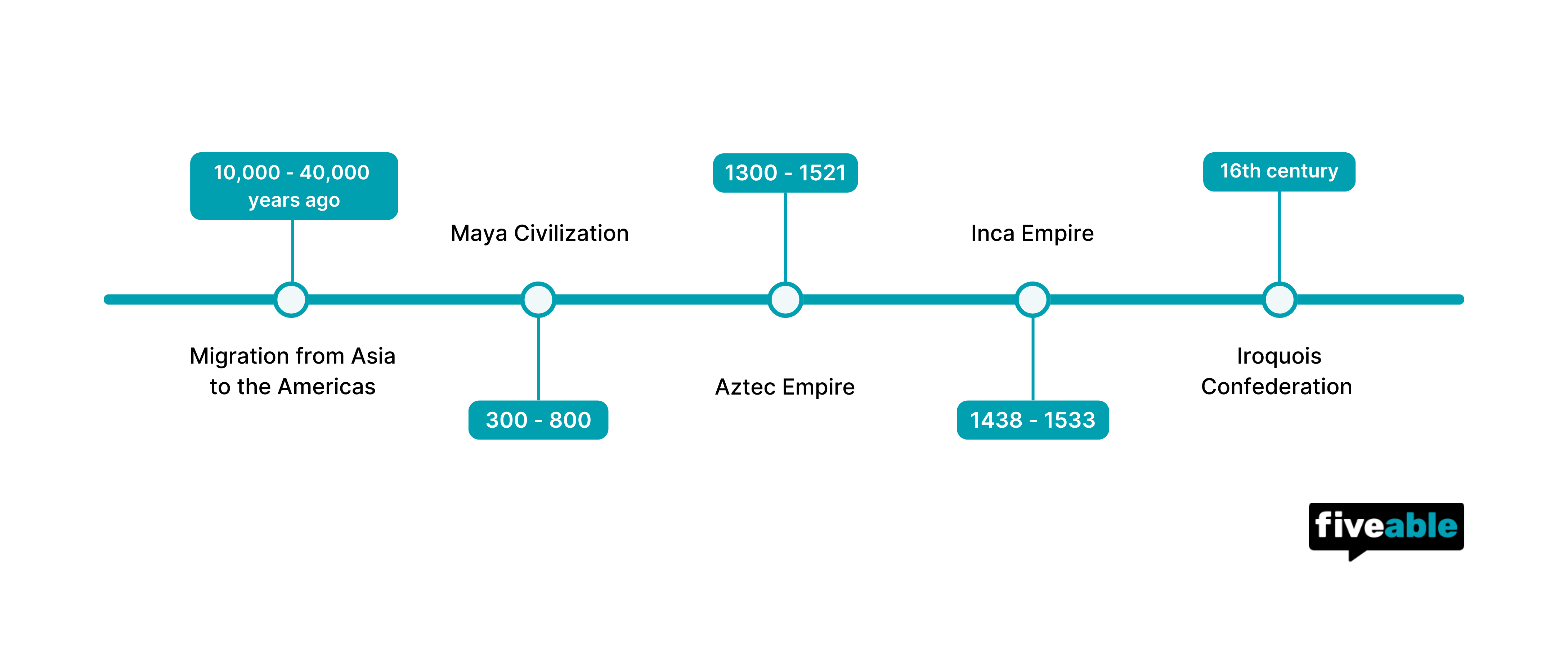
The first settlement of North and South America began at least 10,000 and maybe up to 40,000 years ago. Migrants from Asia might have crossed a land bridge that once connected Siberia and Alaska, land that's now submerged under the Bering Sea.
- People migrated southward over time, from near the Arctic Circle all the way to the southern tip of South America.
- As groups adapted to different environments, they evolved into hundreds of tribes speaking hundreds of languages.
That last point is the chapter's through-line: adaptation to environment created enormous cultural diversity.
Cultures of Central and South America
The native population was concentrated in three highly developed civilizations: the Mayas, the Aztecs, and the Incas.
- The Mayas built remarkable cities in the rain forests of the Yucatan Peninsula (present-day Guatemala, Belize, and southern Mexico) between the years 300 and 800.
- The Aztecs, based in central Mexico, built a powerful empire several centuries after the Maya decline. Their capital, Tenochtitlan, had about 200,000 people, equivalent to the largest cities in Europe at the time.
- The Incas, based in Peru, built a vast empire in western South America while the Aztecs were dominating Mexico and Central America.
What did all three have in common? Each developed highly organized societies, carried on extensive trade, and created calendars based on accurate scientific observation. Each also cultivated a staple crop that provided a stable food supply: corn (maize) for the Mayas and Aztecs, potatoes for the Incas.
Cultures of North America
North of Mexico (present-day United States and Canada), the population in the 1490s may have been anywhere from under 1 million to more than 10 million. Societies here generally had fewer people and less complex social structures than those in Mexico and South America.
Why the difference? Maize.
The cultivation of corn (maize) spread northward from Mexico slowly. Wherever maize arrived, its nutrition supported larger, more densely settled populations, which in turn allowed people to specialize in their work and build more socially diversified societies. No maize, no big cities. That cause-and-effect chain is one of the most testable ideas in this topic.
A few other general patterns:
- Some of the most populous North American societies had disappeared by the 15th century for reasons not well understood.
- By Columbus's time, most people in what is now the U.S. and Canada lived in semipermanent settlements of seldom more than 300 people.
- In most groups, men made tools and hunted game while women gathered plants and nuts or grew crops like corn, beans, and tobacco.
Language diversity
European languages almost all belong to one language family (Indo-European). American Indian languages constituted more than 20 language families containing over 400 distinct languages. The largest families included Algonquian in the Northeast, Siouan on the Great Plains, and Athabaskan in the Southwest. This is hard evidence of how culturally diverse the continent was.
Regional Societies of North America
This is the heart of the chapter. For each region, know the environment, the food source, and the settlement pattern.
Southwest
In the dry region that's now New Mexico and Arizona, the Hohokam, Anasazi, and Pueblos built multifaceted societies. People lived in caves, under cliffs, and in multistoried buildings. The spread of maize cultivation from Mexico prompted economic growth and the development of irrigation systems, and that extra wealth created a more complex society with greater variation between social and economic classes. By the time Europeans arrived, extreme drought and hostile neighbors had weakened these groups, but their descendants still live in the region, and the arid climate preserved some of their stone and masonry dwellings.
Northwest
Along the Pacific coast from present-day Alaska to northern California, people lived in permanent longhouses or plank houses. They ate a rich diet from hunting, fishing, and gathering nuts, berries, and roots. They carved large totem poles to help people remember stories, legends, and myths. High mountain ranges isolated tribes from one another, which created barriers to development.
Great Basin and Great Plains
People responded to the dry climate of the Great Basin and the grasslands of the Great Plains by developing mobile, nomadic lifestyles. Nomadic tribes survived by hunting buffalo, which supplied food plus material for decorations, tools, knives, and clothing. They lived in tepees, pole frames covered in animal skins that could be easily taken apart and moved. Some Plains tribes lived permanently in earthen lodges along rivers, raising corn, beans, and squash and trading actively with other tribes.
One common mix-up to avoid: Plains tribes did NOT have horses before contact. American Indians acquired horses in the 17th century by trading with or stealing from Spanish settlers. Only then could tribes like the Lakota Sioux easily follow buffalo herds. Migration was common too. The Apaches, for example, gradually moved southward from Canada to Texas.
Mississippi River Valley
East of the Mississippi, the Woodland American Indians prospered on a rich food supply from hunting, fishing, and agriculture, which supported permanent settlements. The Adena-Hopewell culture, centered in present-day Ohio, is famous for large earthen mounds, some 300 feet long. Cahokia (near present-day East St. Louis, Illinois) was one of the largest settlements in the Midwest, with as many as 30,000 inhabitants. Cahokia is your go-to example that large, complex urban societies existed in North America before contact.
Northeast
Descendants of the Adena-Hopewell culture spread from the Ohio Valley into New York, combining hunting and farming. Their farming techniques exhausted the soil quickly, so groups moved to fresh land frequently. Multiple families related through the mother's lineage (a matrilineal arrangement) lived together in longhouses up to 200 feet long.
Several tribes near the Great Lakes and in New York, the Seneca, Cayuga, Onondaga, Oneida, Mohawk, and later the Tuscarora, formed the Iroquois Confederation (Haudenosaunee), a powerful political union. From the 16th century through the American Revolution, it battled rival American Indians and Europeans alike.
Atlantic Seaboard
From New Jersey south to Florida lived Coastal Plains peoples such as the Cherokee and the Lumbee, many of them descendants of the Woodland mound builders. They built timber and bark lodgings along rivers, and the rivers and Atlantic Ocean provided a rich food supply.
The big takeaway on diversity
The huge variety of landforms and climates produced widely different cultures. Europeans often lumped these cultures together, but each tribe was very conscious of its own distinctive systems and traditions. A shared "Native American" identity developed much later in history, not before contact.
Key Terms to Know
| Term | Why it matters |
|---|---|
| Land bridge | The possible Siberia-to-Alaska crossing (now under the Bering Sea) that migrants from Asia may have used to first reach the Americas. |
| Mayas | Civilization that built cities in the Yucatan rain forests between 300 and 800, supported by maize. |
| Aztecs | Central Mexican empire whose capital, Tenochtitlan, held about 200,000 people, rivaling Europe's largest cities. |
| Incas | Peru-based civilization that built a vast empire in western South America, fed largely by potatoes. |
| Corn (maize) | The staple crop whose slow spread northward from Mexico determined which societies could grow large and complex. |
| Algonquian | One of the largest American Indian language families, dominant in the Northeast. |
| Siouan | Major language family of the Great Plains. |
| Athabaskan | Major language family of the Southwest. |
| Hohokam | Southwest society that built complex communities supported by maize and irrigation. |
| Anasazi | Southwest society known for cliff and multistory masonry dwellings preserved by the arid climate. |
| Pueblos | Southwest people whose maize-based economy supported greater social and economic class differences. |
| Longhouses | Large dwellings (up to 200 feet in the Northeast) housing multiple families related through the mother's line; also the housing style of permanent Northwest coastal villages. |
| Adena-Hopewell | Ohio-centered Woodland culture famous for earthen mounds up to 300 feet long. |
| Cahokia | Mississippi Valley settlement near present-day East St. Louis with up to 30,000 inhabitants, proof of large-scale pre-contact urban society. |
| Iroquois Confederation | Political union of the Seneca, Cayuga, Onondaga, Oneida, Mohawk, and later Tuscarora that wielded power from the 16th century through the American Revolution. |
| Woodland mound builders | Eastern peoples whose mixed hunting-fishing-farming economies supported permanent villages; ancestors of many Atlantic Seaboard tribes. |
Practice and Next Steps
Reinforce this chapter with the matching Topic 1.2 Native American Societies Before European Contact study guide, which frames the same material the way the exam tests it. The fastest way to check yourself is to pick any region and explain how its environment shaped its food source and settlement pattern.
When you're ready to test your recall, run some APUSH multiple choice practice questions, look up anything fuzzy in the APUSH key terms glossary, and browse the rest of the AMSCO notes for Unit 1 to keep moving through Period 1.
Frequently Asked Questions
What does AMSCO Topic 1.2 cover in APUSH?
AMSCO Topic 1.2 (p.3-p.7) covers Native American societies before European contact, including the Maya, Aztec, and Inca civilizations and the regional cultures of North America (Southwest, Northwest, Great Plains, Mississippi Valley, Northeast, and Atlantic Seaboard). The big theme is how environment and the spread of maize shaped each society's settlement pattern and complexity. It's part of Unit 1, Period 1 (1491-1607).
Why was maize cultivation so important to Native American societies?
Maize spread northward from Mexico and provided the nutrition needed to support larger, more densely settled populations. That allowed people to specialize in their work, build irrigation systems (like in the Southwest), and develop more socially diversified societies with greater class distinctions. Where maize hadn't spread, societies stayed smaller and often more mobile.
Did Plains tribes have horses before European contact?
No. American Indians didn't acquire horses until the 17th century, by trading with or stealing them from Spanish settlers. Before that, Great Plains and Great Basin peoples adapted to the dry grasslands with mobile lifestyles, hunting buffalo on foot and living in easily transported tepees. The horse-mounted buffalo hunter is a post-contact development, which is a common exam trap.
What was Cahokia and why does it matter for the APUSH exam?
Cahokia was a settlement near present-day East St. Louis, Illinois, with as many as 30,000 inhabitants, making it one of the largest settlements in the Midwest before European contact. It's a go-to piece of evidence that complex, large-scale societies existed in North America before 1492. Pair it with the Topic 1.2 study guide for more exam-ready examples.
What was the Iroquois Confederation?
The Iroquois Confederation (also called the Haudenosaunee) was a powerful political union of tribes in New York and near the Great Lakes: the Seneca, Cayuga, Onondaga, Oneida, Mohawk, and later the Tuscarora. From the 16th century through the American Revolution, it fought rival American Indian groups as well as Europeans. It's the standout example of pre-contact political organization in the Northeast.
See Fiveable more often in Google
Mark Fiveable as a preferred source and Google is more likely to show you our guides in Top Stories, with a "preferred" badge in AI Mode and AI Overviews.