AMSCO 2.2 European Colonization Notes

🇺🇸AP US History Review
AMSCO 2.2 European Colonization Notes
🇺🇸 AP US History
AMSCO 1.2:Native American Societies Before European Contact Notes
AMSCO 2.1 Context: European Colonization of North America Notes
AMSCO 2.2 European Colonization Notes
AMSCO 2.3 The Regions of the British Colonies Notes
AMSCO 2.4 Transatlantic Trade Notes
AMSCO 2.5 Interactions between American Indians and Europeans Notes
AMSCO 2.6 Slavery in the British Colonies Notes
AMSCO 2.7 Colonial Society and Culture Notes
AMSCO 2.8 Comparison in Period 2 (1607-1754) Notes
AMSCO 3.1 Contextualizing Period 3
AMSCO 3.2 The Seven Year's War
AMSCO 3.3 Taxation Without Representation
AMSCO 3.4 Philosophical Foundations of the American Revolution
AMSCO 3.5 The American Revolution
AMSCO 3.6 The Influence of Revolutionary Ideals
AMSCO 3.7 The Articles of Confederation
AMSCO 3.8 The Constitutional Convention and Debates Over Ratification
AMSCO 3.9 The Constitution
AMSCO 3.10 Shaping a New Republic
AMSCO 3.11 Developing an American Identity
AMSCO 3.12 Movements in the Early Republic
AMSCO 3.13 Continuity and Change in Period 3
AMSCO 4.1 Contextualizing Period 4
AMSCO 4.2 The Rise of Political Parties and the Era of Jefferson
AMSCO 4.3 Politics and Regional Interests
AMSCO 4.4 America on the World Stage
AMSCO 4.5 Market Revolution
AMSCO 4.6 Effects of the Market Revolution on Society and Culture
AMSCO 4.7 Expanding Democracy
AMSCO 4.8 Jackson and Federal Power
AMSCO 4.9 The Development of an American Culture
AMSCO 4.10 The Second Great Awakening
AMSCO 4.11 An Age of Reform
AMSCO 4.12 African Americans in the Early Republic
AMSCO 4.13 Southern Society in the Early Republic
AMSCO 4.14 Causation in Period 4
AMSCO 5.1 Contextualizing Period 5
AMSCO 5.2 The Idea of Manfiest Destiny
AMSCO 5.3 Manifest Destiny and the Mexican-American War
AMSCO 5.4 The Compromise of 1850
AMSCO 5.5 Sectional Conflict: Regional Differences
AMSCO 5.6 Failure of Compromise
AMSCO 5.7 Election of 1860 and Secession
AMSCO 5.8 Military Conflict in the Civil War
AMSCO 5.9 Government Policies During the Civil War
AMSCO 5.10 Reconstruction
AMSCO 5.11 Failure of Reconstruction
AMSCO 5.12 Comparion in Period 5
AMSCO 6.1 Contextualizing Period 6
AMSCO 6.2 Westward Expansion: Economic Development
AMSCO 6.3 Westward Expansion: Social and Cultural Development
AMSCO 6.4 The "New South"
AMSCO 6.5 Technological Innovation
AMSCO 6.6 The Rise of Industrial Capitalism
AMSCO 6.7 Labor in the Gilded Age
AMSCO 6.8 Immigration and Migration in the Gilded Age
AMSCO 6.9 Responses to Immigration in the Gilded Age
AMSCO 6.10 Development of the Middle Class
AMSCO 6.11 Reform in the Gilded Age
AMSCO 6.12 Role of Government in the Gilded Age
AMSCO 6.13 Politics in the Gilded Age
AMSCO 6.14 Continuity and Change Period 6
AMSCO 7.1 Contextualizing Period 7
AMSCO 7.2 Imperialism: Debates
AMSCO 7.3 The Spanish-American War and U.S. Foreign Policy to 1917
AMSCO 7.4 The Progressives
AMSCO 7.5 World War I: Military and Diplomacy
AMSCO 7.6 World War I: Home Front
AMSCO 7.7 1920s: Innovations in Communication and Technology
AMSCO 7.8 1920s: Cultural and Political Controversies
AMSCO 7.9 The Great Depression
AMSCO 7.10 The New Deal
AMSCO 7.11 Inerwar Foreign Policy
AMSCO 7.12 World War II Mobilization
AMSCO 7.13 World War II Military
AMSCO 7.14 World War II and Postwar Diplomacy
AMSCO 7.15 Comparison in Period 7
AMSCO 8.1 Contextualizing Period 8
AMSCO 8.2 The Cold War from 1945 to 1980
AMSCO 8.3 The Red Scare
AMSCO 8.4 Economy after 1945
AMSCO 8.5 Culture after 1945
AMSCO 8.6 Early Steps in the Civil Rights Movement, 1945-1960
AMSCO 8.7 America as a World Power
AMSCO 8.8 The Vietnam War
AMSCO 8.9 The Great Society
AMSCO 8.10 The African American Civil Rights Movement in the 1960s
AMSCO 8.11 The Civil Rights Movement Expands
AMSCO 8.12 Youth Culture of the 1960s
AMSCO 8.13 The Environment and Natural Resources from 1968 to 1980
AMSCO 8.14 Society in Transition
AMSCO 8.15 Continuity and Change in Period 8
AMSCO 9.1 Contextualizing Period 9
AMSCO 9.2 Reagan and Conservatism
AMSCO 9.3 The End of the Cold War
AMSCO 9.4 A Changing Economy
AMSCO 9.5 Migration and Immgiration in the 1990s and 2000s
AMSCO 9.6 Challenges of the 21st Century
AMSCO 9.7 Causation in Period 9
AMSCO 1.1 Contextualizing Period 1 Notes
AMSCO 1.3 European Exploration in the Americas Notes
AMSCO 1.4 Columbian Exchange, Spanish Exploration, and Conquest Notes
AMSCO 1.5 Labor, Slavery, and Caste in the Spanish Colonial System Notes
AMSCO 1.6 Cultural Interactions in the Americas Notes
AMSCO 1.7 Causation in Period 1 Notes
Overview
AMSCO Topic 2.2, European Colonization in North America (AMSCO p. 34-36), covers how Spain, France, the Netherlands, and England each built very different colonies in North America during the 1600s and early 1700s. The chapter sits at the start of APUSH Period 2 (1607-1754) and sets up the single most-tested idea of the unit: each European power colonized for different reasons (wealth, spreading Christianity, escaping persecution) and that produced different settlement patterns, populations, and relationships with American Indians.
The big picture in one line: Spain converted and subjugated, France and the Netherlands traded, and England settled. If you can explain why those differences existed, you understand this topic. For context on what brought Europeans across the Atlantic in the first place, review the AMSCO 2.1 context notes.
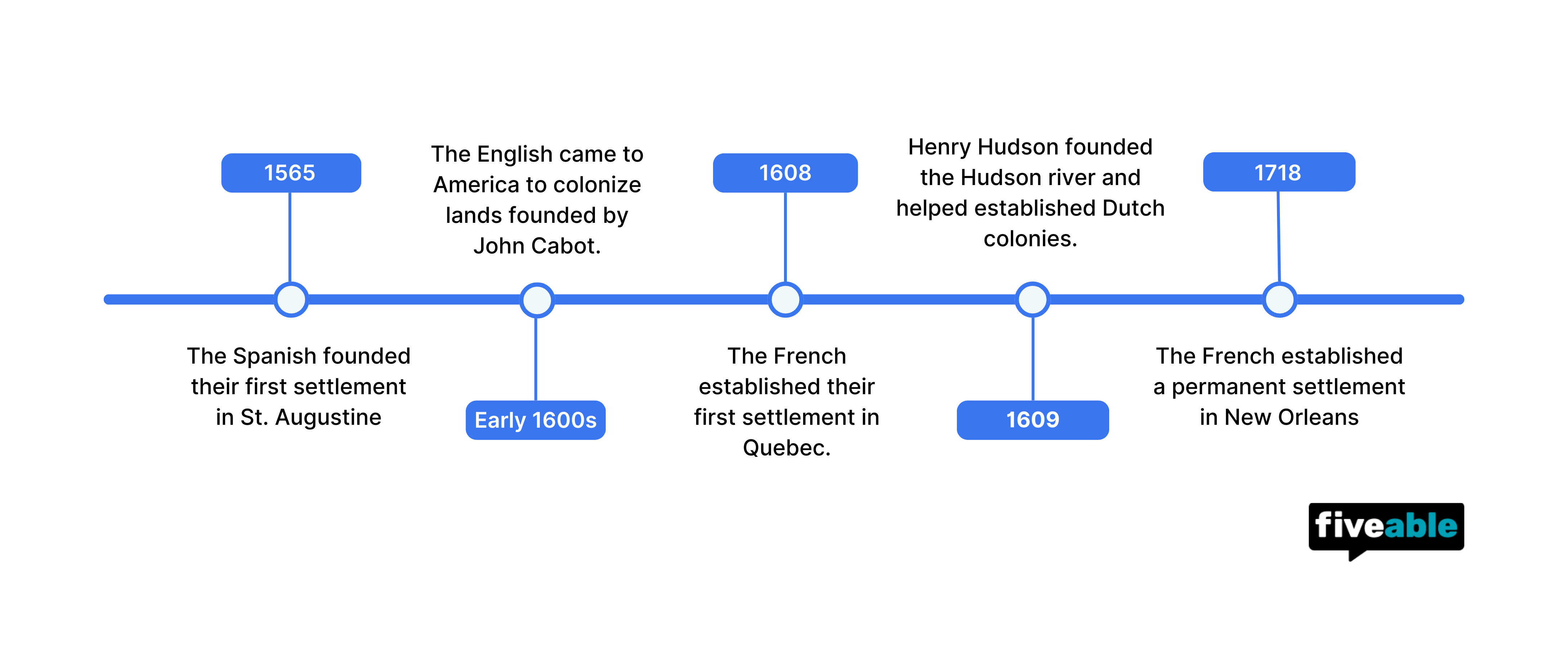
Timeline of key events from 1589-1718. Image Courtesy of Sarah.
Key Takeaways
- Spanish settlements grew slowly because of limited mineral resources and American Indian resistance; Spain also sought to convert native peoples to Catholicism.
- Most French colonists came for the fur trade, using rivers to reach the interior and building alliances through trade and intermarriage with American Indians.
- Dutch traders built networks with American Indians, but they usually stayed near coasts or major rivers and were less likely than the French to intermarry.
- England's growing number of poor and landless families saw opportunity in the Americas, while joint-stock companies funded colonies that drew more families and single women than other European colonies.
- English settlers claimed American Indian land for farms and lived apart from native peoples, a pattern that often led to violence.
Spanish Colonies: Missions, Subjugation, and Slow Growth
Spanish settlements in North America developed slowly because the region had limited mineral resources and American Indians put up strong resistance. Missionary zeal was a major motivator. Catholic Spain wanted to counter the spread of the Reformation and Protestantism, so converting native peoples to Christianity was central to the colonial project.
Spanish colonies were populated mostly by men, and Spanish colonial society gradually incorporated Native Americans and Africans (both enslaved and free) into it. That incorporation, built on subjugating and converting native populations, is what makes the Spanish model distinct from the English one.
Where the Spanish settled:
- Florida. Juan Ponce de Leon claimed it for Spain in 1513. After repeated failures and strong American Indian resistance, the Spanish founded St. Augustine in 1565, more than 50 years before Jamestown. It is the oldest European-founded city in what became the mainland United States. Florida stayed small because there was little gold or silver, native populations declined from war and disease, and hurricanes kept hitting.
- New Mexico and Arizona. Spanish colonists arrived in 1598 in a region American Indians had inhabited for about 700 years. Santa Fe became the capital of New Mexico in 1610.
- Texas. Spanish settlements between Florida and New Mexico grew in the early 1700s as Spain pushed back against French exploration of the lower Mississippi River.
- California. With Russians exploring south from Alaska, Spain founded San Diego in 1769. By 1784, the Franciscan order under Father Junipero Serra had built a chain of missions along the California coast.
French Colonies: Furs, Rivers, and Alliances
French colonization involved relatively few people, almost all of them men. Some came as Christian missionaries, but most came for the lucrative fur trade, traveling deep into the interior of North America to buy furs gathered by American Indians.
Two features defined New France:
- Intermarriage. Many French traders married American Indian women, who served as guides, translators, and negotiators with other native nations. This built real economic and diplomatic alliances, the opposite of the English approach.
- Rivers. Because the French economy ran on trade, rivers were the highways of their empire. Every major French settlement sat on one.
Key events to know:
- Samuel de Champlain, the "Father of New France," founded Quebec on the St. Lawrence River in 1608. It was the first French settlement in America.
- In 1673, Louis Jolliet and Father Jacques Marquette explored the upper Mississippi River.
- Nine years later, Robert de La Salle explored the Mississippi basin and named it Louisiana after King Louis XIV.
- By 1718, the French had moved down the Mississippi and established New Orleans where the river meets the Gulf of Mexico. It became a prosperous trade center.
Dutch Colonies: New Amsterdam and the Hudson River
The Dutch model looked a lot like the French one: small numbers of traders building strong trade networks with American Indians. The differences are in the details, and APUSH loves those details.
- In 1609, the Dutch government hired Henry Hudson, an English sailor, to find a westward (northwest) passage to Asia. He instead sailed up the river later named for him, the Hudson River, establishing Dutch claims to the surrounding region.
- That region became New Amsterdam, later New York.
- The Dutch government handed control of the colony to a private company, the Dutch West India Company, to run for economic gain.
How the Dutch differed from the French: they were more likely to settle in trading posts near the coast or along major rivers rather than ranging across the interior, and they were less likely to intermarry with American Indians.
British Colonies: Families, Farms, and Taken Land
English colonization was the outlier, and it is the model the rest of the course builds on. In the early 1600s, England moved to colonize the lands John Cabot had explored a century earlier. England's population was growing faster than its economy, so the number of poor and landless families kept rising, and the Americas looked like opportunity.
What made the English colonies different:
- Financing. The English used joint-stock companies, which pooled money from many investors, to fund the risky business of colonization. No single person bore the whole cost if a colony failed.
- Who came. English migration included a far higher percentage of families and single women than Spanish, French, or Dutch colonization. The English colonies also attracted a more diverse mix of European settlers than other colonies did.
- Why they came. Most migrated seeking better lives or religious freedom, plus social mobility and economic prosperity.
- How they treated the land and its people. English settlers wanted to farm, so they claimed American Indian land and lived separately from native peoples rather than intermarrying or building trade alliances.
That combination (lots of settlers, farming, land seizure, living apart) explains why English-Indian relations turned violent so often, a thread picked up in the AMSCO 2.5 notes on interactions between American Indians and Europeans.
The Four-Way Comparison You Need for the Exam
Comparing European colonization styles is a classic APUSH question setup, so it's worth holding the contrast in a quick mental table:
| Power | Who came | Main goal | Relations with American Indians |
|---|---|---|---|
| Spain | Mostly men | Extract wealth, spread Catholicism | Subjugation and conversion; incorporated natives and Africans into colonial society |
| France | Few people, mostly men | Fur trade, some missionary work | Trade alliances and frequent intermarriage |
| Netherlands | Few traders | Trade for profit (Dutch West India Company) | Strong trade networks, but little intermarriage |
| England | Families and single women in large numbers | Farming, religious freedom, better lives | Took land, lived separately, rarely intermarried |
The driver behind every row is economics. A fur-trade economy needs Indian partners; a farming economy needs Indian land. Once you see that, the whole pattern clicks.
Key Terms to Know
| Term | Why it matters |
|---|---|
| John Cabot | English-sponsored explorer whose voyages a century earlier gave England its claim to North America. |
| Joint-stock companies | Investor-funded companies that financed English colonization so no single backer carried all the risk. |
| St. Augustine | Spanish settlement founded in Florida in 1565, the oldest European-founded city in the mainland United States. |
| Ponce de Leon | Spanish explorer who claimed Florida for Spain in 1513. |
| Santa Fe | Capital of Spanish New Mexico, established in 1610 in a region Indians had inhabited for about 700 years. |
| Father Junipero Serra | Franciscan priest who, by 1784, had established missions along the California coast. |
| Samuel de Champlain | "Father of New France" who founded Quebec, the first French settlement in America, in 1608. |
| Quebec | First French settlement, located on the St. Lawrence River; the anchor of New France. |
| Louis Jolliet | Explorer who, with Marquette, traveled the upper Mississippi River in 1673. |
| Jacques Marquette | French missionary priest who explored the upper Mississippi alongside Jolliet. |
| Robert de La Salle | Explored the Mississippi basin and named it Louisiana after King Louis XIV. |
| New Orleans | Permanent French settlement (1718) at the mouth of the Mississippi that became a prosperous trade center. |
| Henry Hudson | English sailor hired by the Dutch in 1609; his voyage up the Hudson River established Dutch claims in the region. |
| Hudson River | The river that anchored Dutch trade and settlement in North America. |
| New Amsterdam | Dutch colony on the Hudson that later became New York. |
| Dutch West India Company | Private company the Dutch government granted control of the colony for economic gain. |
Want flashcard-style review of these? Hit the APUSH key terms glossary.
Practice and Next Steps
Lock in this topic with the Topic 2.2 European Colonization course study guide, which frames the same content the way the exam tests it. Then keep moving through the unit with the AMSCO 2.3 notes on the regions of the British colonies, or browse every chapter on the AMSCO notes hub.
To check yourself:
- Run guided multiple-choice practice on Period 2 to test the four-way colonization comparison.
- Try a comparison-style prompt in FRQ practice with instant scoring. "Compare European colonization approaches" is exactly the kind of short-answer question this topic feeds.
- When you finish Unit 2, take a full-length APUSH practice exam to see how this material shows up alongside everything else.
Frequently Asked Questions
What is AMSCO Topic 2.2 about in APUSH?
AMSCO 2.2 (p. 34-36) covers European colonization in North America during the 1600s and early 1700s. It compares the Spanish, French, Dutch, and British colonial models: Spain focused on extracting wealth and converting natives, France and the Netherlands built small trade-based colonies, and England sent large numbers of families to farm on land taken from American Indians.
What was the first permanent European settlement in the United States?
St. Augustine, Florida, founded by the Spanish in 1565, is the oldest European-founded city in the mainland United States. That's more than 50 years before the English founded Jamestown in 1607, a comparison APUSH multiple-choice questions love to test.
How did French colonization differ from English colonization in APUSH?
The French sent few colonists, mostly men, who worked the fur trade and built alliances with American Indians, often through intermarriage with native women who served as guides and translators. The English sent large numbers of families and single women who wanted to farm, so they claimed American Indian land and lived separately rather than intermarrying. The economic goal (trade vs. farming) drove the difference in relations.
What is a joint-stock company and why does it matter in APUSH?
A joint-stock company pooled money from many investors to finance a venture, so no single backer carried all the risk if it failed. England used joint-stock companies to fund the risky business of colonization in the early 1600s, which is how English colonies got off the ground without the crown paying for everything. You can review this and other terms in the APUSH key terms glossary.
How does Topic 2.2 show up on the APUSH exam?
Comparing European colonization approaches is a classic short-answer and multiple-choice setup: expect questions asking you to explain why Spanish, French, Dutch, and English colonies developed differently between 1607 and 1754. The strongest answers connect each power's economic goal to its relationship with American Indians, like fur trade leading to alliances and farming leading to land seizure. Try a comparison prompt with FRQ practice and instant scoring.
See Fiveable more often in Google
Mark Fiveable as a preferred source and Google is more likely to show you our guides in Top Stories, with a "preferred" badge in AI Mode and AI Overviews.