Historical Reasoning in the APUSH LEQ

🇺🇸AP US History Review
Historical Reasoning in the APUSH LEQ
Overview
The Analysis and Reasoning point on the APUSH LEQ rewards you for using a historical reasoning process (causation, comparison, or continuity and change over time) to frame and structure your entire argument. It's one of the six points on the APUSH LEQ rubric, sitting in the same reporting category as the complex understanding point. Quick format recap: the LEQ is worth 15% of your exam score, you pick one of three prompts, and you get about 40 minutes to write.
Here's the good news. This point is mostly about organization, not about knowing more facts. If your thesis and body paragraphs are built around the right reasoning process, you earn it almost automatically. If your essay is just a chronological story of what happened, you don't.
What the Rubric Requires
The LEQ directions tell you exactly what this point demands: "Use historical reasoning (e.g., comparison, causation, continuity or change) to frame or structure an argument that addresses the prompt." In plain terms, your essay needs a reasoning skeleton. The reader should be able to look at your thesis and body paragraphs and see that you're analyzing causes and effects, weighing similarities and differences, or tracking continuities and changes, not just listing events.
Two clarifications that take pressure off:
- The reasoning has to run through the essay, from your thesis into your body paragraphs. A single analytical sentence dropped into a narrative essay won't cut it.
- Your treatment does not have to be perfectly balanced. In a continuity and change essay, you can spend most of your time on changes and less on continuities. As long as the reasoning process genuinely structures your argument, you're fine. The strongest essays do touch both sides, and doing so also sets you up for the complexity point.
This point is earned independently from the others, so even a shaky thesis doesn't lock you out of it. Still, the points work together. A defensible thesis with a line of reasoning usually announces your reasoning process, your evidence proves it, and pushing the reasoning further (multiple causes, both continuity and change) is one of the listed paths to the complex understanding point.
How to Earn It, Step by Step
Step 1: Decode which reasoning process the prompt wants
Every LEQ prompt is built around one of three reasoning processes, and the wording tells you which one.
- Causation asks why something happened or what effects it had. Look for "Evaluate the extent to which X caused Y" or "Evaluate the effects of." Your job is to weigh which causes or effects mattered most.
- Comparison asks about similarities and differences between two events, groups, regions, or periods. Don't just list them. Explain what the similarities and differences reveal.
- Continuity and change over time (CCOT) asks what changed and what stayed the same across a period. Look for "fostered change," "transformed," or "maintained."
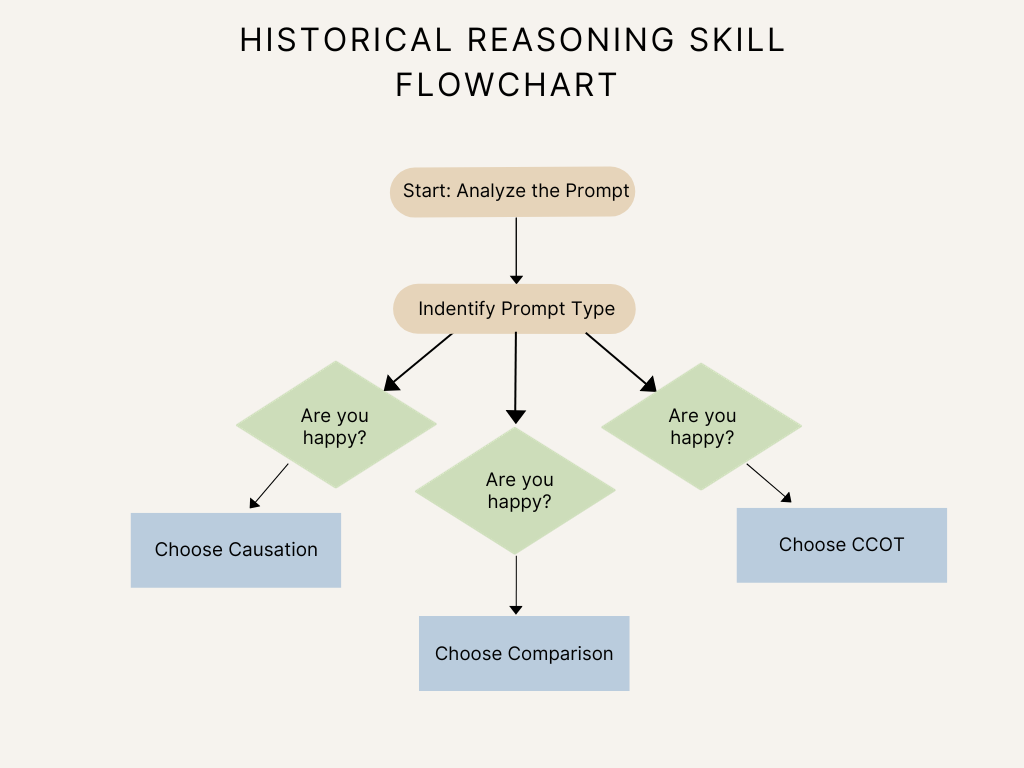
Take the released sample LEQ: "Evaluate the extent to which the ratification of the United States Constitution fostered change in the function of the federal government in the period from 1776 to 1800." The phrase "fostered change" hands you the reasoning process. This is a continuity and change prompt, and "evaluate the extent" means you need to judge how much change actually happened, not just describe it.
Step 2: Bake the reasoning into your thesis
Your thesis should make the reasoning process visible before the reader hits your first body paragraph. For a CCOT prompt, that means naming a significant change and (ideally) a continuity, then taking a position on the extent.
Here's an editorial example for the Constitution prompt:
Although debates over the proper scope of federal power continued from the Articles of Confederation era into the 1790s, the ratification of the Constitution changed the function of the federal government to a large extent by granting it the power to tax, enforce federal law, and manage a national financial system.
Notice the structure. "Although... continued" signals continuity, "changed... to a large extent by" signals change and takes a position, and the listed powers preview the body paragraphs. One sentence, and the reasoning point is already in motion.
Step 3: Organize body paragraphs around the reasoning, not the timeline
This is where most essays win or lose the point. Don't organize by "first this happened, then that happened." Organize by the analytical categories your thesis set up.
For the Constitution prompt (editorial example):
- Paragraph 1, change in federal power. Under the Articles of Confederation, Congress couldn't tax or raise an army effectively, a weakness exposed by Shays' Rebellion in 1786-1787. The Constitution gave the federal government taxation power, and Washington's suppression of the Whiskey Rebellion in 1794 showed the new government could actually enforce federal law.
- Paragraph 2, change in economic function. Hamilton's financial program (assumption of state debts, the national bank) created a federal economic role that simply didn't exist before 1789.
- Paragraph 3, continuity. Fights over states' rights versus federal authority persisted, visible in the ratification debates between Federalists and Anti-Federalists and again in reactions to Hamilton's plan. The argument over how much power the national government should have did not disappear; it just moved into the new constitutional framework.
Each paragraph exists because of the reasoning process. That's what "frame or structure an argument" means.
Step 4: Keep the reasoning language visible all the way through
Use the vocabulary of your reasoning process in topic sentences and transitions. For CCOT, that's "a fundamental change was," "this continuity persisted because," "the extent of change is clear in." For causation, "the most significant cause was," "as a direct result." For comparison, "in contrast," "both regions, however." This isn't decoration. It's how a reader scoring fast under time pressure sees the structure you built, and it forces you to actually analyze instead of narrate.
Don't forget that reasoning is doing double duty with the rest of the rubric. Your contextualization sets the stage for the reasoning, and explaining how each piece of evidence supports your line of reasoning is exactly what the second evidence point asks for.
Common Mistakes
- Narrating instead of arguing. A chronological retelling of 1776 to 1800, no matter how accurate, doesn't use a reasoning process. Fix this by making every body paragraph answer a "how much," "why," or "compared to what" question rather than a "what happened next" question.
- Listing without explaining. Naming three similarities or three changes is identification, not reasoning. After each one, add a sentence explaining why it matters to your argument about the prompt.
- Ignoring the other side entirely. A CCOT essay that's 100% change with zero acknowledgment of continuity is on thin ice, and it definitely won't reach the complexity point. Even one well-developed continuity paragraph (or a few solid sentences) shows the reasoning process in full.
- Restating the prompt's reasoning words without doing the reasoning. Writing "the Constitution fostered change to a great extent" over and over isn't analysis. Show the extent with specific evidence and explain the mechanism of change.
- Switching reasoning processes mid-essay. If your thesis promises continuity and change but your body paragraphs drift into a list of causes with no connection back to change over time, the structure collapses. Pick the process the prompt demands and stay in it.
- Saving all the analysis for the conclusion. Graders need to see reasoning structuring the body paragraphs. A purely narrative essay with an analytical final paragraph reads as an afterthought, not a frame.
Practice and Next Steps
The fastest way to build this skill is reps with real prompts. Pull LEQs from the APUSH past exam questions and, before writing anything, just identify the reasoning process and sketch a thesis plus three topic sentences. That five-minute drill trains exactly what this rubric point measures.
When you're ready to write full essays, use FRQ practice with instant scoring to get rubric-aligned feedback on whether your reasoning actually structures the response. Then work through the other rubric points with the sibling guides on the thesis and complex understanding, or zoom back out to the full LEQ overview to see how all six points fit together.
Frequently Asked Questions
What is the analysis and reasoning point on the APUSH LEQ?
It's the rubric point you earn for using a historical reasoning process (causation, comparison, or continuity and change over time) to frame or structure your argument. The reasoning has to run from your thesis through your body paragraphs, not just appear in one sentence. See the full APUSH LEQ guide for how it fits with the other five points.
Does my LEQ have to address both continuity and change to get the reasoning point?
No, the rubric doesn't require perfect balance. You can spend most of your essay on changes and less on continuities (or vice versa) and still earn the point, as long as the reasoning process genuinely structures your argument. That said, addressing both sides strengthens your essay and is one of the listed paths to the separate complex understanding point.
How do I know which reasoning skill an APUSH LEQ prompt wants?
The prompt's wording tells you. Phrases like 'fostered change' or 'transformed' signal continuity and change over time, 'caused' or 'effects of' signal causation, and prompts about two groups, regions, or periods signal comparison. For example, 'Evaluate the extent to which the ratification of the Constitution fostered change' is a continuity and change prompt.
How many points is the LEQ worth on the APUSH exam?
The LEQ is scored on a 6-point rubric: 1 for thesis, 1 for contextualization, 2 for evidence, and 2 for analysis and reasoning (the reasoning point plus the complex understanding point). The essay counts for 15% of your total APUSH exam score, and you answer one required broad prompt covering 1491-1800, 1800-1898, or 1890-2001.
Is the analysis and reasoning point the same on the LEQ and the DBQ?
Both rubrics have a 2-point Analysis and Reasoning category, but the first point differs. On the LEQ it rewards using a reasoning process (causation, comparison, or continuity and change) to structure your argument; on the DBQ it rewards sourcing analysis, explaining how point of view, purpose, situation, or audience matters for at least two documents. The second point, complex understanding, works the same way on both essays.
See Fiveable more often in Google
Mark Fiveable as a preferred source and Google is more likely to show you our guides in Top Stories, with a "preferred" badge in AI Mode and AI Overviews.