2.8 Comparison in Period 2

🇺🇸AP US History Unit 2 Review
2.8 Comparison in Period 2
🇺🇸 AP US History
Colonial societies across North America developed in different ways based on European imperial goals, geography, labor systems, economic priorities, and relationships with Native peoples. Comparing these regions helps explain why early colonial experiences varied across the continent.
Key Takeaways
- Spanish colonies sought precious metals and religious conversion, while French colonies focused on fur trade and alliances with Native peoples.
- Dutch colonies built trading posts and diverse communities, while British colonies established the largest permanent European settlements.
- British regions developed different economies: New England combined farming and maritime work, the Middle Colonies exported grain, the Chesapeake grew tobacco, and the Lower South grew rice and indigo.
- The Chesapeake shifted from indentured servitude to slavery, while plantation colonies developed racial hierarchies.
- British colonies generally formed separate societies from Native peoples, while Spanish missions incorporated them into colonial society; relations worsened as land pressures grew.
- Regional specialization linked colonial economies, different forms of governance shaped political traditions, and unequal reliance on slavery contributed to sectional conflict.
European Colonial Models: A Comparative Overview
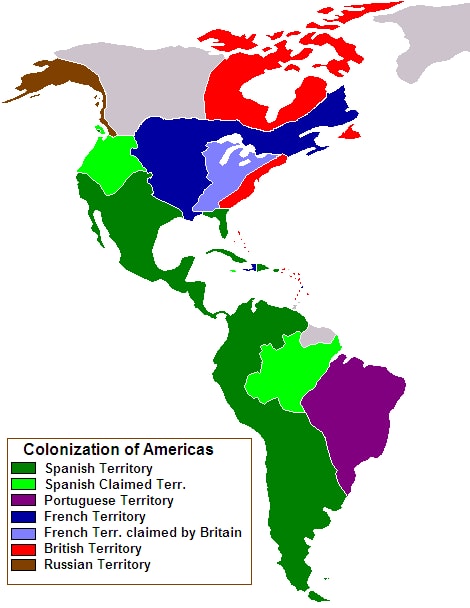
Each European power approached colonization with different goals and methods, creating distinct colonial societies:
🇪🇸 Spanish Colonies:
- Focused on resource extraction (precious metals) and religious conversion
- Created mission system and encomienda labor structure
- Incorporated indigenous peoples into colonial society, though in subordinate positions
- Concentrated settlements in Florida, Southwest, and California
🇫🇷 French Colonies:
- Emphasized trade (especially fur) rather than large-scale settlement
- Relied on alliances with Native Americans
- Maintained relatively small European population along waterways
- Developed loose network along Mississippi River valley and Great Lakes
🇳🇱 Dutch Colonies:
- Prioritized commercial interests through trading posts
- Established diverse, tolerant communities in New Netherland
- Maintained pragmatic relationships with indigenous groups
- Created settlement pattern later absorbed into British colonies
🇬🇧 British Colonies:
- Established largest European population in permanent settlements
- Developed agricultural economies with regional specializations
- Created increasingly separate societies from Native Americans
- Formed distinct regional patterns within British colonial system
Comparing British Colonial Regions
Within the British colonies, significant regional variations developed:
| Feature | New England | Middle Colonies | Chesapeake | Lower South |
|---|---|---|---|---|
| Economic Base | Mixed farming, fishing, shipbuilding, trade | "Breadbasket" grain production, diverse commerce | Tobacco monoculture | Rice, indigo plantations |
| Labor System | Family labor, limited slavery | Mix of free labor, indentured servants, slaves | Initially indentured servants, transition to enslaved labor | Plantation slavery system |
| Social Structure | Town-centered, religious communities | Ethnically diverse, more tolerant | Hierarchical, dominated by planter elite | Strict racial hierarchy, plantation aristocracy |
| Religious Pattern | Puritan/Congregational dominance | Religious pluralism | Anglican establishment | Anglican establishment |
Key Comparison Points Across All Colonies
Economic Systems and Labor
The development of different economic systems across colonial regions created lasting patterns:
Resource-Based Economies:
Each region specialized based on available resources and climate:
- New England developed a mixed economy (shipbuilding, fishing, small farms)
- Middle Colonies produced grain exports
- Chesapeake focused on tobacco cultivation
- Lower South developed rice and indigo plantation systems
- New France built economy around fur trade
- Spanish colonies emphasized mining and ranching
Labor Systems:
Colonial labor needs shaped social structures:
- Family farming dominated New England
- Mix of free and bound labor in Middle Colonies
- Transition from indentured servitude to slavery in Chesapeake
- Plantation slavery predominated in Lower South
- Mission labor in Spanish territories
- Trade partnerships in French territories
Social and Cultural Development
Colonial societies developed distinct social and cultural characteristics:
Settlement Patterns:
- Concentrated town settlements in New England
- Scattered farms in Middle Colonies
- Dispersed plantations in Southern regions
- Trading posts and missions in French and Spanish territories
Diversity and Identity:
- English cultural dominance gradually evolved into distinct colonial identities
- Religious homogeneity in some regions (New England) versus pluralism in others (Middle Colonies)
- Development of racial hierarchies, especially in plantation colonies
- Varying degrees of cultural exchange with Native Americans
Relationship with Native Americans
European-Native American relations followed different patterns:
- British colonies generally established separate societies from Native Americans
- French built trade networks and military alliances with indigenous groups
- Spanish incorporated Native Americans into colonial society through missions and labor systems
- Relations deteriorated as land pressures increased in all colonial regions
Effects of Colonial Development
The different patterns of colonial development had lasting effects:
- Economic Legacies: Regional economic specialization created interdependence between colonies while establishing patterns that would persist after independence
- Social Structures: Different social hierarchies, religious practices, and ethnic compositions created regional identities that would influence later political developments
- Labor Systems: The varying reliance on slavery across regions created economic and moral tensions that would ultimately contribute to sectional conflicts
- Political Cultures: Different approaches to governance in each region (town meetings in New England, county systems in the South) established distinctive political traditions
- Native American Impact: Different patterns of interaction with indigenous peoples resulted in varying degrees of cultural influence and conflict
By examining these comparisons, we can better understand how the diverse colonial foundations established during the period 1607-1754 created enduring regional differences that would shape American development for centuries to come.
Practice Questions for 2.8
1 of 10
By 1700 the Chesapeake relied on enslaved labor while New England remained primarily family farms. Which broader development best explains this regional divergence in labor systems?
A.
A British law banning indentured servitude in the Chesapeake after 1700.
B.
Religious beliefs made New Englanders broadly more opposed to slavery.
C.
Closer access to slave-trade routes increased Chesapeake availability of enslaved Africans.
D.
Tobacco monoculture and high mortality increased planters' demand for enslaved labor.
Vocabulary
The following words are mentioned explicitly in the AP® course framework for this topic.Term | Definition |
|---|---|
American Indians | The indigenous peoples of North America who had established societies, economies, and political systems before European contact. |
Atlantic slave trade | The transatlantic commercial system in which enslaved Africans were forcibly transported to the Americas to provide labor for colonial economies. |
British colonizers | European settlers and administrators from Britain who established colonies in North America with specific economic and political objectives. |
colonization patterns | The different methods and approaches used by European powers to establish and organize settlements in North America based on their imperial goals and local conditions. |
cultural factors | The beliefs, practices, and traditions of colonizers that influenced the development and character of colonial societies. |
demographic factors | Population characteristics such as size, composition, and distribution that shaped colonial societies and their development. |
Dutch colonizers | European settlers and administrators from the Dutch Republic who established colonies in North America with specific economic and political objectives. |
economic factors | The systems of production, trade, and labor that shaped colonial development and differentiated regions from one another. |
environmental factors | Geographic and climate conditions that influenced colonial settlement patterns, economic development, and social structures. |
French colonizers | European settlers and administrators from France who established colonies in North America with specific economic and political objectives. |
imperial goals | The political, economic, and territorial objectives that European powers sought to achieve through colonization in North America. |
migration patterns | The movement of people from one geographic location to another, including the causes and consequences of such movements over time. |
regional differences | Variations in environmental, economic, cultural, and demographic characteristics among British colonies along the Atlantic coast. |
resource competition | The struggle between European colonizers and American Indians for control of land, furs, and other valuable resources in North America. |
Spanish colonizers | European settlers and administrators from Spain who established colonies in North America with specific economic and political objectives. |
system of slavery | The institutionalized practice of enslaving people, developed in the English colonies to reflect their specific economic, demographic, and geographic needs. |
transatlantic commercial exchanges | Trade and economic interactions between the British colonies and Great Britain that strengthened economic ties and interdependence. |
transatlantic philosophical exchanges | The sharing of intellectual ideas and Enlightenment thought between the British colonies and Great Britain. |
transatlantic political exchanges | The transmission of political ideas, governance concepts, and constitutional principles between the British colonies and Great Britain. |
transatlantic religious exchanges | The transmission of religious ideas, movements, and practices between the British colonies and Great Britain. |
Frequently Asked Questions
What were the main differences between Spanish, French, Dutch, and British colonies in North America?
Spanish colonies: focused on extracting wealth (silver, encomienda), tightly controlled by crown, mixed-race hierarchies, Catholic missions, and often violent displacement of Native peoples (e.g., New Spain; Pueblo Revolt shows resistance). French colonies: small settler numbers, fur trade economy, generally cooperative alliances with Native peoples (e.g., Iroquois/Algonquin trading networks), Catholic missions, fewer plantations and less racial slavery. Dutch colonies: trade- and commerce-driven (New Netherland), religiously tolerant, relied on merchant capitalism and fur trade, smaller settlements later taken by British. British colonies: diverse regional economies (New England, Chesapeake, Middle Colonies), private land ownership, headright/indentured servitude evolving into plantation slavery in the South, more self-government (colonial assemblies, salutary neglect), and growing Atlantic ties. For AP exam comparison tasks, link differences to imperial goals, labor systems, Native relations, and regional development (see Fiveable Topic 2.8 study guide: /apush/unit-2/comparison-period-2/study-guide/osbWaPWHbIDMpvo1PPjH). For extra practice, try problems at /practice/ap-us-history.
Why did the British colonies develop so differently from each other along the Atlantic coast?
They developed differently because settlers had different goals, environments, labor systems, and people—all of which map onto the AP CED themes. Northern New England had small farms, towns, Puritan religion, mixed economy (shipping, fishing, timber) and family-based labor, so it formed tight-knit, religiously driven communities. The Chesapeake (Virginia, Maryland) had tobacco plantations, used the headright system and lots of indentured servants early on, then shifted to plantation slavery—producing a scattered, unequal society with weaker towns. The Middle Colonies blended grains, trade, and religious diversity, becoming commercially and ethnically mixed. Geography and climate shaped crops; imperial goals and labor needs shaped slavery vs. servitude; demographics (gender ratios, immigration) shaped family life and politics; and salutary neglect let colonial assemblies gain power. For AP essays, compare specific regional examples and use CED terms (headright, plantation slavery, salutary neglect). See the Topic 2.8 study guide for a focused review (/apush/unit-2/comparison-period-2/study-guide/osbWaPWHbIDMpvo1PPjH). For extra practice, try the 1,000+ AP questions (/practice/ap-us-history).
How did the New England colonies compare to the Southern colonies in terms of economy and society?
New England colonies vs. Southern colonies—quick compare for APUSH: Economically, New England had a mixed, market-oriented economy: small family farms, shipbuilding, fishing, timber, and commerce tied into triangular trade. Town-centered production encouraged artisans and merchants. The South relied on cash-crop plantation agriculture (tobacco, rice, indigo) that used the headright system, indentured servitude early on, and then large-scale African chattel slavery—plantation slavery shaped its economy and export ties. Socially, New England was more community- and church-centered (Puritan family life, town meetings, higher literacy—think Mayflower Compact roots), more egalitarian in settlement patterns, and more urban/market-connected. The South was more hierarchical, dominated by a planter elite, rural with fewer towns, and social life structured around slavery. These regional differences are exactly the “compare” skills the CED expects—use this when answering short-answer or LEQ prompts (see the Topic 2.8 study guide for review: /apush/unit-2/comparison-period-2/study-guide/osbWaPWHbIDMpvo1PPjH). For extra practice, check Fiveable’s Unit 2 resources and practice questions (/practice/ap-us-history).
What caused competition between European powers and Native Americans over resources?
Competition came from different goals and scarce resources. European empires (Spanish, French, Dutch, British) sought land, labor, fur, and cash crops for mercantilist markets—Spanish silver and encomienda labor in New Spain, French and Dutch focus on the fur trade, and English colonists on land for tobacco and plantations. Native American groups also relied on the same lands, animals, and trade networks for survival and power. Those overlapping needs—plus differing cultural views about land use and growing European demand—pushed rivals into competition for territory, trade partnerships, and labor. That competition encouraged trade and alliances but also produced displacement, diplomatic breakdowns, and frequent violence (e.g., frontier conflicts, shifting Iroquois alliances). This is a core CED idea (KC-2.1, KC-2.2) you should link to in DBQs or short-answer questions. For a quick topic review, see the Fiveable study guide (/apush/unit-2/comparison-period-2/study-guide/osbWaPWHbIDMpvo1PPjH) and try practice problems (/practice/ap-us-history).
I'm confused about how the Atlantic slave trade worked differently in various British colonies - can someone explain?
Short answer: the Atlantic slave trade looked different across British colonies because each region’s economy, environment, and labor needs shaped who was brought, how they worked, and how slavery developed. - Caribbean sugar islands: massive, brutal importation of Africans for sugar plantations; high death rates, constant importation, strict slave codes, plantation (gang) labor—slavery here shaped by cash-crop monoculture. - Chesapeake (Virginia, Maryland): tobacco plantations at first used many indentured servants; by late 1600s-1700s they shifted to racial, hereditary slavery with fewer imports over time and more natural population growth among enslaved people. - South Carolina & Georgia: rice and indigo plantations relied on skilled West African labor and the task system; enslaved communities retained African knowledge and grew in importance. - Northern/Mid-Atlantic colonies: smaller-scale slavery (house servants, artisans, urban labor), more mixed labor systems, less reliance on constant importation. On the AP you’ll often be asked to compare these effects (Topic 2.8). Use terms like triangular trade, plantation slavery, headright system, and note differences in demographics and legal codes. For a quick review, see the Topic 2.8 study guide (/apush/unit-2/comparison-period-2/study-guide/osbWaPWHbIDMpvo1PPjH) and practice questions (/practice/ap-us-history).
Why did some colonies rely more on slave labor than others?
Different colonies relied on slave labor to different degrees because of economics, environment, and demographics. Warm southern climates and fertile soils (Chesapeake, Deep South, Caribbean) favored labor-intensive staple crops like tobacco, rice, and sugar that needed lots of steady field work—so planters turned to plantation slavery. In contrast, New England’s mixed farms, towns, and shipping economy didn’t need large permanent labor forces, so they used more family labor, small-scale hiring, and indentured servants. Political and legal choices mattered too: the headright system and declining availability of indentured servants after Bacon’s Rebellion pushed Chesapeake elites toward African slavery; slave codes and the Atlantic slave trade made slavery more entrenched. Use these regional differences when you answer AP short answers or LEQs—compare causes (environment, economy, laws) and cite specific colonies/examples. For a quick review, check Topic 2.8 study guide (/apush/unit-2/comparison-period-2/study-guide/osbWaPWHbIDMpvo1PPjH) and hit practice questions (/practice/ap-us-history).
What were the specific economic goals of each European colonial power in North America?
Each European power had distinct economic goals in North America that shaped settlement, labor, and native relations: - Spanish (New Spain): extract precious metals, run large ranches and plantations, use the encomienda system and forced/ coerced labor to produce wealth, and convert natives—focused on bullion and a hierarchical, extractive economy. - French (Canada & interior): fur trade was primary—establish trading posts, foster alliances with Native peoples, few settlers, and profit from trade networks rather than large-scale colonization. - Dutch (New Netherland): commercial trading outpost model—profit from fur and Atlantic trade, merchant-driven settlements, patroonships to attract labor/settlers. - British (varied regions): mercantilist goals—export raw materials and import British goods. Chesapeake: tobacco plantations (headright, indentured servitude → enslaved labor). New England: mixed economy (shipping, shipbuilding, small farms). Middle colonies: cash crops and commerce. Caribbean sugar islands (British/French/Spanish) prioritized plantation slavery and huge export profits. For AP exam comparison practice, review Topic 2.8 (CED) and the Fiveable study guide (/apush/unit-2/comparison-period-2/study-guide/osbWaPWHbIDMpvo1PPjH) and try practice problems (/practice/ap-us-history).
How did environmental factors affect the development of different colonial regions?
Environmental differences shaped each colonial region’s economy, labor, settlement, and Native relations. Cold, rocky New England had short growing seasons—so colonists focused on shipbuilding, fishing, mixed farming, and towns with family farms and tight Puritan communities. The Chesapeake’s warm climate and fertile soil favored tobacco plantations, the headright system, indentured servitude, and then plantation slavery as labor needs grew; disease and dispersed settlements weakened ties to England. Middle Colonies’ moderate climate and fertile river valleys produced grains and diversity of peoples, boosting trade and more religious/ethnic tolerance. Caribbean sugar islands and southern lowlands developed plantation slavery on a massive scale because sugar and rice required intense labor and specialized techniques. Spanish, French, and Dutch colonies reflected local resources too: Spanish encomienda/mining in New Spain, French fur trade in Canada, Dutch commercial ports. For AP comparison practice, link your claims to causes/effects and use Key Concept terms (plantation slavery, fur trade, salutary neglect). See the Topic 2.8 study guide (/apush/unit-2/comparison-period-2/study-guide/osbWaPWHbIDMpvo1PPjH) and try practice questions (/practice/ap-us-history).
What's the difference between how Spain and Britain treated Native Americans in their colonies?
Short answer: Spain and Britain had different imperial goals that shaped their Native American policies. Spain (Spanish New Spain) focused on extracting wealth and converting people to Christianity through missions and the encomienda system; Spanish settlers often lived among Native communities, intermarried, and imposed colonial institutions (produce priestly conversion, blended societies), though that also produced forced labor, disease, and uprisings like the Pueblo Revolt. British colonies concentrated on permanent settlement and land for farmers/plantations. British colonists usually kept Native peoples separate, pushed them off land through treaties settlers ignored, and clashed more frequently in frontier violence (e.g., King Philip’s War, Bacon’s Rebellion showed settler-Native tensions). For AP exam practice, this comparison is a classic KC-2.1.I/2.1.III prompt—use specific examples (encomienda, missions, Pueblo Revolt vs. New England/Chesapeake conflicts) when you answer (see the Topic 2.8 study guide: /apush/unit-2/comparison-period-2/study-guide/osbWaPWHbIDMpvo1PPjH). For more drills, try Fiveable practice questions (/practice/ap-us-history).
Can someone explain how transatlantic trade connected the British colonies to each other and Britain?
Transatlantic trade tied the British colonies into a single Atlantic economy: colonies exported raw materials (New England fish/rum, Middle Colonies grain, Chesapeake tobacco, Caribbean sugar) to Britain and to other colonies, while importing British manufactured goods and credit. The triangular trade linked Africa (enslaved people) → Caribbean/colonies (plantation labor) → Europe (sugar, tobacco) and created interdependence—New England rum financed slave voyages, Chesapeake tobacco funded imports, and Caribbean sugar shaped British shipping priorities. Mercantilist policy and salutary neglect let colonial merchants grow regional networks and local markets, which strengthened cultural and political ties to Britain but also fostered distinct regional economies and tensions (useful for Topic 2.8 comparison prompts on the exam). For more on connections and keywords (triangular trade, plantation slavery, mercantilism), see the Topic 2 study guide (/apush/unit-2/comparison-period-2/study-guide/osbWaPWHbIDMpvo1PPjH). Practice questions: /practice/ap-us-history.
What were the long-term effects of different colonization patterns on American society?
Different colonization patterns produced durable regional differences that shaped U.S. society. Spanish and French empires created frontier extractive economies and mixed-race societies with missionary and trade networks (e.g., encomienda, fur trade). British settlement split into New England (mixed economy, town meetings, Puritan social order), Chesapeake (tobacco plantations, headright/indentured servitude, later racialized plantation slavery), and Middle Colonies (diverse populations, grain export). Long-term effects: regional economies that favored commerce/industry in the North and plantation slavery in the South; distinct social hierarchies and labor systems (indentured servitude → racial slavery); different political cultures (town meetings and self-government in New England, elite planters in the South); and varied Native American relations (trade alliances vs. displacement). These continuities fed later conflicts over slavery, representation, and federal power—exactly the kinds of comparisons the AP exam asks you to make (use comparison, causation, continuity/change). For a focused review, see the Topic 2.8 study guide (/apush/unit-2/comparison-period-2/study-guide/osbWaPWHbIDMpvo1PPjH) and practice questions (/practice/ap-us-history).
How do I write a comparison essay about colonial development in different regions for the SAQ?
For an SAQ comparing colonial development across regions, be direct and structured. Start with a one-sentence thesis that answers the prompt (similarity, difference, or both) and names the regions you’ll compare (e.g., New England vs. Chesapeake). Then give 1–2 specific pieces of evidence for each region linking back to your claim—use CED keywords: economy (plantation slavery, fur trade, mercantilism), labor systems (indentured servitude, headright, enslaved labor), settlement motives (religious vs. economic), and relations with Native Americans (Pueblo Revolt, Iroquois diplomacy). End with a 1–2 sentence connective point that explains why the similarity/difference mattered (political, social, or economic effect). Aim for 2–4 concise sentences per bullet of evidence; SAQs reward direct claims + specific evidence. For examples and timed practice, see the Topic 2.8 study guide (/apush/unit-2/comparison-period-2/study-guide/osbWaPWHbIDMpvo1PPjH) and try practice questions (/practice/ap-us-history).
Why did the British colonies become more resistant to British control over time?
They grew more resistant because increasing economic, political, and cultural ties to Britain also made colonists expect local control—and when Britain tried to tighten control after the 1750s, colonists pushed back. Under salutary neglect the colonies ran their own assemblies, economies (triangular trade, regional markets), and legal traditions; merchants and planters got used to self-rule. After the Seven Years’ War Britain enforced mercantilist taxes and imperial policies to pay debts and assert authority, which clashed with colonial ideas about representation and rights (Enlightenment and English political traditions). Regional differences (New England town politics, Chesapeake plantation elites, Middle Colonies’ commerce) produced different forms of resistance (legal protests, boycotts, elite petitioning, popular protests). Events like Bacon’s Rebellion and growing slave/servant systems also shaped local identities and distrust of distant rule. For review, see the Topic 2.8 study guide (/apush/unit-2/comparison-period-2/study-guide/osbWaPWHbIDMpvo1PPjH) and practice problems (/practice/ap-us-history). On the exam, link causes (salutary neglect → tightened policy → resistance) and use specific examples to earn evidence/context points.
What caused the demographic differences between Northern and Southern colonies?
Northern and Southern colonies developed different demographics because of environment, economy, and labor systems. In New England and the Middle colonies, colder soil and diversified economies (small farms, fishing, shipping, merchants) attracted families, religious migrants, and artisans, so communities were more urbanized and had higher rates of family migration and social institutions (town meetings, churches). In the Chesapeake and the lower South, warm climate and fertile soil favored labor-intensive tobacco and rice plantations. That drove demand for cheap labor—first indentured servitude and the headright system, then increasingly African chattel slavery via the triangular trade—so the South had fewer families, more males early on, and a growing enslaved population concentrated on plantations (see keywords: plantation slavery, headright, indentured servitude). These differences shaped politics and culture (e.g., elite plantation oligarchies vs. mixed mercantile towns). For AP review, connect this to Topic 2.8 comparison skills and use the Fiveable study guide (/apush/unit-2/comparison-period-2/study-guide/osbWaPWHbIDMpvo1PPjH) and practice questions (/practice/ap-us-history).
How did religious and cultural exchanges shape colonial attitudes toward Britain?
Religious and cultural exchanges tied colonies to Britain but also seeded resistance. Transatlantic religious ideas (Puritan congregationalism in New England, Anglicanism in the Chesapeake) built shared identities and justified political deference, while British Enlightenment and Whig political thought encouraged colonial participation in imperial life. Cultural ties—language, legal traditions, consumer goods from mercantilist trade under salutary neglect—strengthened loyalty. At the same time, local religious diversity, increasing American-born generations, regional economies (plantation slavery in the Caribbean/Chesapeake vs. mixed economies in the Middle Colonies), and experience with self-government (Mayflower Compact, colonial assemblies) fostered distinct colonial cultures and expectations of rights, which produced friction when Britain tried to tighten control. So exchanges produced both stronger bonds and growing demands for autonomy—exactly the comparison you’ll be asked to make on AP prompts (Topic 2.8). For a focused review, see the Topic 2.8 study guide (/apush/unit-2/comparison-period-2/study-guide/osbWaPWHbIDMpvo1PPjH) and try practice questions (/practice/ap-us-history).
See Fiveable more often in Google
Mark Fiveable as a preferred source and Google is more likely to show you our guides in Top Stories, with a "preferred" badge in AI Mode and AI Overviews.