AMSCO 6.5 Technological Innovation

🇺🇸AP US History Review
AMSCO 6.5 Technological Innovation
🇺🇸 AP US History
AMSCO 1.2:Native American Societies Before European Contact Notes
AMSCO 2.1 Context: European Colonization of North America Notes
AMSCO 2.2 European Colonization Notes
AMSCO 2.3 The Regions of the British Colonies Notes
AMSCO 2.4 Transatlantic Trade Notes
AMSCO 2.5 Interactions between American Indians and Europeans Notes
AMSCO 2.6 Slavery in the British Colonies Notes
AMSCO 2.7 Colonial Society and Culture Notes
AMSCO 2.8 Comparison in Period 2 (1607-1754) Notes
AMSCO 3.1 Contextualizing Period 3
AMSCO 3.2 The Seven Year's War
AMSCO 3.3 Taxation Without Representation
AMSCO 3.4 Philosophical Foundations of the American Revolution
AMSCO 3.5 The American Revolution
AMSCO 3.6 The Influence of Revolutionary Ideals
AMSCO 3.7 The Articles of Confederation
AMSCO 3.8 The Constitutional Convention and Debates Over Ratification
AMSCO 3.9 The Constitution
AMSCO 3.10 Shaping a New Republic
AMSCO 3.11 Developing an American Identity
AMSCO 3.12 Movements in the Early Republic
AMSCO 3.13 Continuity and Change in Period 3
AMSCO 4.1 Contextualizing Period 4
AMSCO 4.2 The Rise of Political Parties and the Era of Jefferson
AMSCO 4.3 Politics and Regional Interests
AMSCO 4.4 America on the World Stage
AMSCO 4.5 Market Revolution
AMSCO 4.6 Effects of the Market Revolution on Society and Culture
AMSCO 4.7 Expanding Democracy
AMSCO 4.8 Jackson and Federal Power
AMSCO 4.9 The Development of an American Culture
AMSCO 4.10 The Second Great Awakening
AMSCO 4.11 An Age of Reform
AMSCO 4.12 African Americans in the Early Republic
AMSCO 4.13 Southern Society in the Early Republic
AMSCO 4.14 Causation in Period 4
AMSCO 5.1 Contextualizing Period 5
AMSCO 5.2 The Idea of Manfiest Destiny
AMSCO 5.3 Manifest Destiny and the Mexican-American War
AMSCO 5.4 The Compromise of 1850
AMSCO 5.5 Sectional Conflict: Regional Differences
AMSCO 5.6 Failure of Compromise
AMSCO 5.7 Election of 1860 and Secession
AMSCO 5.8 Military Conflict in the Civil War
AMSCO 5.9 Government Policies During the Civil War
AMSCO 5.10 Reconstruction
AMSCO 5.11 Failure of Reconstruction
AMSCO 5.12 Comparion in Period 5
AMSCO 6.1 Contextualizing Period 6
AMSCO 6.2 Westward Expansion: Economic Development
AMSCO 6.3 Westward Expansion: Social and Cultural Development
AMSCO 6.4 The "New South"
AMSCO 6.5 Technological Innovation
AMSCO 6.6 The Rise of Industrial Capitalism
AMSCO 6.7 Labor in the Gilded Age
AMSCO 6.8 Immigration and Migration in the Gilded Age
AMSCO 6.9 Responses to Immigration in the Gilded Age
AMSCO 6.10 Development of the Middle Class
AMSCO 6.11 Reform in the Gilded Age
AMSCO 6.12 Role of Government in the Gilded Age
AMSCO 6.13 Politics in the Gilded Age
AMSCO 6.14 Continuity and Change Period 6
AMSCO 7.1 Contextualizing Period 7
AMSCO 7.2 Imperialism: Debates
AMSCO 7.3 The Spanish-American War and U.S. Foreign Policy to 1917
AMSCO 7.4 The Progressives
AMSCO 7.5 World War I: Military and Diplomacy
AMSCO 7.6 World War I: Home Front
AMSCO 7.7 1920s: Innovations in Communication and Technology
AMSCO 7.8 1920s: Cultural and Political Controversies
AMSCO 7.9 The Great Depression
AMSCO 7.10 The New Deal
AMSCO 7.11 Inerwar Foreign Policy
AMSCO 7.12 World War II Mobilization
AMSCO 7.13 World War II Military
AMSCO 7.14 World War II and Postwar Diplomacy
AMSCO 7.15 Comparison in Period 7
AMSCO 8.1 Contextualizing Period 8
AMSCO 8.2 The Cold War from 1945 to 1980
AMSCO 8.3 The Red Scare
AMSCO 8.4 Economy after 1945
AMSCO 8.5 Culture after 1945
AMSCO 8.6 Early Steps in the Civil Rights Movement, 1945-1960
AMSCO 8.7 America as a World Power
AMSCO 8.8 The Vietnam War
AMSCO 8.9 The Great Society
AMSCO 8.10 The African American Civil Rights Movement in the 1960s
AMSCO 8.11 The Civil Rights Movement Expands
AMSCO 8.12 Youth Culture of the 1960s
AMSCO 8.13 The Environment and Natural Resources from 1968 to 1980
AMSCO 8.14 Society in Transition
AMSCO 8.15 Continuity and Change in Period 8
AMSCO 9.1 Contextualizing Period 9
AMSCO 9.2 Reagan and Conservatism
AMSCO 9.3 The End of the Cold War
AMSCO 9.4 A Changing Economy
AMSCO 9.5 Migration and Immgiration in the 1990s and 2000s
AMSCO 9.6 Challenges of the 21st Century
AMSCO 9.7 Causation in Period 9
AMSCO 1.1 Contextualizing Period 1 Notes
AMSCO 1.3 European Exploration in the Americas Notes
AMSCO 1.4 Columbian Exchange, Spanish Exploration, and Conquest Notes
AMSCO 1.5 Labor, Slavery, and Caste in the Spanish Colonial System Notes
AMSCO 1.6 Cultural Interactions in the Americas Notes
AMSCO 1.7 Causation in Period 1 Notes
Overview
AMSCO Topic 6.5, Technological Innovation, covers the wave of inventions between 1865 and 1898 that transformed American communication, industry, cities, and shopping. This chapter explains how the telegraph and transatlantic cable shrank the world, how Bessemer steel and Edison's electric light powered heavy industry, and how trolleys, skyscrapers, and department stores reshaped urban life. The big takeaway for the APUSH exam: businesses used technological innovations and abundant natural resources to dramatically increase the production of goods, which set up the rise of industrial capitalism in Topic 6.6.
Key Takeaways
- Morse's telegraph sped up communication, and Cyrus W. Field's transatlantic cable connected overseas markets, leaving smaller producers exposed to international price changes.
- The Bessemer process made durable steel, while coal and iron ore helped make the Great Lakes region the center of American steel production.
- Edison's Menlo Park lab organized inventors into teams, while his electric light and Westinghouse's AC transformer helped bring electric power to cities.
- Electric transit and steel bridges let people commute farther, while steel-framed skyscrapers, elevators, and steam heating helped cities grow upward.
- Department stores, chain stores, mail-order catalogs, and advertising helped businesses sell mass-produced goods and made shopping a popular pastime.
Communication and Business Inventions
The first radical change in communication speed came from Samuel F. B. Morse's workable telegraph, demonstrated in 1844. By the Civil War, telegraph lines and railroads were already standard parts of modern life, especially in the North.
After the war, the pace picked up fast:
- Transatlantic cable (1866). Cyrus W. Field's improved cable made it possible to send messages across the ocean in minutes. By 1900, cables linked every inhabited continent in a network of nearly instant global communication.
- The catch: this communication revolution internationalized markets and prices for basic commodities like grain, coal, and steel. Local and smaller producers were suddenly at the mercy of international forces. (This is a great cause-and-effect point for essays.)
- Telephone (1876). Alexander Graham Bell's invention became another pillar of fast communication.
A flood of business and consumer inventions followed:
- Business tools: typewriter (1867), cash register (1879), calculating machine (1887), adding machine (1888)
- Consumer products: Lewis E. Waterman's fountain pen (1884), George Eastman's Kodak camera (1888), King Gillette's safety razor and blade (1895)
These products became essential tools for business and everyday life by 1900.
The Steel Industry and the Bessemer Process
Steel launched the rise of heavy industry. In the 1850s, Henry Bessemer in England and William Kelly in the United States both discovered that blasting air through molten iron produced high-quality steel, a far more durable metal than iron.
Geography explains where the industry grew. The Great Lakes region from Pennsylvania to Illinois had abundant coal reserves plus access to the iron ore of Minnesota's Mesabi Range, so it became the center of American steel production. This is exactly the pattern the exam wants you to see: new technology plus access to natural resources equals a massive jump in production.
Edison, Westinghouse, and Electric Power
Thomas Edison was possibly the greatest inventor of the 19th century. He started as a telegraph operator and patented his first invention, a vote-recording machine, in 1869 at age 22. Income from early inventions let him build a research laboratory in Menlo Park, New Jersey, in 1876.
Menlo Park matters as much as any single gadget. It was the world's first modern research laboratory, an "invention factory" that Edison promised would turn out "a minor invention every ten days and a big thing every six months or so." Its real contribution was the idea of mechanics and engineers working as a team on a project instead of independently. Invention itself became organized and industrial.
Out of Edison's lab came more than a thousand patented inventions:
- The phonograph
- The dynamo for generating electric power
- The mimeograph machine
- The motion picture camera
- His improvements to the incandescent lamp in 1879, the first practical electric lightbulb, arguably the most significant invention of the era. Electric light revolutionized city life, from how people worked to how they shopped.
George Westinghouse held more than 400 patents of his own. His two biggest:
- An air brake for railroads (1869)
- A transformer for producing high-voltage alternating current (AC), which made possible electric lighting of cities, electric streetcars, subways, and electrically powered machinery and appliances
Westinghouse and General Electric came to dominate electric technology with AC power systems, which replaced Edison's direct current (DC). By 1900, electric trades employed nearly a million people, making electric light and power one of the nation's largest and fastest growing industries.
Technology and the Growth of Cities
New transportation and building technology let cities grow both outward and upward.
From Walking Cities to Streetcar Cities
Before the Civil War, people lived in "walking cities" because they had to live within walking distance of their jobs and shops. Horse-drawn streetcars changed that, creating streetcar cities where people lived miles from work and commuted in.
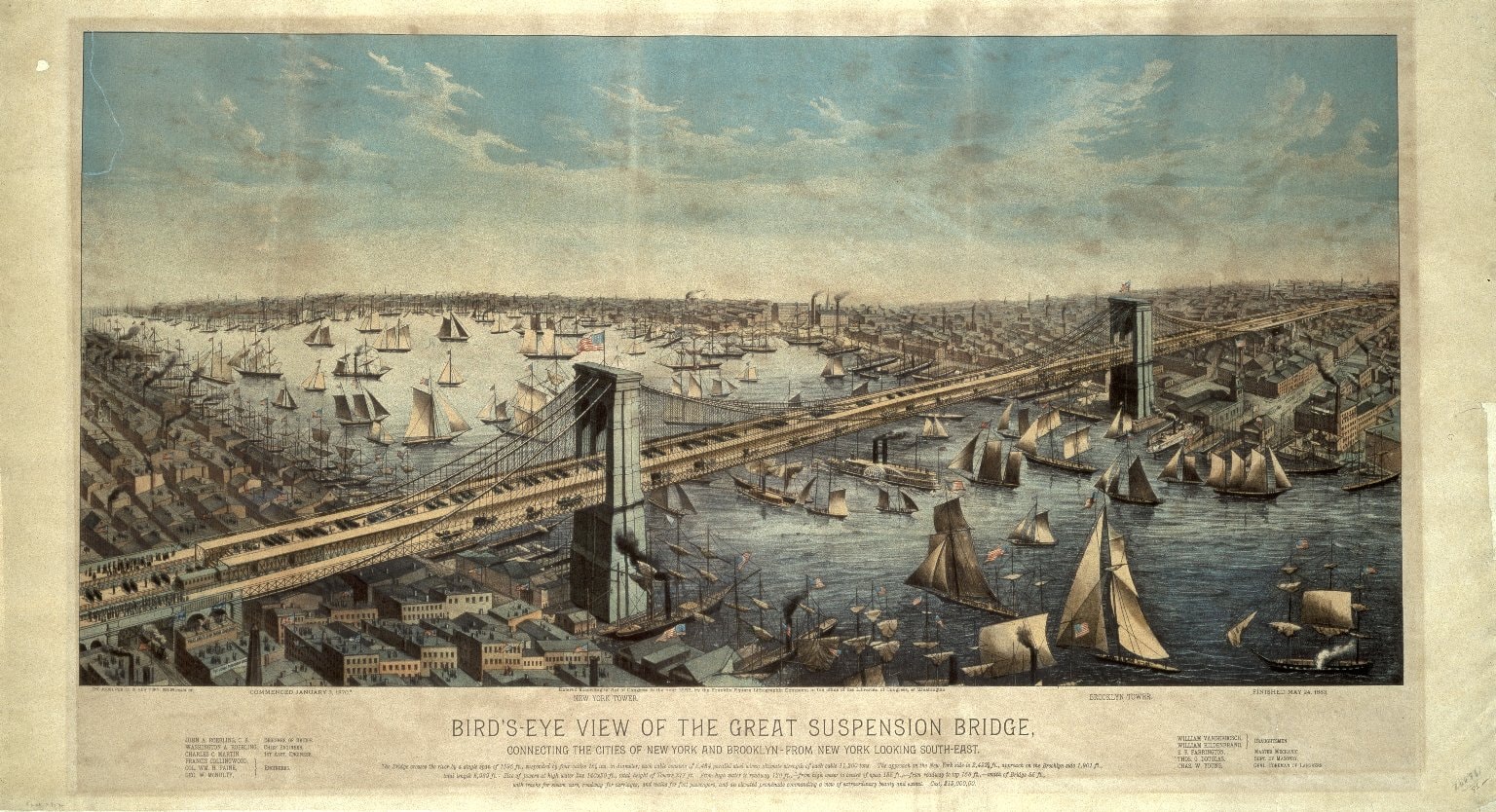
By the 1890s, horse-drawn cars and cable cars were being replaced by electric trolleys, elevated railroads, and subways, which pushed urban residences even farther from the commercial center. Massive steel suspension bridges, most famously New York's Brooklyn Bridge (1883), made even longer commutes possible. Notice the chain: Bessemer steel made the bridges, Westinghouse's AC made the trolleys run.
Skyscrapers
Rising land values in central business districts made taller buildings profitable, so cities soared upward too. In 1885, Chicago got the first true skyscraper with a steel skeleton, a ten-story building designed by William Le Baron Jenny. Two innovations made buildings that tall livable:
- The Otis elevator
- Central steam heating with radiators in every room
By 1900, steel-framed skyscrapers had replaced church spires as the dominant feature of American urban skylines. That image (skyscrapers over steeples) is a favorite symbol of the new industrial age.
Marketing Consumer Goods
Factories were producing more than ever, so businesses invented new ways to sell to a mass public:
- Department stores. R. H. Macy in New York and Marshall Field in Chicago made the large department store popular in urban centers.
- Chain stores. Frank Woolworth's five-and-dime stores brought nationwide chains to towns and neighborhoods.
- Mail-order companies. Sears, Roebuck and Co. and Montgomery Ward used the improved rail system to ship everything from hats to houses to rural customers. The Sears catalog was so beloved it was nicknamed the "wish book."
- Packaged and preserved foods. Brand names like Kellogg and Post became common in American homes. Refrigerated railroad cars and canning let Gustavus Swift and other packers change American eating habits with mass-produced meat and vegetable products.
Advertising and new marketing techniques did more than promote a consumer economy. They created a consumer culture in which shopping itself became a favorite pastime. That cultural shift connects forward to the development of the middle class in Topic 6.10.
Key Terms to Know
| Term | Why it matters |
|---|---|
| Transatlantic cable | Cyrus Field's 1866 cable enabled near-instant overseas messages and internationalized commodity markets. |
| Alexander Graham Bell | Invented the telephone in 1876, a cornerstone of the communication revolution. |
| Kodak camera | George Eastman's 1888 camera was a hit consumer product of the new mass market. |
| Henry Bessemer | His process (blasting air through molten iron) made cheap, high-quality steel possible, launching heavy industry. |
| Thomas Edison | Patented over 1,000 inventions, including the phonograph and the first practical electric lightbulb (1879). |
| Menlo Park | Edison's New Jersey lab (1876), the world's first modern research laboratory, pioneered team-based invention. |
| George Westinghouse | Held 400+ patents; his railroad air brake and AC transformer powered cities, trolleys, and factories. |
| Electric power | AC systems from Westinghouse and General Electric replaced Edison's DC; electric trades employed nearly a million people by 1900. |
| Subways | With electric trolleys and elevated railroads, subways let cities expand far beyond walking distance. |
| Brooklyn Bridge | The 1883 steel suspension bridge enabled longer commutes between residential areas and city centers. |
| Skyscraper | Chicago's ten-story steel-skeleton building (1885, William Le Baron Jenny) let cities grow upward. |
| Otis elevator | Made tall buildings practical; paired with central steam heating. |
| Large department store | R. H. Macy and Marshall Field made big-city shopping a destination experience. |
| Sears, Roebuck & Co. | Mail-order giant whose catalog ("the wish book") brought consumer goods to rural America by rail. |
| Canning | Along with refrigerated railcars, preserved food for national distribution and changed American diets. |
| Gustavus Swift | Meatpacker who used refrigerated railcars to mass-produce and ship meat nationwide. |
| Advertising | New marketing techniques built a consumer economy and made shopping a pastime. |
| Consumer economy | The mass-production, mass-marketing system that defined Gilded Age life and culture. |
Practice and Next Steps
Pair these AMSCO notes with the Topic 6.5 Technological Innovation study guide for the course-aligned version of this content, then continue to AMSCO 6.6 The Rise of Industrial Capitalism to see how Carnegie and Rockefeller built on these technologies. You can browse all chapters on the APUSH AMSCO notes page.
To check your understanding:
- Drill Period 6 multiple-choice with guided practice questions
- Write a cause-and-effect response and get instant feedback with FRQ practice
- Review more Gilded Age vocabulary in the APUSH key terms glossary
Frequently Asked Questions
What is APUSH Topic 6.5 Technological Innovation about?
Topic 6.5 covers the inventions of 1865-1898 that transformed American life: the transatlantic cable and telephone, the Bessemer steel process, Edison's electric lightbulb and Westinghouse's AC power, electric trolleys and skyscrapers, and mass marketing through department stores and mail-order catalogs. The core idea is that businesses used new technology and abundant natural resources to dramatically increase production.
Why was Edison's Menlo Park laboratory so important?
Menlo Park, built in 1876 in New Jersey, was the world's first modern research laboratory. Its biggest contribution wasn't any single gadget but the idea of engineers and mechanics inventing as a team instead of independently. Over 1,000 patented inventions came out of it, including the phonograph and the first practical electric lightbulb in 1879.
What was the Bessemer process and why does it matter for APUSH?
In the 1850s, Henry Bessemer (England) and William Kelly (US) discovered that blasting air through molten iron produced high-quality steel cheaply. Cheap steel launched heavy industry, and the Great Lakes region became the center of production because it had coal reserves and access to Minnesota's Mesabi Range iron ore. It's a classic example of technology plus natural resources driving industrial growth.
What's the difference between Edison's and Westinghouse's electric systems?
Edison championed direct current (DC), while George Westinghouse developed a transformer for high-voltage alternating current (AC). AC won out: Westinghouse and General Electric came to dominate electric technology because AC made possible city lighting, electric streetcars, subways, and powered machinery. By 1900, electric trades employed nearly a million people.
How does Topic 6.5 show up on the APUSH exam?
Expect cause-and-effect questions about how technological innovation increased production and reshaped society, like how the transatlantic cable internationalized commodity markets or how electric trolleys and steel skyscrapers transformed cities. These inventions also set up Topic 6.6 on industrial capitalism, so they appear as context or evidence in essays about the Gilded Age economy. You can drill this content with guided practice questions.
See Fiveable more often in Google
Mark Fiveable as a preferred source and Google is more likely to show you our guides in Top Stories, with a "preferred" badge in AI Mode and AI Overviews.