AMSCO 3.5 The American Revolution

🇺🇸AP US History Review
AMSCO 3.5 The American Revolution
🇺🇸 AP US History
AMSCO 1.2:Native American Societies Before European Contact Notes
AMSCO 2.1 Context: European Colonization of North America Notes
AMSCO 2.2 European Colonization Notes
AMSCO 2.3 The Regions of the British Colonies Notes
AMSCO 2.4 Transatlantic Trade Notes
AMSCO 2.5 Interactions between American Indians and Europeans Notes
AMSCO 2.6 Slavery in the British Colonies Notes
AMSCO 2.7 Colonial Society and Culture Notes
AMSCO 2.8 Comparison in Period 2 (1607-1754) Notes
AMSCO 3.1 Contextualizing Period 3
AMSCO 3.2 The Seven Year's War
AMSCO 3.3 Taxation Without Representation
AMSCO 3.4 Philosophical Foundations of the American Revolution
AMSCO 3.5 The American Revolution
AMSCO 3.6 The Influence of Revolutionary Ideals
AMSCO 3.7 The Articles of Confederation
AMSCO 3.8 The Constitutional Convention and Debates Over Ratification
AMSCO 3.9 The Constitution
AMSCO 3.10 Shaping a New Republic
AMSCO 3.11 Developing an American Identity
AMSCO 3.12 Movements in the Early Republic
AMSCO 3.13 Continuity and Change in Period 3
AMSCO 4.1 Contextualizing Period 4
AMSCO 4.2 The Rise of Political Parties and the Era of Jefferson
AMSCO 4.3 Politics and Regional Interests
AMSCO 4.4 America on the World Stage
AMSCO 4.5 Market Revolution
AMSCO 4.6 Effects of the Market Revolution on Society and Culture
AMSCO 4.7 Expanding Democracy
AMSCO 4.8 Jackson and Federal Power
AMSCO 4.9 The Development of an American Culture
AMSCO 4.10 The Second Great Awakening
AMSCO 4.11 An Age of Reform
AMSCO 4.12 African Americans in the Early Republic
AMSCO 4.13 Southern Society in the Early Republic
AMSCO 4.14 Causation in Period 4
AMSCO 5.1 Contextualizing Period 5
AMSCO 5.2 The Idea of Manfiest Destiny
AMSCO 5.3 Manifest Destiny and the Mexican-American War
AMSCO 5.4 The Compromise of 1850
AMSCO 5.5 Sectional Conflict: Regional Differences
AMSCO 5.6 Failure of Compromise
AMSCO 5.7 Election of 1860 and Secession
AMSCO 5.8 Military Conflict in the Civil War
AMSCO 5.9 Government Policies During the Civil War
AMSCO 5.10 Reconstruction
AMSCO 5.11 Failure of Reconstruction
AMSCO 5.12 Comparion in Period 5
AMSCO 6.1 Contextualizing Period 6
AMSCO 6.2 Westward Expansion: Economic Development
AMSCO 6.3 Westward Expansion: Social and Cultural Development
AMSCO 6.4 The "New South"
AMSCO 6.5 Technological Innovation
AMSCO 6.6 The Rise of Industrial Capitalism
AMSCO 6.7 Labor in the Gilded Age
AMSCO 6.8 Immigration and Migration in the Gilded Age
AMSCO 6.9 Responses to Immigration in the Gilded Age
AMSCO 6.10 Development of the Middle Class
AMSCO 6.11 Reform in the Gilded Age
AMSCO 6.12 Role of Government in the Gilded Age
AMSCO 6.13 Politics in the Gilded Age
AMSCO 6.14 Continuity and Change Period 6
AMSCO 7.1 Contextualizing Period 7
AMSCO 7.2 Imperialism: Debates
AMSCO 7.3 The Spanish-American War and U.S. Foreign Policy to 1917
AMSCO 7.4 The Progressives
AMSCO 7.5 World War I: Military and Diplomacy
AMSCO 7.6 World War I: Home Front
AMSCO 7.7 1920s: Innovations in Communication and Technology
AMSCO 7.8 1920s: Cultural and Political Controversies
AMSCO 7.9 The Great Depression
AMSCO 7.10 The New Deal
AMSCO 7.11 Inerwar Foreign Policy
AMSCO 7.12 World War II Mobilization
AMSCO 7.13 World War II Military
AMSCO 7.14 World War II and Postwar Diplomacy
AMSCO 7.15 Comparison in Period 7
AMSCO 8.1 Contextualizing Period 8
AMSCO 8.2 The Cold War from 1945 to 1980
AMSCO 8.3 The Red Scare
AMSCO 8.4 Economy after 1945
AMSCO 8.5 Culture after 1945
AMSCO 8.6 Early Steps in the Civil Rights Movement, 1945-1960
AMSCO 8.7 America as a World Power
AMSCO 8.8 The Vietnam War
AMSCO 8.9 The Great Society
AMSCO 8.10 The African American Civil Rights Movement in the 1960s
AMSCO 8.11 The Civil Rights Movement Expands
AMSCO 8.12 Youth Culture of the 1960s
AMSCO 8.13 The Environment and Natural Resources from 1968 to 1980
AMSCO 8.14 Society in Transition
AMSCO 8.15 Continuity and Change in Period 8
AMSCO 9.1 Contextualizing Period 9
AMSCO 9.2 Reagan and Conservatism
AMSCO 9.3 The End of the Cold War
AMSCO 9.4 A Changing Economy
AMSCO 9.5 Migration and Immgiration in the 1990s and 2000s
AMSCO 9.6 Challenges of the 21st Century
AMSCO 9.7 Causation in Period 9
AMSCO 1.1 Contextualizing Period 1 Notes
AMSCO 1.3 European Exploration in the Americas Notes
AMSCO 1.4 Columbian Exchange, Spanish Exploration, and Conquest Notes
AMSCO 1.5 Labor, Slavery, and Caste in the Spanish Colonial System Notes
AMSCO 1.6 Cultural Interactions in the Americas Notes
AMSCO 1.7 Causation in Period 1 Notes
Overview
AMSCO Topic 3.5, The American Revolution, covers the path from the Intolerable Acts in 1774 to the Treaty of Paris in 1783. That includes the First and Second Continental Congresses, the first fighting at Lexington and Concord, the Declaration of Independence, and the full Revolutionary War. This chapter sits at the heart of Period 3 (1754-1800), and on the AP exam the big question it answers is: how did the colonies beat the most powerful empire on Earth despite Loyalist opposition and Britain's enormous military and financial advantages?
John Adams later wrote that "the revolution was in the minds of the people" before the war even started. This chapter shows how that mental revolution turned into an actual one between 1774 and 1776, and how the war was won by 1783. It picks up where the protests of AMSCO 3.3 Taxation Without Representation and the Enlightenment ideas of AMSCO 3.4 Philosophical Foundations left off.
Key Takeaways
- The Intolerable Acts brought delegates from 12 colonies to the First Continental Congress, where they protested British policy and organized a boycott without seeking independence.
- Fighting began at Lexington and Concord, where militia inflicted British casualties; at Bunker Hill, the British took the hill but lost over a thousand men.
- The Second Continental Congress named George Washington army commander, sought peace through the Olive Branch Petition, and declared independence after the king rejected reconciliation.
- The war divided Americans, and despite early losses, Patriots kept fighting through hardship because of their ideological commitment.
- Saratoga brought France openly into the war, French support helped Washington win at Yorktown, and the Treaty of Paris recognized American independence.
The First Continental Congress (1774)
The Intolerable Acts pushed every colony except Georgia to send delegates to Philadelphia in September 1774. Here's the key point: most delegates did NOT want independence. They wanted to protest Parliament's violations of their rights and go back to the relationship with Britain that existed before the Seven Years' War.
Who showed up
All the delegates were wealthy White men, but their views ranged widely.
- Radicals (wanted the biggest concessions from Britain): Patrick Henry of Virginia, Samuel Adams and John Adams of Massachusetts
- Moderates: George Washington of Virginia, John Dickinson of Pennsylvania
- Conservatives (favored mild protest): John Jay of New York, Joseph Galloway of Pennsylvania
- Not represented at all: Loyalists, who refused to challenge the king's government in any way
What the Congress did
Joseph Galloway proposed a plan, similar to the Albany Plan of 1754, that would have created a colonial union within the British Empire. It failed by a single vote. Instead, the Congress took four actions:
- Endorsed the Suffolk Resolves (originally from Massachusetts), calling for immediate repeal of the Intolerable Acts, military preparations, and a boycott of British goods
- Passed the Declaration and Resolves, a moderate petition asking the king to redress colonial grievances while still recognizing Parliament's authority to regulate commerce
- Created the Continental Association, a network of committees to enforce the boycott
- Agreed to meet again in May 1775 if colonial rights weren't recognized
Fighting Begins: Lexington, Concord, and Bunker Hill
The king's government dismissed the Congress's petition, declared Massachusetts in a state of rebellion, and sent more troops. Violence followed within months.
Lexington and Concord (April 19, 1775)
General Thomas Gage sent a British force from Boston to seize colonial military supplies at Concord. Paul Revere and William Dawes rode ahead to warn the countryside. The Minutemen of Lexington met the British on the village green, where eight Americans were killed in a brief skirmish. Nobody knows who fired the first shot, and the chapter is honest that we probably never will.
The British destroyed some supplies at Concord, but the march back to Boston was a disaster for them. Hundreds of militiamen fired from behind stone walls, inflicting 250 British casualties and humiliating a professional army at the hands of "amateur" fighters.
Bunker Hill (June 17, 1775)
The first true battle between opposing armies happened outside Boston. Massachusetts farmers fortified Breed's Hill (next to Bunker Hill, which gave the battle its misleading name). The British took the hill, but at a cost of over a thousand casualties. Americans claimed a victory of sorts: they had proven they could make the British bleed.
The Second Continental Congress and the Push Toward Independence
Delegates met again in Philadelphia in May 1775, and they were split. New England delegates mostly wanted independence; middle colony delegates hoped to negotiate a new relationship with Britain. So the Congress did something contradictory: it waged war and sued for peace at the same time.
War measures
- Adopted the Declaration of the Causes and Necessities for Taking Up Arms and called on the colonies for troops
- Appointed George Washington commander-in-chief of a new colonial army and sent him to Boston
- Authorized Benedict Arnold to raid Quebec, hoping to pull Canada away from the British Empire
- Organized an American navy and marine corps in fall 1775 to attack British ships
Peace efforts fail
In July 1775, the Congress sent the Olive Branch Petition to King George III, pledging loyalty and asking him to step in with Parliament to protect colonial rights. The king angrily rejected it and approved the Prohibitory Act (August 1775), declaring the colonies in rebellion. Parliament then banned all trade between Britain and the colonies. The door to reconciliation was closing fast.
The Declaration of Independence
On June 7, 1776, Richard Henry Lee of Virginia introduced a resolution declaring the colonies independent. A five-member committee, including Thomas Jefferson, drafted a supporting statement. Jefferson's draft listed grievances against George III and laid out the principles justifying revolution: "all men are created equal" with "unalienable rights" to "Life, Liberty, and the pursuit of Happiness."
The Congress adopted Lee's resolution on July 2 and the Declaration of Independence on July 4, 1776. (How Americans applied these ideals afterward is the subject of AMSCO 3.6 The Influence of Revolutionary Ideals.)
The Revolutionary War: Who Fought and Why It Was Hard
Of the roughly 2.6 million people in the 13 colonies in 1775, maybe 40 percent actively supported the Patriot cause, about 25 percent were Loyalists, and the rest stayed neutral. This was partly a civil war, with Americans fighting Americans.
British advantages vs. Patriot resilience
Britain had three times the population, a wealthy economy, a large trained army, the world's most powerful navy, and experience fighting overseas. The Patriots had almost none of that. Soldiers served short stints in local militias, left to tend their farms, and came back. Even though several hundred thousand fought on the Patriot side over the course of the war, Washington never commanded more than 20,000 regular troops at once, and his army was short on supplies, poorly equipped, and rarely paid. What the Patriots did have was ideological commitment: a core of people resilient enough to endure real hardship for independence. That commitment is exactly what the AP exam wants you to be able to explain.
African Americans, Loyalists, and American Indians
- African Americans: Washington initially rejected Black soldiers, but when the British offered freedom to enslaved people who joined them, Washington and Congress matched the offer. About 5,000 African Americans fought as Patriots, most of them free northerners in mixed-race units. Peter Salem was among those recognized for bravery.
- Loyalists (Tories): Almost 60,000 fought alongside British soldiers. They were strongest in major port cities (except Boston) and probably a majority in New York, New Jersey, and Georgia. They tended to be wealthier and more conservative, including most government officials and Anglican clergy. The war split families: Benjamin Franklin was a leading Patriot while his son William served as the last royal governor of New Jersey. About 80,000 Loyalists emigrated to Canada or Britain by the war's end.
- American Indians: Most tried to stay neutral at first, but colonist attacks pushed many to side with the British, who promised to limit western settlement.
Early losses, 1775-1777
The first three years went badly. Washington's army was routed in the battle for New York City in 1776, and by the end of 1777 the British held both New York and Philadelphia. Washington's demoralized troops spent the brutal winter of 1777-1778 at Valley Forge, Pennsylvania. Economically, things were just as bleak: British occupation of American ports cut trade 95 percent between 1775 and 1777, inflation ran wild, and the paper continentals issued by Congress became nearly worthless.
Saratoga, the French Alliance, and Victory
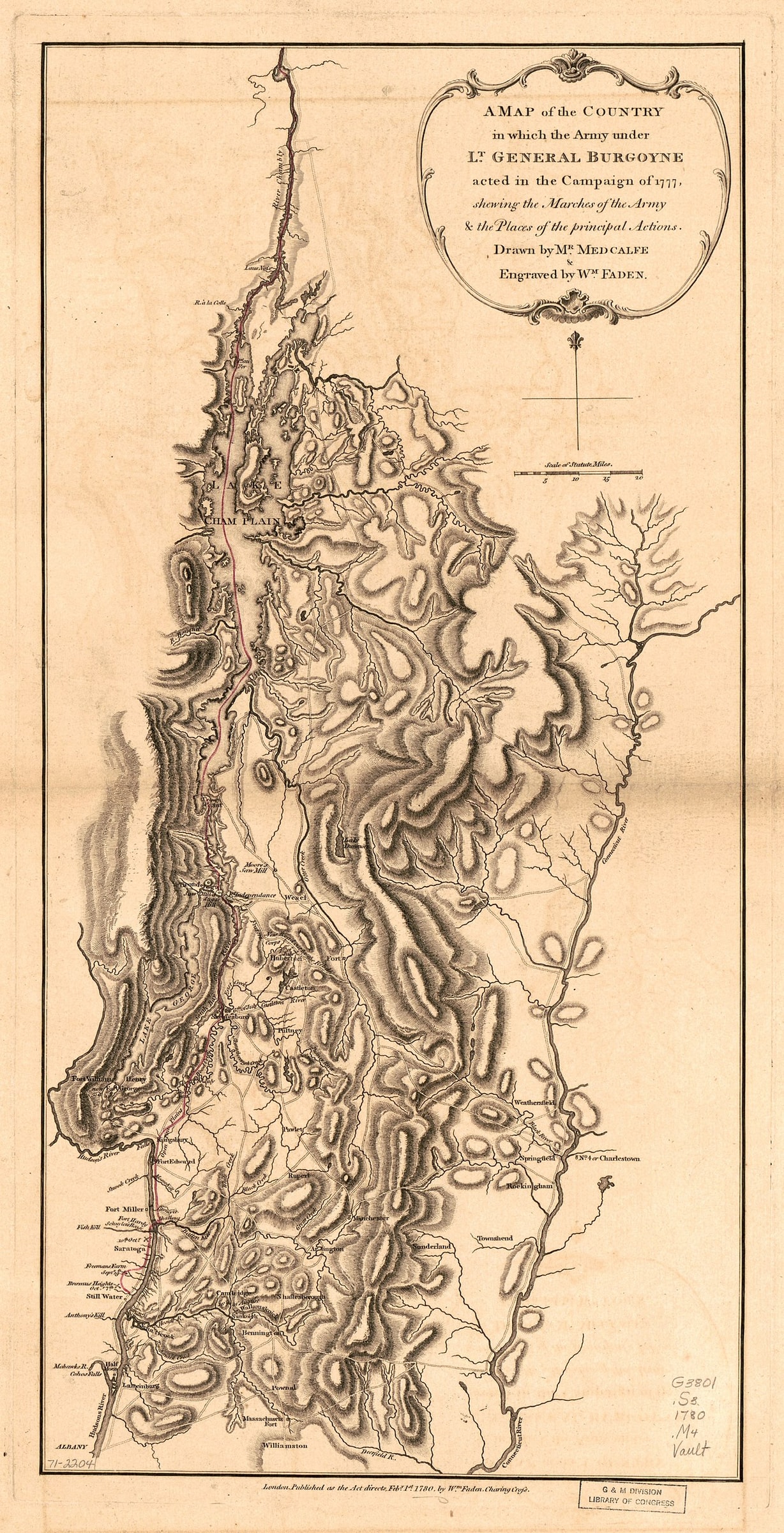
The turning point came at the Battle of Saratoga in upstate New York in October 1777. British General John Burgoyne marched south from Canada trying to cut New England off from the rest of the states. American generals Horatio Gates and Benedict Arnold attacked, and Burgoyne surrendered.
The diplomatic result mattered even more than the military one. Saratoga convinced France to openly enter the war in 1778. King Louis XVI, an absolute monarch, had zero sympathy for revolution, but he saw a chance to weaken Britain by wrecking its colonial empire. (France had secretly sent money and supplies since 1775; Spain and Holland joined against Britain in 1779.) The French alliance was decisive because it widened the war and forced Britain to spread its military resources beyond America.
Yorktown and the Treaty of Paris
Facing a global war, Britain consolidated in New York and then tried a southern strategy in 1780, focusing on Virginia and the Carolinas where Loyalists were numerous. Meanwhile, Patriots under George Rogers Clark captured British forts in the Illinois country during 1778-1779, gaining control of parts of the Ohio territory.
The last major battle came at Yorktown, Virginia, in 1781. With heavy French naval and military support, Washington forced General Charles Cornwallis to surrender his army. The defeat broke the Tory government in Parliament. Lord North resigned, and Whig leaders who wanted peace took over.
The Treaty of Paris (1783) set four terms:
- Britain recognized the United States as an independent nation
- The Mississippi River became the western boundary
- Americans got fishing rights off the coast of Canada
- Americans would pay debts owed to British merchants and honor Loyalist property claims
Key Terms to Know
| Term | Why it matters |
|---|---|
| First Continental Congress | The 1774 Philadelphia meeting (12 colonies, no Georgia) that protested British policy without yet seeking independence. |
| Suffolk Resolves | Massachusetts statement endorsed by the Congress demanding repeal of the Intolerable Acts, backed by military prep and a boycott. |
| Joseph Galloway | Conservative delegate whose plan for a colonial union within the empire failed by one vote. |
| Lexington and Concord | The first fighting of the Revolution, April 19, 1775, where militia inflicted 250 casualties on retreating British troops. |
| Minutemen | Colonial militia ready to fight on short notice; they faced the British at Lexington. |
| Bunker Hill | June 1775 battle (actually on Breed's Hill) where the British took the position but lost over a thousand men. |
| Second Continental Congress (1775) | The body that ran the war, named Washington commander-in-chief, and ultimately declared independence. |
| Olive Branch Petition | The July 1775 last-ditch plea of loyalty to George III, which the king rejected. |
| Prohibitory Act (1775) | Parliament's declaration that the colonies were in rebellion, ending hopes of reconciliation. |
| Declaration of Independence | Jefferson's document, adopted July 4, 1776, listing grievances against George III and justifying revolution with natural rights. |
| Patriots | The roughly 40 percent of colonists who actively fought Britain, strongest in New England and Virginia. |
| Loyalists (Tories) | The roughly 25 percent who sided with the king; about 60,000 fought for Britain and 80,000 later emigrated. |
| Continentals | Congress's paper money, which became nearly worthless from wartime inflation. |
| Valley Forge | The Pennsylvania camp where Washington's army endured the harsh winter of 1777-1778. |
| Battle of Saratoga | The October 1777 American victory that convinced France to openly join the war in 1778. |
| George Rogers Clark | Patriot leader who captured British forts in the Illinois country, securing parts of the Ohio territory. |
| Yorktown | The 1781 Virginia battle where Cornwallis surrendered to combined American and French forces. |
| Treaty of Paris (1783) | The peace treaty recognizing American independence with the Mississippi River as the western border. |
Practice and Next Steps
Pair these notes with the Fiveable course guide for Topic 3.5 The American Revolution, then keep moving through the APUSH AMSCO notes collection. The next chapter, AMSCO 3.6 The Influence of Revolutionary Ideals, looks at how the Revolution changed American society.
To check your understanding, try guided multiple-choice practice on Period 3, or write a response in FRQ practice with instant scoring. A causation question on why the Patriots won (militias, Washington's leadership, ideological commitment, French aid) is a classic APUSH prompt, so practice building that argument now.
Frequently Asked Questions
What does AMSCO Topic 3.5 The American Revolution cover?
AMSCO 3.5 covers the period from the Intolerable Acts (1774) through the Treaty of Paris (1783). Major content includes the First and Second Continental Congresses, Lexington and Concord, the Declaration of Independence, the strengths of each side in the war, the French alliance after Saratoga, and the surrender at Yorktown.
Why was the Battle of Saratoga the turning point of the Revolutionary War?
The American victory at Saratoga in October 1777 convinced France to openly ally with the United States in 1778. The French alliance widened the war and forced Britain to spread its military resources beyond America, which proved decisive. The diplomatic result mattered even more than the battlefield win itself.
Did most colonists actually support the American Revolution?
No. Of the roughly 2.6 million colonists in 1775, only about 40 percent actively supported the Patriot cause, while about 25 percent were Loyalists and the rest stayed neutral. Loyalists were probably the majority in New York, New Jersey, and Georgia, and nearly 60,000 of them fought alongside the British, making the war partly a civil war.
What were the terms of the Treaty of Paris 1783?
The Treaty of Paris (1783) had four key terms: Britain recognized the United States as an independent nation, the Mississippi River became the western boundary, Americans gained fishing rights off the coast of Canada, and Americans agreed to pay debts owed to British merchants and honor Loyalist property claims.
How does the American Revolution show up on the APUSH exam?
The exam often asks you to explain why the Patriots won despite Britain's military and financial advantages. Build your answer around colonial militias and the Continental Army, Washington's leadership, the colonists' ideological commitment, and French assistance after Saratoga. You can practice this kind of causation argument with FRQ practice and instant scoring.
See Fiveable more often in Google
Mark Fiveable as a preferred source and Google is more likely to show you our guides in Top Stories, with a "preferred" badge in AI Mode and AI Overviews.